






Details
Description
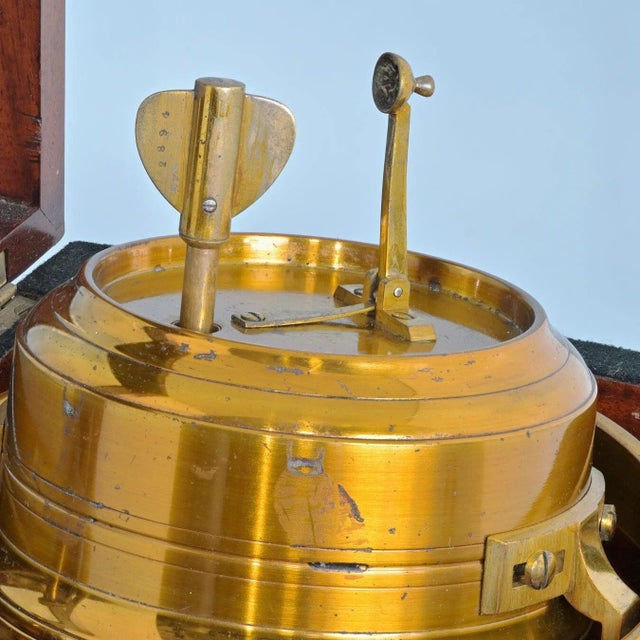
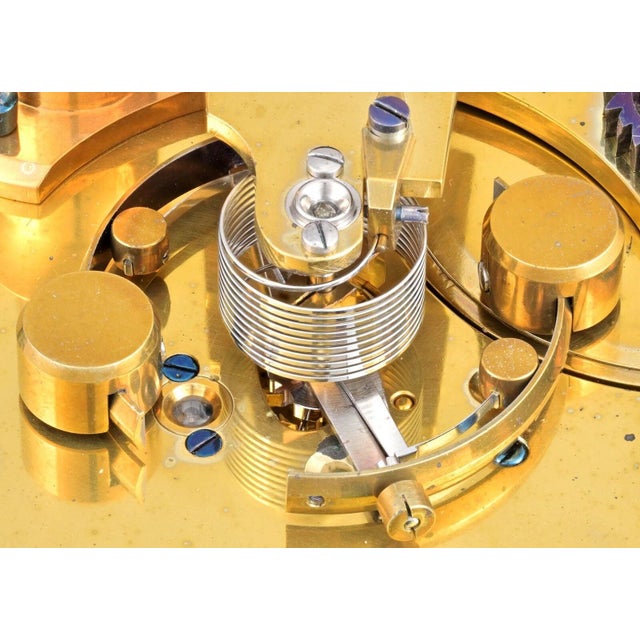
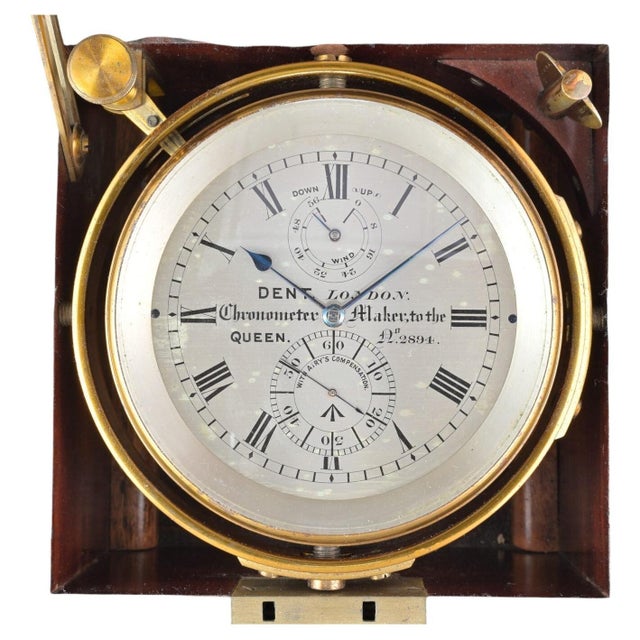
A robust full-plate brass fusee movement forms the foundation of this precision navigational timekeeper, built around 1860 by dent of … Read more A robust full-plate brass fusee movement forms the foundation of this precision navigational timekeeper, built around 1860 by dent of london. Four cylindrical brass pillars fastened with heat-blued steel screws secure the plates, which bear the engraved broad arrow mark of the british admiralty. The drive train incorporates harrison's maintaining power with a blued steel click and spring, paired with a blued ratchet wheel and double-toothed pawl mounted to the barrel bridge. Regulation relies on an earnshaw spring detent escapement with endstones to the escape pivots, working alongside a free-sprung palladium helical hairspring and a plain balance cock set with a diamond endstone. Auxiliary temperature compensation is provided by airy's bar, an ingenious device devised in 1871 by astronomer royal george airy to fine-tune the adjustment of weights across the balance rim. The bimetallic two-arm balance carries two primary cylindrical weights and timing nuts, supplemented by airy's auxiliary bar bearing two smaller circular weights. Three blued steel screws fasten the mechanism to the gilt dial plate. The engraved silvered brass dial, measuring 102 mm in diameter, presents roman hour numerals, blued steel hands, an upper 56-hour power reserve register, and an enlarged lower seconds subdial neatly engraved with the ministry broad arrow and marked 'with airy's compensation'. The movement is suspended within a heavy turned brass bowl fitted with an automatic sprung dust shutter over the winding arbor, counterbalanced within brass gimbal rings and secured by a manual transit lock. The bowl is housed in a two-tier mahogany transport box equipped with folding brass side carry handles, an exterior numbered brass plaque, and a fitted ratchet winding key stamped with serial number 2894. As was standard practice for admiralty chronometers in active service, the original upper lid was permanently removed to facilitate daily winding and observation aboard ship. Greenwich observatory ledger transcripts preserved alongside the chronometer record its official acquisition in may 1865 through part-exchange of an arnold instrument. The surviving records chart an extensive naval career across numerous british warships, including sea postings aboard hms diamond, hms tamar, hms cyclops, hms argonaut, hms goliath, and hms mars. The movement is reported to be in full working order. See less
- Dimensions
- 0.39ʺW × 0.39ʺD × 7.09ʺH
- Period
- 19th Century
- Item Type
- Vintage, Antique or Pre-owned
- Materials
- Brass
- Glass
- Condition
- Good Condition, Unknown, Some Imperfections
- Color
- Black
- Condition Notes
- Very Good — This vintage item has no defects, but it may show slight traces of use. Very Good — This vintage item has no defects, but it may show slight traces of use. less
Returns & Cancellations
Return Policy - All sales are final 48 hours after delivery, unless otherwise specified in the description of the product.
Cancellation Policy - Prior to shipping or local pickup, buyers may cancel an order for up to 48 hours, unless otherwise specified.
Related Collections
- Lapis Lazuli Clocks
- Driftwood Clocks
- Kenneth Ludwig Chicago Clocks
- Medium-Density Fibreboard Clocks
- Renaissance Revival Clocks
- Grandfather Clocks
- Howard Miller Clocks
- Antique Pendulum Wall Clocks
- Art Deco Clocks
- Antique Grandfather Clocks
- Seth Thomas Clock Company Clocks
- Gustavian (Swedish) Clocks
- Black Forest Clocks
- French Clocks
- Sunburst Clocks
- Italian Clocks
- Bronze French Clocks
- Wood Clocks
- Victorian Clocks
- Mid-Century Modern Clocks
- Brass Clocks
- Marble Clocks
- Mantel Clocks
- Wind Up Clocks
- Asian Clocks