


Details
Description
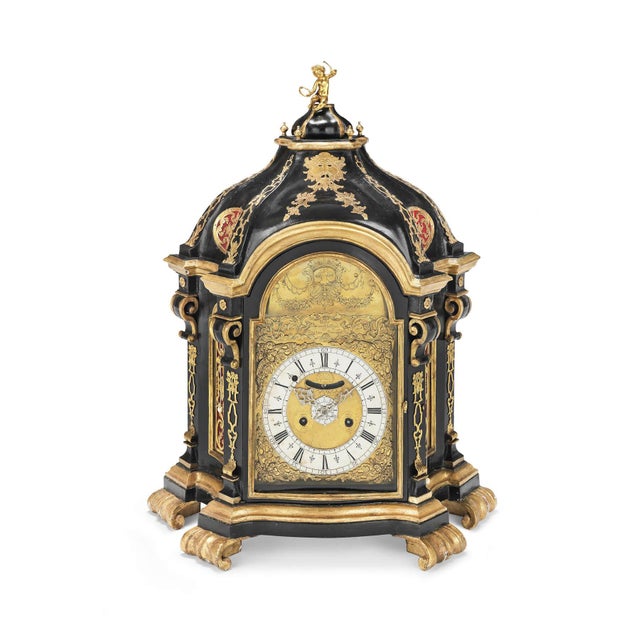
This imposing Roman clock is conceived as a miniature Baroque architecture, powerfully theatrical and rich in symbolic meaning. Crafted in …
Read more
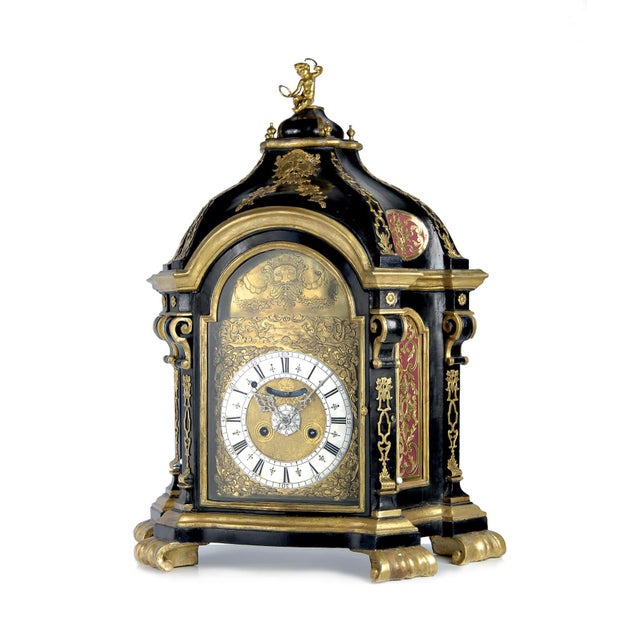
This imposing Roman clock is conceived as a miniature Baroque architecture, powerfully theatrical and rich in symbolic meaning. Crafted in ebonized wood and lavishly adorned with gilt bronze mounts, it is dated 1758 and signed Peter Lo Beptter.
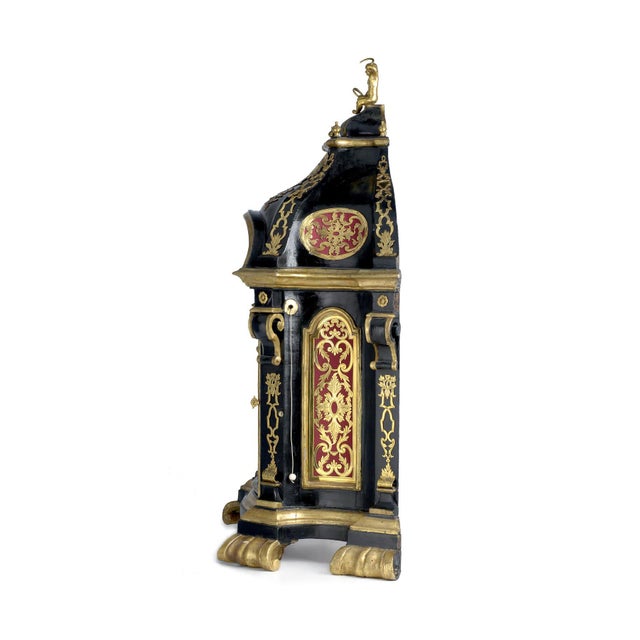
The monumental domed case is crowned by a dynamic putto holding a scythe and an ouroboros, standing above canted front angles and resting on boldly carved scroll feet. The entire surface is animated by pierced and engraved gilt-brass strapwork, lending the clock both visual depth and rhythmic movement—hallmarks of mature Italian Baroque taste.
Symbolism: The Ouroboros
The ouroboros, the ancient emblem of a serpent devouring its own tail, originates in Egyptian iconography and entered Western culture through Greek magical traditions. It later became a central symbol in Gnosticism, Hermeticism, and alchemy. Derived from the Ancient Greek οὐροβόρος (oura, “tail” + boros, “eating”), it traditionally represents eternal cyclic renewal, the endless sequence of life, death, and rebirth.
In this clock, the ouroboros is deliberately contrasted with the scythe, a universal symbol of time’s cruelty, impermanence, and death. Together, they create a profound meditation on continuity versus finality—time as both eternal cycle and relentless destroyer.
The Mask
Dominating the arched brass dial is a boldly carved man’s mask, evocative of the expressive visages of ancient theatrical drama and comedy. This mask reinforces the Baroque fascination with theatrum mundi—the world as a stage—where time governs every act.
Above the dial sits an applied cartouche engraved with the Latin inscription:
“Volat Irrevocabile Tempus et Dies tuos Dinumerat.”
The Latin Inscription
This powerful phrase translates as:
“Time flies irrevocably and counts your days.”
It is both a moral warning and a philosophical reflection, perfectly aligned with the clock’s symbolic program.
The Dial and Hands
Below the cartouche is a finely executed silvered chapter ring with Roman and Arabic numerals, surrounding a matted central field with a pendulum aperture. The winding holes are neatly ringed, accompanied by an alarm-setting disc. The ensemble is completed by elaborately pierced and silvered hands, light yet expressive in true Baroque fashion.
The Movement
The clock is powered by a substantial rectangular movement, constructed with four pinned vase-shaped pillars. It features a pivotted verge escapement with a short bob pendulum, and strikes the hours and quarters on two bells with corresponding hammers—a sophisticated complication that enhances both its mechanical and ceremonial presence.
See less
- Dimensions
- 25.2ʺW × 13.78ʺD × 31.5ʺH
- Styles
- Baroque
- Period
- 17th Century
- Country of Origin
- Italy
- Item Type
- Vintage, Antique or Pre-owned
- Materials
- Wood
- Condition
- Good Condition, Original Condition Unaltered, Some Imperfections
- Color
- Black
Returns & Cancellations
Return Policy - All sales are final 48 hours after delivery, unless otherwise specified in the description of the product.
Cancellation Policy - Prior to shipping or local pickup, buyers may cancel an order for up to 48 hours, unless otherwise specified.
Related Collections
- Cloisonné Clocks
- Bronze French Clocks
- Dark Green Clocks
- Grandfather Clocks
- Howard Miller Clocks
- French Clocks
- Ceramic Clocks
- Black Forest Clocks
- Wood Clocks
- Carriage Clocks
- Antique Pendulum Wall Clocks
- Industrial Clocks
- China Clocks
- Art Deco Clocks
- Marble Clocks
- Seth Thomas Clock Company Clocks
- Brass Clocks
- Mid-Century Modern Clocks
- General Electric Clocks
- Wall Clocks
- Mantel Clocks
- Antique Grandfather Clocks
- Gold Clocks
- Wind Up Clocks
- Italian Clocks