




Details
Description
Weinmann Phytanthoza Iconographia Botanical Engravings of Grapes, Set of Four, Regensburg
Circa 1745
This set of four color-printed and hand-finished …
Read more
Weinmann Phytanthoza Iconographia Botanical Engravings of Grapes, Set of Four, Regensburg
Circa 1745
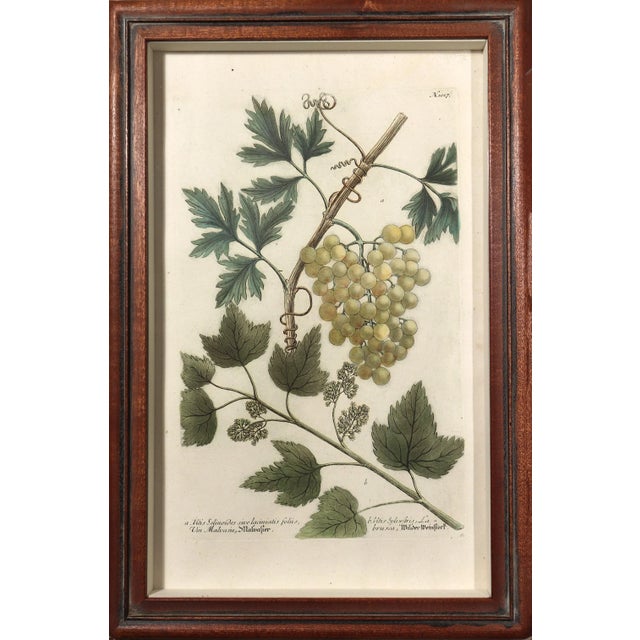
This set of four color-printed and hand-finished botanical engravings of grape vines comes from Johann Wilhelm Weinmann’s Phytanthoza Iconographia, the great Regensburg florilegium of 1737–1745. The four plates, numbered 1014 to 1017, belong to the fourth and final plate volume, published by Heinrich Georg Neubauer in 1745, and form a consecutive run devoted to the genus Vitis. Each vine is shown life-size with its fruit, foliage and tendrils, and each is named in the plate’s trilingual caption in Latin, French and German.
Plate 1014 pairs two vines grown for drying: at left the Corinth or currant grape, Vitis Corinthiaca seu uvae passae minores, Raisins de Corinthe, Kleine Rosinen, a slender flowering stem with small lobed leaves, and at right the raisin grape, Vitis vinifera seu uva passa major, Raisins, Rosinen, a heavy bunch of oval purple fruit hanging from a woody cane above a broad leaf and sprays of blossom.
Plate 1015 shows the white wine grape, Vitis Vinifera, Vin blanc, Wein, a single large five-lobed leaf over a compact cluster of green-gold berries on a cut cane with a coiling tendril.
Plate 1016 shows the red wine grape, Vitis Vinifera fructu rubro, Vin rouge, Weinreben oder rother Wein, a dense bunch of blue-black fruit beneath a spreading leaf, with tendrils curling to either side.
Plate 1017 pairs the parsley-leaved or Malvasia vine, Vitis Selinoides sive laciniatis foliis, Vin Malvasie, Malvasier, with its deeply cut foliage and a bunch of pale green grapes, and the wild vine, Vitis Sylvestris, Labrusca, Wilder Weinstock, with small toothed leaves and panicles of flowers.
The plates were made by the mixed method that distinguishes the Phytanthoza from every earlier botanical book: etched and engraved outlines combined with mezzotint tone, printed in color from the plate and then finished by hand. The process, credited to the Augsburg engraver and publisher Bartholomäus Seuter, gives the soft, continuous shading that models the bloom on the grape skins and the veining of the leaves. Several of the plates carry the engraver’s initial “S.” at the lower right for Seuter.
The prints are presented in a set of custom-made shadow-box frames of sapele, an African hardwood prized for its density and straight grain, with rounded corners, a molded inner edge and a deep cream spacer that sets each sheet well back from the glass. The backboards are covered in red marbled paper and fitted with brass hanging rings.
As a set of four the prints hang well as a block of two over two or in a single vertical or horizontal row, and the subject suits a dining room, a wine room, a kitchen or a butler’s pantry as naturally as a library or a hall. The sapele frames sit comfortably with mahogany and walnut furniture, and the green, gold and purple of the fruit read well against both pale and dark walls.
Dimensions
Each frame:
Height: 18 inches (45.7 cm)
Width: 11 inches (27.9 cm)
Depth: 1 3/4 inches (4.4 cm)
Provenance
Earle D. Vandekar of Knightsbridge
Condition
Excellent antique condition. The colors remain fresh and the impressions are strong. The paper is clean with minimal age toning.
References
Johann Wilhelm Weinmann, Phytanthoza Iconographia, 4 plate volumes, Regensburg: Hieronymus Lentz (volumes I–III) and Heinrich Georg Neubauer (volume IV), 1737–1745; plates 1014–1017 in volume IV.
Gordon Dunthorne, Flower and Fruit Prints of the 18th and Early 19th Centuries (Washington, D.C., 1938), no. 327, noting the early use of color printing in the plates.
Claus Nissen, Die Botanische Buchillustration (Stuttgart, 1951–1966), BBI 2126; Hunt Institute, Catalogue of Botanical Books, no. 494; Stafleu and Cowan, Taxonomic Literature, 2nd ed., 17.050.
Sacheverell Sitwell and Wilfrid Blunt, Great Flower Books 1700–1900 (London, 1956).
Maureen Cassidy-Geiger, “Graphic Sources for Meissen Porcelain: Origins of the Print Collection in the Meissen Archives,” Metropolitan Museum Journal 31 (1996), for the use of Weinmann’s plates by the Meissen painters.
Historical Context
Johann Wilhelm Weinmann (1683–1741) settled in Regensburg as an apothecary in 1710, bought his own pharmacy two years later, and used the fortune it produced to finance an illustrated survey of every plant then known in cultivation. The Phytanthoza Iconographia appeared in four plate volumes between 1737 and 1745, with 1,025 plates depicting more than 4,000 plants; Weinmann died before it was finished and the final volume was seen through the press by his collaborators. The drawings for the earliest plates were supplied by the young Georg Dionysius Ehret, who left the project after quarreling over payment, and later volumes were drawn by other Regensburg and Nuremberg artists. The engraving was shared among Bartholomäus Seuter, Johann Elias Ridinger and Johann Jakob Haid of Augsburg.
The plates were the first in any botanical book to be printed in color, and their shaded, sharply outlined manner was taken up almost at once by the flower painters at Meissen, whose “Holzschnittblumen” decoration of around 1740 copies plants directly from Weinmann and similar engraved sources.
See less
- Dimensions
- 11ʺW × 2ʺD × 18ʺH
- Frame Type
- Framed
- Art Subjects
- Botanic
- Brand
- Weinmann
- Designer
- Weinmann
- Period
- Mid 18th Century
- Country of Origin
- Germany
- Item Type
- Vintage, Antique or Pre-owned
- Materials
- Engraving
- Paper
- Condition
- Good Condition, Original Condition Unaltered, Some Imperfections
- Color
- White
- Condition Notes
- Good Good less
Questions about the item?
Returns & Cancellations
Return Policy - All sales are final 48 hours after delivery, unless otherwise specified in the description of the product.
Cancellation Policy - Prior to shipping or local pickup, buyers may cancel an order for up to 48 hours, unless otherwise specified.
Related Collections
- Rattan Original Prints
- Medium-Density Fibreboard Original Prints
- Soicher Marin Original Prints
- Sam Francis Original Prints
- Silver Finish Original Prints
- Johannes Kip Original Prints
- Dye Transfer Original Prints
- Original Prints in Lexington, KY
- Damien Hirst Original Prints
- Donald Sultan Original Prints
- Original Prints in Panama City, FL
- Original Prints in Salt Lake City
- Ralph Lauren Original Prints
- John Kiraly Original Prints
- Framed Prints
- Botanical Prints
- Bird Prints
- Woodblock Prints
- Screen Prints
- Japanese Woodblock Prints
- Thomas McKnight Original Prints
- George Barbier Original Prints
- Frank Stella Original Prints
- Gustave Baumann Original Prints
- Teak Original Prints