



Details
Description
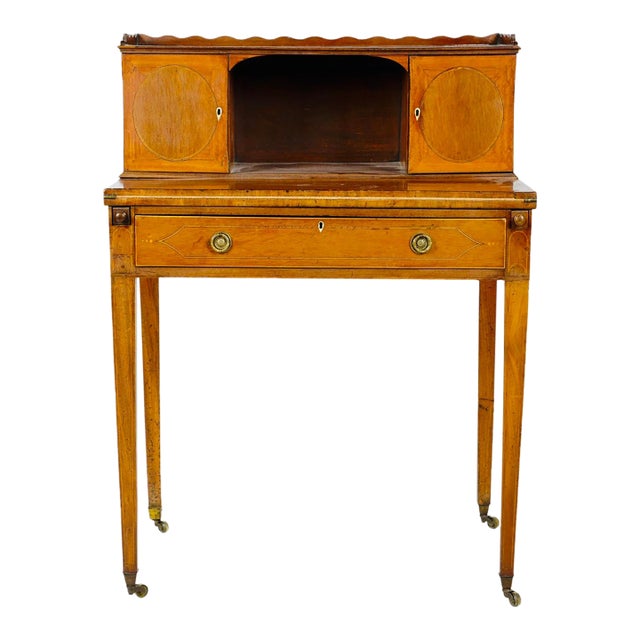
An elegant English Regency writing desk or writing table with fitted superstructure, dating to the early 19th century, circa 1815–1830.
…
Read more
An elegant English Regency writing desk or writing table with fitted superstructure, dating to the early 19th century, circa 1815–1830.
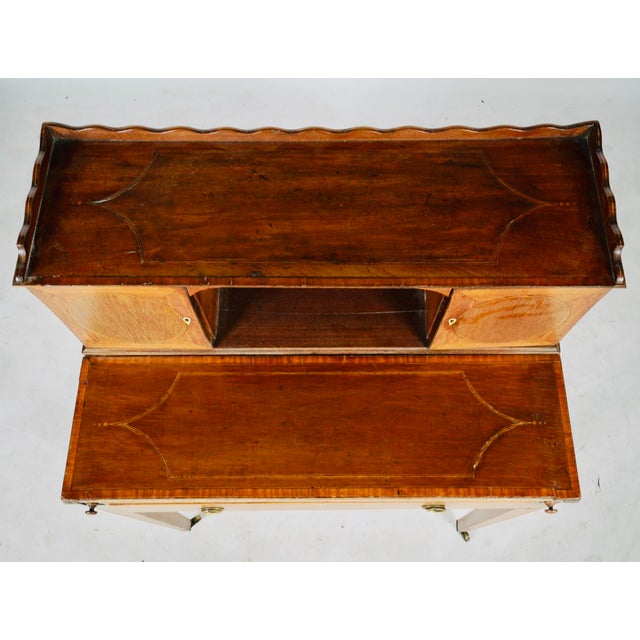
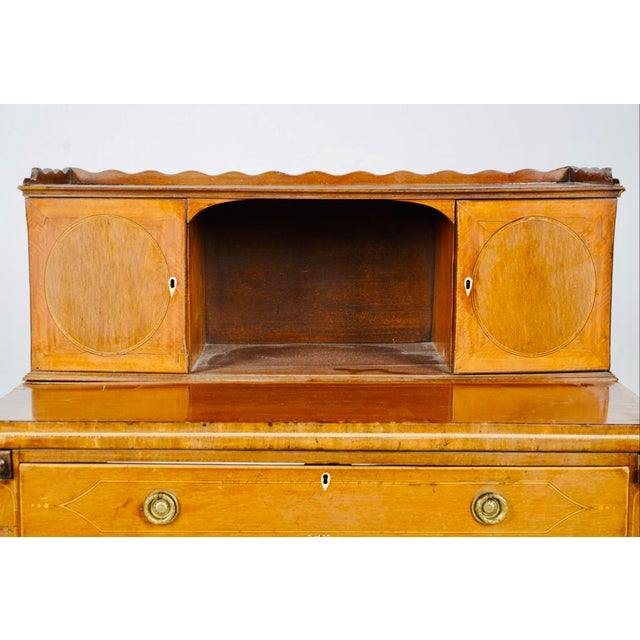
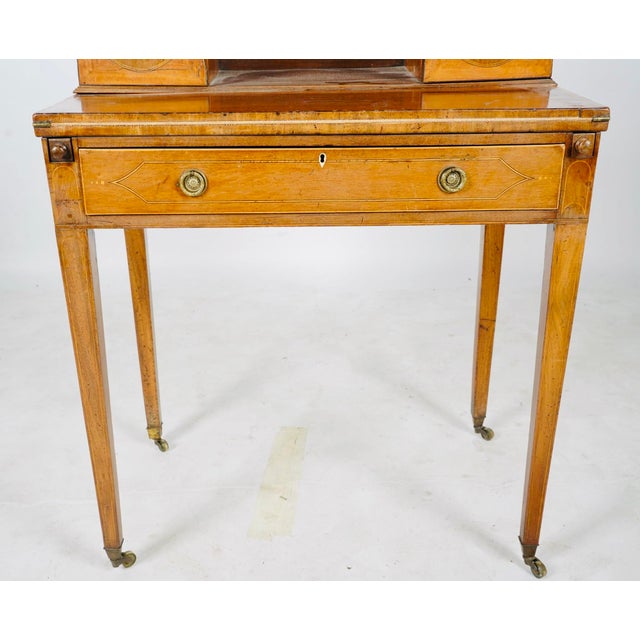
The desk is beautifully proportioned, raised on four slender square tapered legs terminating in brass casters. The mahogany case is enriched throughout with fine contrasting string inlay and restrained geometric decoration characteristic of the Regency period. A broad frieze drawer is centered by its original-style brass escutcheon and fitted with handsome circular brass pulls.
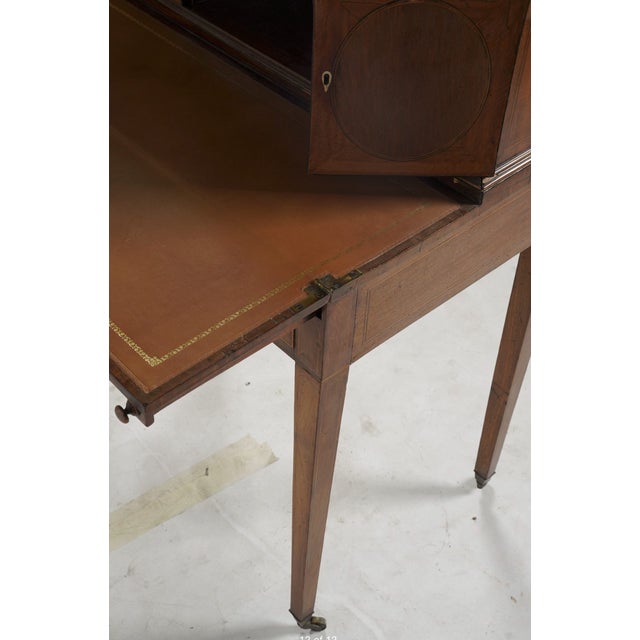
The upper writing surface opens to reveal a warm tan leather writing panel embellished with delicate gilt tooling, creating a generous and practical work surface while preserving the compact proportions of the piece when closed.
Above, the architectural superstructure incorporates two locking cupboard doors, each decorated with a large circular inlaid reserve. The cupboards flank a generous open central compartment and conceal additional fitted storage, including small drawers and pigeonholes. The whole is crowned by a particularly charming shaped and scalloped gallery.
Fine details—including contrasting line inlay, geometric corner decoration, brass hardware, keyhole escutcheons and brass casters—give the desk visual interest without overwhelming its exceptionally graceful silhouette.
The contrast between the warm mahogany, pale inlay and honey-colored leather is especially attractive and gives the piece the layered, sophisticated appearance associated with quality English Regency furniture.
An unusually decorative and highly functional antique desk, equally compelling as a writing table, bedroom desk, library piece or dramatic console in a traditional or collected contemporary interior.
Origin: England
Period: Early 19th century, circa 1815–1830
Style: English Regency / Neoclassical
Maker: Unknown English cabinetmaker
Materials: Mahogany, contrasting satinwood or lightwood inlay/stringing, leather, brass hardware and casters
Features: Fitted superstructure, two cupboard doors, interior drawers and compartments, open central niche, large frieze drawer, gilt-tooled leather writing surface, shaped gallery and brass casters.
Condition: Antique condition consistent with approximately two centuries of age and use. Visible surface wear, scratches, minor veneer/inlay losses and variations to the finish are present and contribute to the piece's historic character. The photographs should be consulted as part of the condition description.
Dating it
I would be comfortable calling this circa 1820, with 1815–1830 as the safer cataloguing range. The casters, tapered legs, restrained neoclassical inlay, circular door reserves and fitted writing arrangement all support that period. The relatively plain back is also exactly what I would expect from a piece intended to stand against a wall.
One thing I particularly like, O’l Sport, is that this isn't trying to impress through carving. The cabinetmaker is using proportion, veneer, stringing and geometry to do the work. That is precisely what makes good Regency furniture so sophisticated.
And I would absolutely put “Early 19th Century” in the Chairish title rather than merely “Regency Style.” Assuming inspection confirms what these photographs suggest, its age is an important part of its appeal
An elegant English Regency writing desk or writing table with fitted superstructure, dating to the early 19th century, circa 1815–1830.
The desk is beautifully proportioned, raised on four slender square tapered legs terminating in brass casters. The mahogany case is enriched throughout with fine contrasting string inlay and restrained geometric decoration characteristic of the Regency period. A broad frieze drawer is centered by its original-style brass escutcheon and fitted with handsome circular brass pulls.
The upper writing surface opens to reveal a warm tan leather writing panel embellished with delicate gilt tooling, creating a generous and practical work surface while preserving the compact proportions of the piece when closed.
Above, the architectural superstructure incorporates two locking cupboard doors, each decorated with a large circular inlaid reserve. The cupboards flank a generous open central compartment and conceal additional fitted storage, including small drawers and pigeonholes. The whole is crowned by a particularly charming shaped and scalloped gallery.
Fine details—including contrasting line inlay, geometric corner decoration, brass hardware, keyhole escutcheons and brass casters—give the desk visual interest without overwhelming its exceptionally graceful silhouette.
The contrast between the warm mahogany, pale inlay and honey-colored leather is especially attractive and gives the piece the layered, sophisticated appearance associated with quality English Regency furniture.
An unusually decorative and highly functional antique desk, equally compelling as a writing table, bedroom desk, library piece or dramatic console in a traditional or collected contemporary interior.
Origin: England
Period: Early 19th century, circa 1815–1830
Style: English Regency / Neoclassical
Maker: Unknown English cabinetmaker
Materials: Mahogany, contrasting satinwood or lightwood inlay/stringing, leather, brass hardware and casters
Features: Fitted superstructure, two cupboard doors, interior drawers and compartments, open central niche, large frieze drawer, gilt-tooled leather writing surface, shaped gallery and brass casters.
Condition: Antique condition consistent with approximately two centuries of age and use. Visible surface wear, scratches, minor veneer/inlay losses and variations to the finish are present and contribute to the piece's historic character. The photographs should be consulted as part of the condition description.
Dating it
I would be comfortable calling this circa 1820, with 1815–1830 as the safer cataloguing range. The casters, tapered legs, restrained neoclassical inlay, circular door reserves and fitted writing arrangement all support that period. The relatively plain back is also exactly what I would expect from a piece intended to stand against a wall.
One thing I particularly like, O’l Sport, is that this isn't trying to impress through carving. The cabinetmaker is using proportion, veneer, stringing and geometry to do the work. That is precisely what makes good Regency furniture so sophisticated.
And I would absolutely put “Early 19th Century” in the Chairish title rather than merely “Regency Style.” Assuming inspection confirms what these photographs suggest, its age is an important part of its appeal
See less
- Dimensions
- 30ʺW × 19ʺD × 40ʺH
- Table Knee Clearance
- 24.0 in
- Table Shape
- Rectangle
- Period
- Early 19th Century
- Country of Origin
- United Kingdom
- Item Type
- Vintage, Antique or Pre-owned
- Materials
- Brass
- Leather
- Mahogany
- Satinwood
- Condition
- Good Condition, Original Condition Unaltered, Some Imperfections
- Color
- Brown
- Condition Notes
- Excellent condition Excellent condition less
Questions about the item?
Returns & Cancellations
Return Policy - All sales are final 48 hours after delivery, unless otherwise specified in the description of the product.
Cancellation Policy - Prior to shipping or local pickup, buyers may cancel an order for up to 48 hours, unless otherwise specified.
Related Collections
- Bright Green Writing Desks
- John Vesey Writing Desks
- Herter Brothers Writing Desks
- Rope Writing Desks
- Chelsea House Inc Writing Desks
- Gothic Revival Writing Desks
- Arts and Crafts Writing Desks
- Walnut Writing Desks
- Lexington Furniture Writing Desks
- Maitland - Smith Writing Desks
- Japanese Writing Desks
- Mahogany Writing Desks
- English Traditional Writing Desks
- French Writing Desks
- Black Writing Desks
- Ladies Writing Desks
- Pine Writing Desks
- Antique Writing Desks
- Green Writing Desks
- Louis XVI Writing Desks
- Louis XV Writing Desks
- Bamboo Writing Desks
- Italian Writing Desks
- Mid-Century Modern Writing Desks
- Charles Limbert Writing Desks