

Details
Description
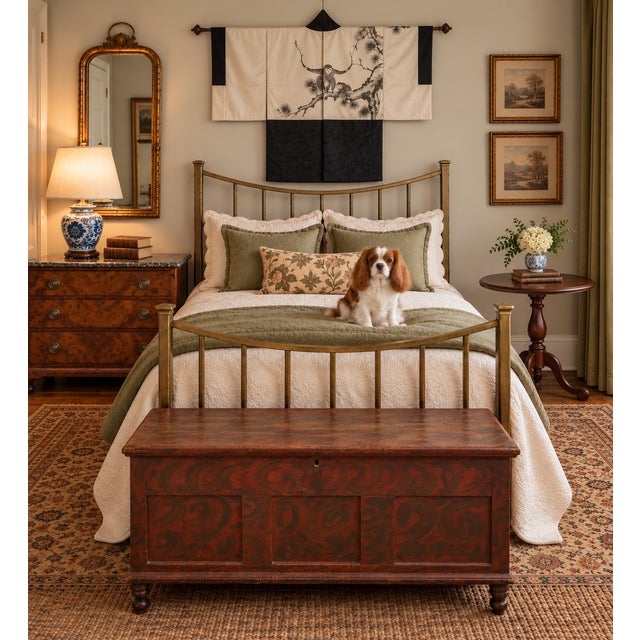
The Guest Bedroom — The Bed.
A beautiful place to settle in for the night.
Early Shōwa period Japanese men’s …
Read more
The Guest Bedroom — The Bed.
A beautiful place to settle in for the night.
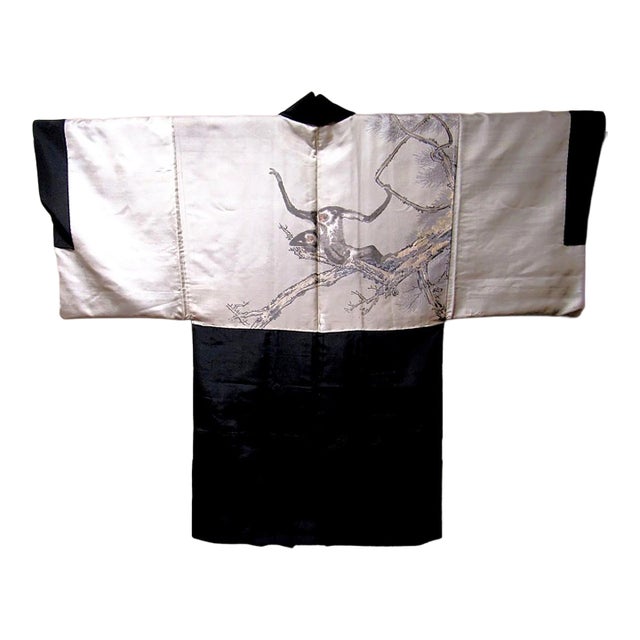
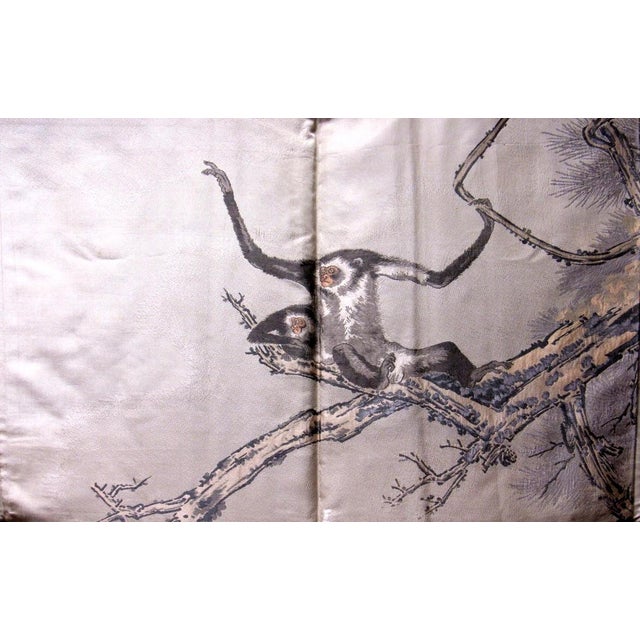
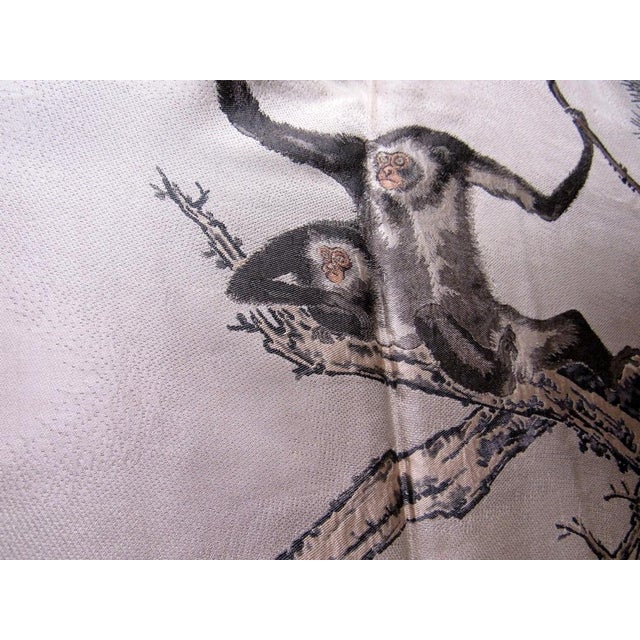
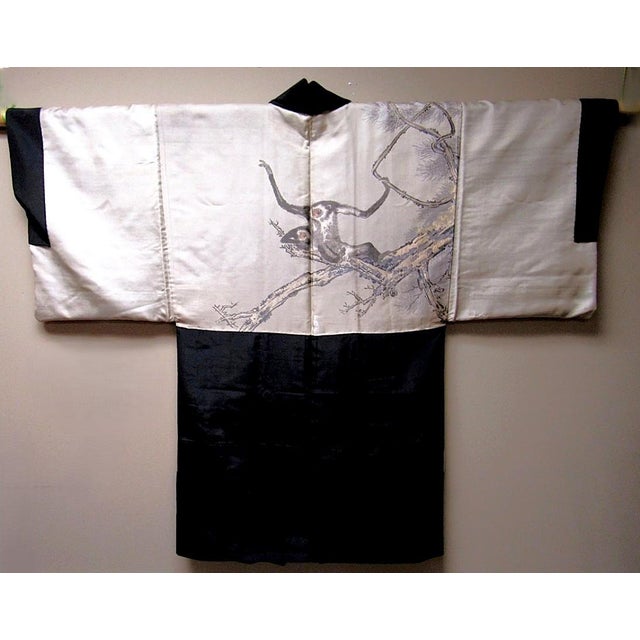
Early Shōwa period Japanese men’s black silk haori, circa 1930s, featuring an exceptional pictorial silk lining woven with an adult gibbon and its young among the branches of a tree. The restrained black silk exterior opens to reveal a finely detailed interior scene worked in silvery gray, taupe, cream and muted gold, creating a textile that is as compelling displayed as art as it is appreciated as a historic garment.
A particularly interesting example of early 20th-century Japanese textile art, this haori can be displayed open on a wall to reveal the complete composition. Its neutral palette and graphic black border allow it to work especially well in bedrooms, living rooms, studies, libraries and entries, as well as interiors incorporating Asian antiques and Japanese art.
Japan, early Shōwa period, circa 1930s. Silk.
JUNE'S THOUGHTS
I chose this haori for the wall in The Guest Bedroom because I wanted something above the bed that had presence without making the room feel heavy.What I particularly like is its versatility as wall art. I could just as easily see it over a console in an entry, above a sofa, in a library or study, or even in a dining room. It doesn't require an Asian room around it. Displayed open, it becomes a large textile artwork with enough scale to hold a wall while still having a quiet quality from across the room. Then, when you come closer, you discover the gibbons and the extraordinary detail of the woven scene.
COLLECTOR'S NOTE
The most intriguing aspect of this haori is that its principal decoration was deliberately placed inside. By the late 19th and early 20th centuries, Japanese men’s haori often paired restrained exteriors with elaborate silk linings, or haura. This contrast allowed luxury and personal taste to remain largely concealed, turning the interior of the garment into a private work of art revealed when the haori was opened or removed.
The animals depicted here are gibbons, identifiable by their extremely elongated arms and essentially tailless bodies. Although gibbons are not native to Japan, they became an important subject in Japanese art through the influence of Chinese painting, particularly the celebrated 13th-century Chan Buddhist painter Muqi. His gibbon paintings were greatly admired in Japan and influenced generations of Japanese artists.
Gibbons also acquired meaning within Zen imagery. In the well-known “gibbon reaching for the moon” theme, the animal attempts to grasp the moon or its reflection in water—a metaphor for pursuing illusion rather than enlightenment. The dramatically extended arms of the adult in this scene recall that tradition, although without a visible moon or reflection it would be speculative to identify this as that specific story. More accurately, it belongs to the broader East Asian tradition of depicting gibbons among trees, here showing an adult and its young.
Dating to the early Shōwa period, probably the 1930s, this haori represents a period when men’s pictorial linings could be remarkably imaginative. Closed, it is a restrained black silk garment; opened, it reveals a sophisticated woven landscape whose imagery reaches back through centuries of Chinese and Japanese painting.
#0900JWHcpk
See less
- Dimensions
- 54ʺW × 1ʺD × 44ʺH
- Period
- 1930s
- Country of Origin
- Japan
- Item Type
- Vintage, Antique or Pre-owned
- Materials
- Silk
- Condition
- Good Condition, Original Condition Unaltered, Some Imperfections
- Color
- Taupe
- Condition Notes
- Excellent vintage condition consistent with age. The black silk exterior and pictorial silk lining are remarkably well preserved for a … moreExcellent vintage condition consistent with age. The black silk exterior and pictorial silk lining are remarkably well preserved for a textile dating to approximately the 1930s. The woven gibbon scene remains clear and detailed, with the subtle tonal variations integral to the design. Light age-related creasing and minor handling wear may be present, as expected with a vintage silk garment. No significant damage noted. Creases can be ironed out with a steam iron and a light hand towel. PLEASE NOTE: The styled interior image is a computer-generated rendering created for visual inspiration. For accurate color, condition, and detail, please refer to the accompanying photographs. less
Questions about the item?
Returns & Cancellations
Return Policy - All sales are final 48 hours after delivery, unless otherwise specified in the description of the product.
Cancellation Policy - Prior to shipping or local pickup, buyers may cancel an order for up to 48 hours, unless otherwise specified.
Related Collections
- Loloi Rugs Textile Art
- Louis XIII Textile Art
- Resin Textile Art
- Workaday Handmade Textile Art
- Antique Gold Finish Textile Art
- Kenneth Ludwig Chicago Textile Art
- Chanel Textile Art
- Mid-Century Modern Textile Art
- Chinese Textile Art
- Japanese Textile Art
- Tapestry
- Framed Scarves
- Scandinavian Textile Art
- Aubusson Tapestry
- Märta Måås-Fjetterström Textile Art
- Surrealism Textile Art
- Space Age Textile Art
- Pablo Picasso Textile Art
- Ralph Lauren Textile Art
- Cardboard Textile Art