

Details
Description
Victorian Sailor’s Woolwork Picture of the Merchant Ship ‘China’
Circa 1860–1875.
Wool on canvas; figured maple frame.
A fine and …
Read more
Victorian Sailor’s Woolwork Picture of the Merchant Ship ‘China’
Circa 1860–1875.
Wool on canvas; figured maple frame.
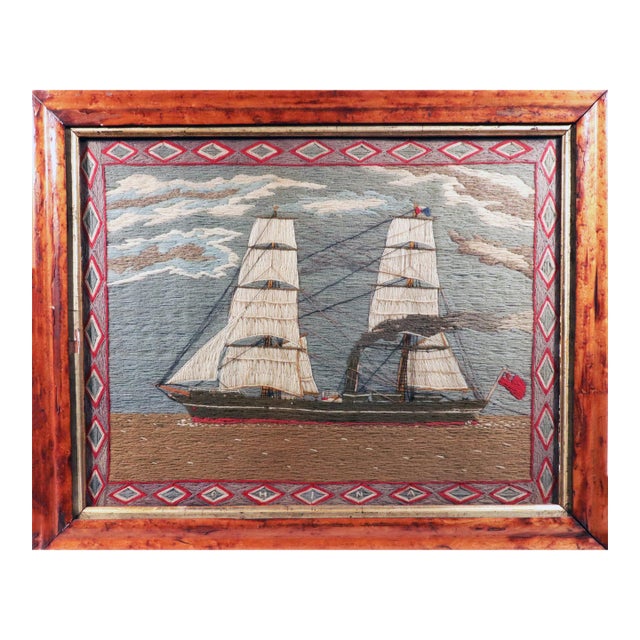
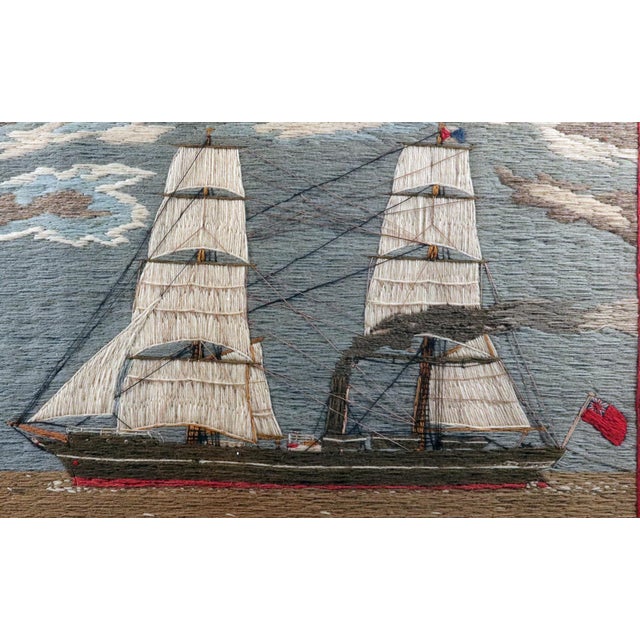
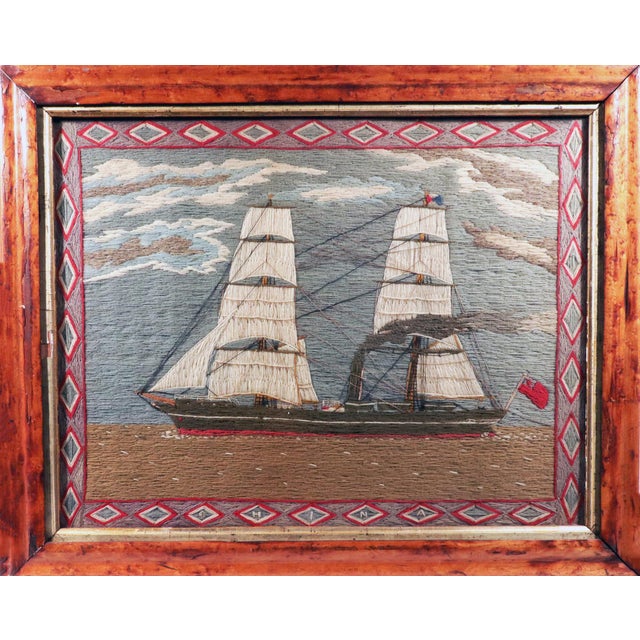
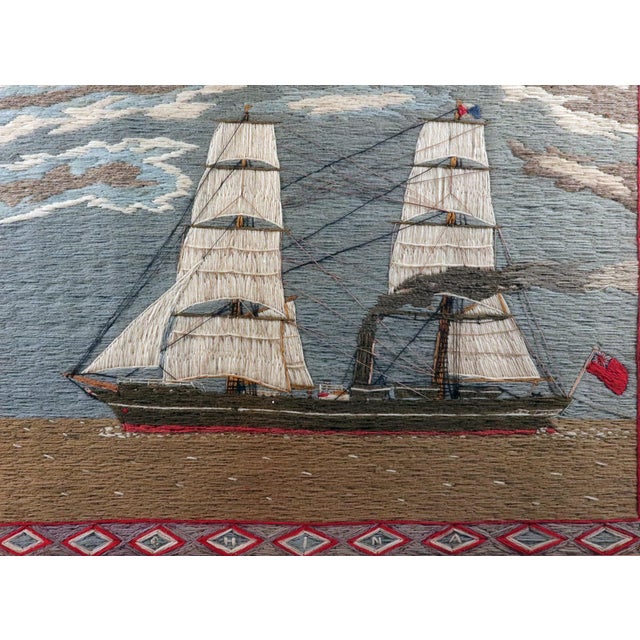
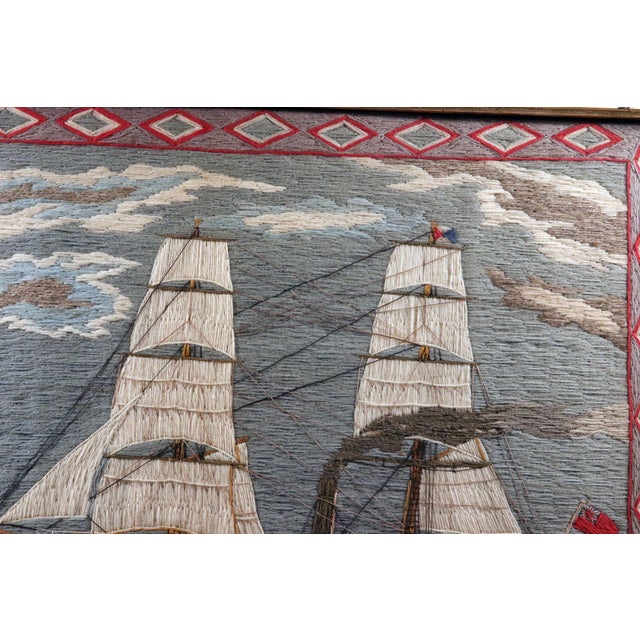
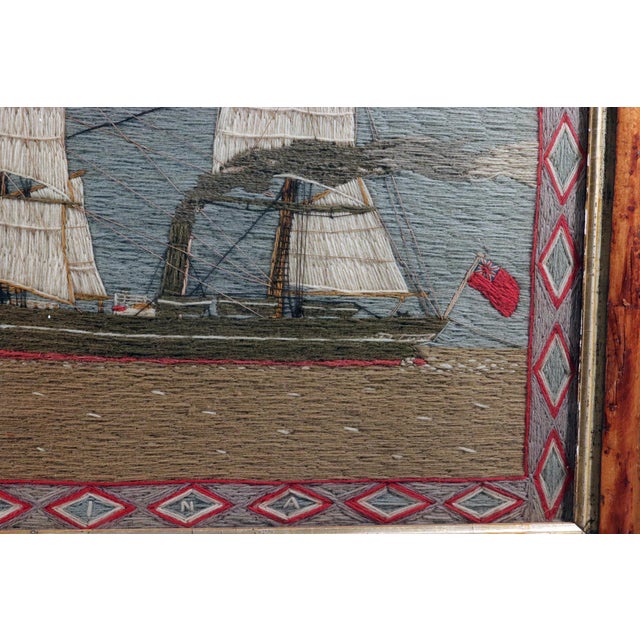
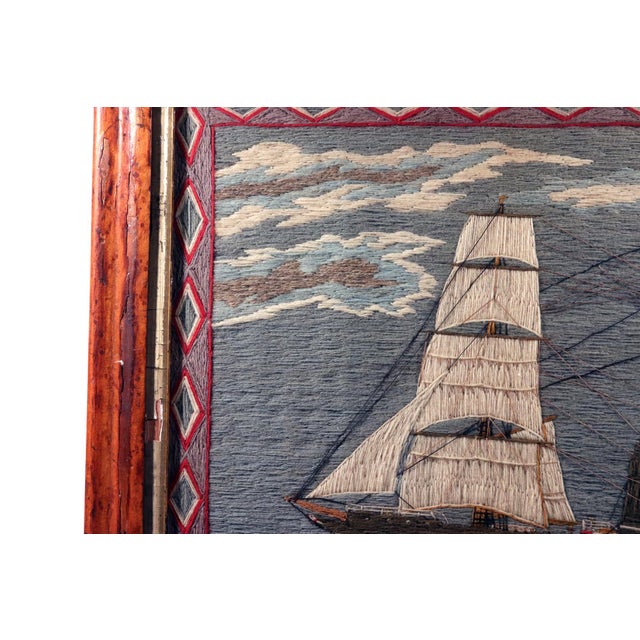
A fine and well-preserved Victorian sailor’s woolwork picture — known colloquially as a ‘woolie’ — depicting the British merchant vessel ‘China’ under way in a freshening breeze. The vessel is shown in the conventional Portside or profile view standard to the genre: a compact, dark-hulled steam-auxiliary square-rigged brig, seen from the starboard side, with all sail set and a light plume of smoke rising from the single funnel amidships.
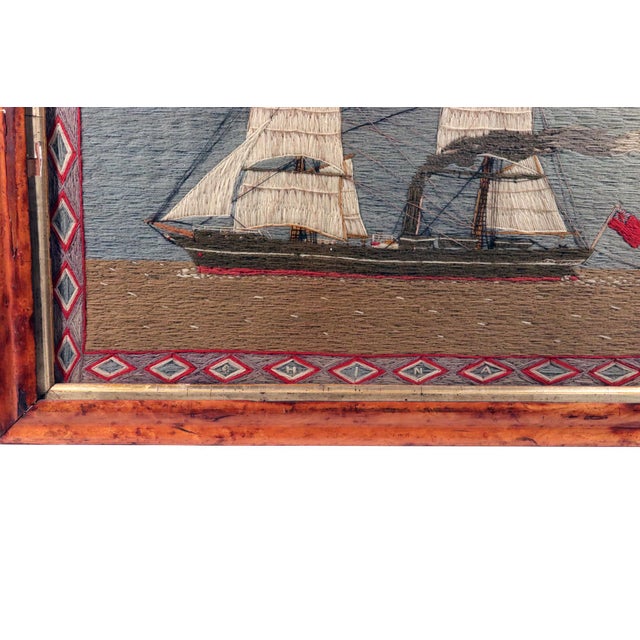
The Red Ensign of the British Merchant Navy flies from the stern, while a smaller flag — possibly a house flag or signal pennant — is hoisted at the fore topmast. The name ‘CHINA’ is worked in large letters into the lower border of the woolwork itself, confirming the vessel’s identity.
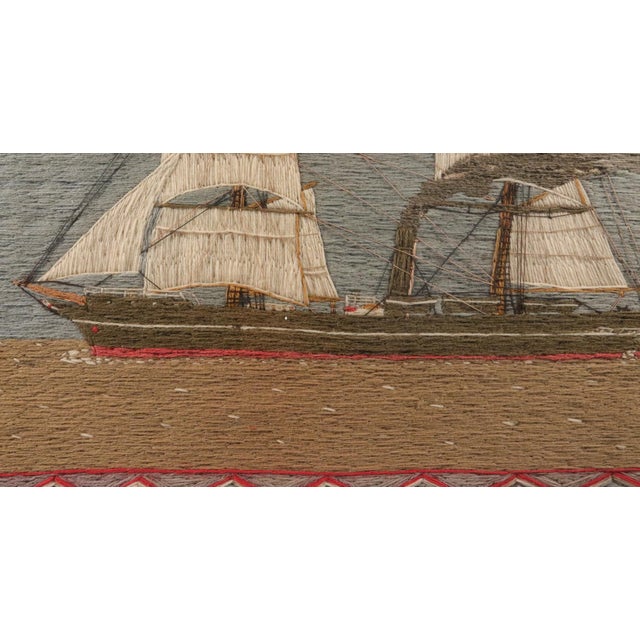
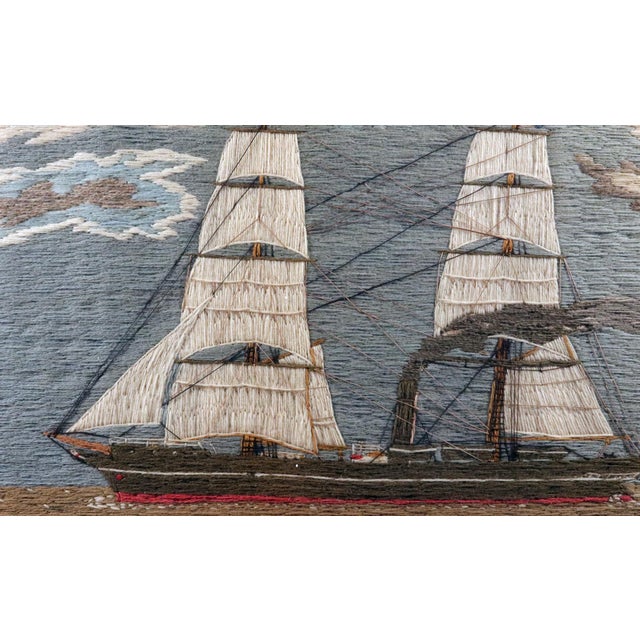
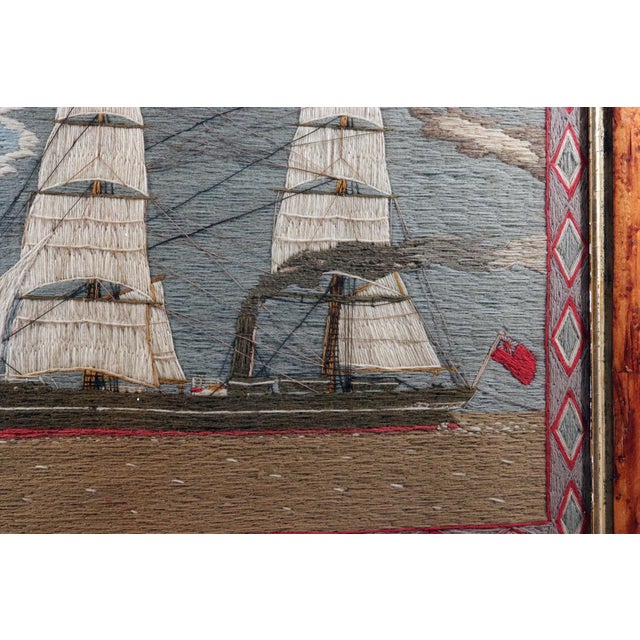
The ship carries square sails on both fore and main masts, arranged in multiple tiers: the combination of two square-rigged masts with a steam funnel identifies her as a steam-auxiliary brig, a type characteristic of British merchant shipping during the transitional decades of the 1860s and 1870s, when steam engines were routinely fitted to established sailing hulls as auxiliary propulsion rather than replacing sail altogether. The hull, black above a red waterline, sits low and purposefully in the water, suggesting a vessel at working trim.
The sky is worked in a palette of blue-grey, cream, and white wools, with billowing cumulus clouds rendered in careful overlapping stitches that convey convincing volume and atmosphere. The sea is worked in undulating horizontal bands of brown, ochre, and grey, with small whitecaps indicated in cream wool — a convention of the genre that captures the movement of the water with economical but effective means. The rigging — shrouds, stays, halyards, and braces — is rendered in fine stitched lines with notable attention to its complexity and accuracy.
The woolwork is framed within a characteristic diamond or lozenge-pattern border worked as part of the composition itself: alternating lozenges in red, white, and grey-mauve, within fine-line rules, enclose the maritime scene on all four sides. The name ‘CHINA’ is incorporated into the lower border in the same diamond-pattern field. The whole is presented in a figured maple frame of warm, reddish tone with a gilt inner slip — a frame type particularly associated with the mounting of woolwork pictures in the Victorian period.
DIMENSIONS
• Height: 18 inches (45.7 cm)
• Width: 22¼ inches (56.5 cm)
• Depth: ¼ inch (0.6 cm)
PROVENANCE
Massachusetts Collection
Remains of an old label reads "Purchased from a Second Hand Store in Edgertown, 10/13/82 ($350). Donated to store by family named Smithens on Slatter Street, Edgertown."
CONDITION
The woolwork is in good overall condition, with the wool retaining good strength of colour throughout. The sky, sea, and vessel are clearly legible and the rigging well preserved. The diamond-pattern border is intact and the lettering of the vessel’s name clear. The figured maple frame is in sound condition. The wool is now protected by Museum UV Glass.
HISTORICAL CONTEXT
Sailor’s woolwork pictures — known variously as woolies, or woolworks — are among the most distinctive and evocative productions of Victorian maritime folk art.
The vessel depicted here — a steam-auxiliary square-rigged brig flying the Red Ensign of the British Merchant Navy — is characteristic of British merchant shipping of the transitional period from sail to steam, approximately 1855–1875. During these decades, many established sailing vessels were fitted with auxiliary steam engines and a single funnel, permitting them to steam in light winds or contrary conditions while retaining their full sail plan for the open ocean passages on which steam was uneconomical. The two-masted brig rig, with square sails on both fore and main masts, was a common rig for mid-sized British merchant vessels of this period, suited to coastal, short-sea, and medium-distance ocean trades. The name ‘China’ was a natural choice for a vessel engaged in, or associated with, the Far East trade, though several British-registered merchant vessels of this name are recorded in the period.
Despite extensive research in the Crew List Index Project, Lloyd’s Register of Shipping, and the Mercantile Navy List, a specific vessel named ‘China’ matching the characteristics depicted — a steam-auxiliary brig of the 1860s–1870s, flying the Red Ensign — has not been conclusively identified in the digitised records currently available online. Further research in the Lloyd’s Register Foundation’s Heritage and Education Centre, the National Maritime Museum at Greenwich, or the National Archives series BT 98 and BT 99 (crew lists and agreements) may allow a specific identification to be established.
(Ref: NY11150-carr)
See less
- Dimensions
- 22.25ʺW × 1.25ʺD × 18ʺH
- Period
- Mid 19th Century
- Country of Origin
- United Kingdom
- Item Type
- Vintage, Antique or Pre-owned
- Materials
- Wool
- Condition
- Good Condition, Original Condition Unaltered, Some Imperfections
- Color
- Blue
- Condition Notes
- Good condition and with Muesum UV glass for protection Good condition and with Muesum UV glass for protection less
Questions about the item?
Returns & Cancellations
Return Policy - All sales are final 48 hours after delivery, unless otherwise specified in the description of the product.
Cancellation Policy - Prior to shipping or local pickup, buyers may cancel an order for up to 48 hours, unless otherwise specified.
Related Collections
- Loloi Rugs Textile Art
- Chanel Textile Art
- Louis XIII Textile Art
- Cork Textile Art
- Old New House Textile Art
- Hair on Hide Textile Art
- Cashmere Textile Art
- Workaday Handmade Textile Art
- Antique Gold Finish Textile Art
- Textile Art in Santa Fe
- Ralph Lauren Textile Art
- Mid-Century Modern Textile Art
- Framed Scarves
- Chinese Textile Art
- Tapestry
- Japanese Textile Art
- Scandinavian Textile Art
- Aubusson Tapestry
- Brutalist Textile Art
- Surrealism Textile Art
- Asian Style Textile Art
- Cardboard Textile Art
- Space Age Textile Art
- Märta Måås-Fjetterström Textile Art
- Pablo Picasso Textile Art