





Details
Description
Late 18th century french jean-baptiste perronneau credited pastel on paper
this work is a portrait of a woman, traditionally attributed …
Read more
Late 18th century french jean-baptiste perronneau credited pastel on paper
this work is a portrait of a woman, traditionally attributed to jean-baptiste perronneau (1715–1783), a celebrated 18th-century french portraitist known for his mastery of both oil painting and, above all, pastel.
perronneau was one of the leading figures of french rococo portraiture.
his career has often been compared to that of his contemporary maurice quentin de la tour, but perronneau is now appreciated for a more restrained, psychologically penetrating and technically sound approach.
he travelled extensively throughout europe, working for the bourgeoisie and the aristocracy,
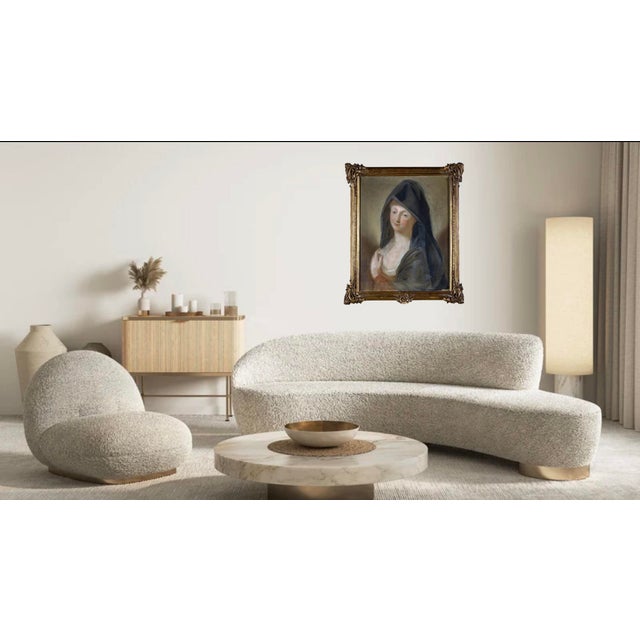
the painting depicts a young woman wrapped in a large dark veil, an iconographic element that evokes both the fashion of the time and a certain introspection.
one can see the typical “hatched” or shaded technique, which lends the skin a luminous and natural quality, contrasting with the density of the veil’s fabric.
the figure is depicted in a half-length portrait, with her face turned slightly towards the viewer.
the light comes from the left, softly illuminating her face and décolleté, whilst leaving the rest of the figure and the background in a half-light that enhances the delicacy of the features.
in keeping with the spirit of the enlightenment, perronneau does not confine himself to a formal reproduction, but seeks to capture the “liveliness of the gaze” and a hint of a smile, lending the subject a sense of real presence and dignity.
the work is a pastel, a technique in which perronneau excelled, creating soft, nuanced surfaces.
this wonderful pastel on paper, dating from the mid-18th century, is quite consistently attributed to the great french artist jean-baptiste perronneau.
it comes as its pendant, from a prestigious private collection belonging to a roman family of french origin; by tradition, they have always been regarded as authentic works by this great artist jean-baptiste perronneau, who specialised in pastel portraits.
this is thought to have been executed during his stay in rome, following the fashion of the ‘grand tour’, around 1780.
this artist was in the habit of depicting his graceful subjects from the nobility in three-quarter profile, exactly as in one of our beautiful examples.
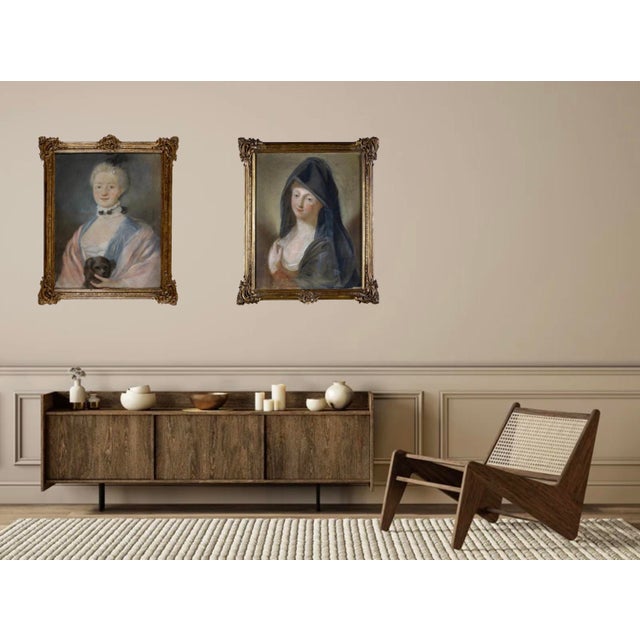
a pendant piece to this beautiful pastel is also available on this platform
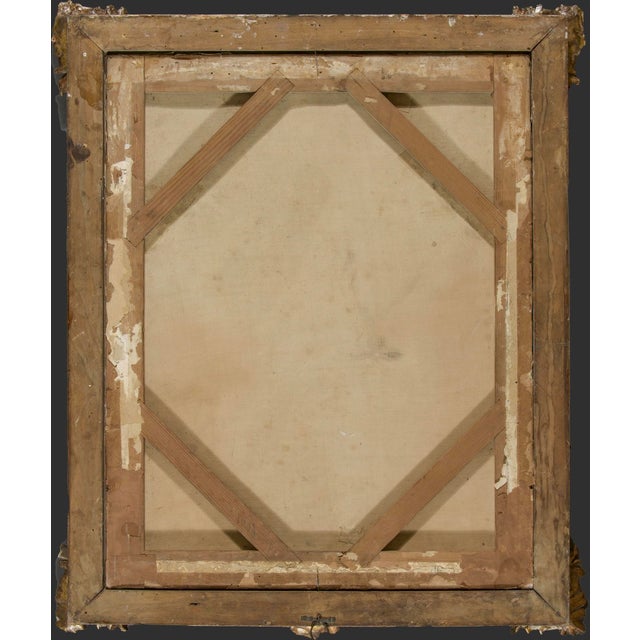
this not signed wonderful artworks is set in a rich carved and gilded wooden frame in the louis xv style, characterised by rocaille motifs, shells and scrolls (‘queue de cochon’), typical of mid-18th-century france. In excellent condition still retaining their original blown glass panes.
baptiste perronneau (paris, 1715 – amsterdam, 1783) was one of the leading figures in 18th-century french portraiture.
this beautiful and significant work is executed in pastel, a technique in which perronneau excelled, challenging the supremacy of his contemporary maurice quentin de la tour.
one notes the characteristic softness of the line, which allows for subtle gradations and a velvety rendering of the complexion.
the subject is a lady depicted in half-length, turned slightly in a three-quarter pose. This compositional angle, combined with her gaze directed towards the viewer, lends the portrait a sense of intimacy and naturalness, typical of the rococo sensibility but with a greater psychological depth.
perronneau is renowned for his use of sophisticated skin tones, often incorporating subtle shades of blue and green into the shadows to impart depth and realism.
the contrast between the deep black of the veil and the luminous white of the shirt beneath creates a strong focal point on the face, accentuating the delicacy of her features.
one can see loose, vibrant strokes of pastel, particularly evident in the rendering of the lace on the chest and the folds of the veil, which suggest the textural quality of the fabrics without getting lost in overly minute details.
in this portrait, the artist succeeds in balancing formal elegance with psychological vitality.
unlike the more celebratory portraits of the period, perronneau tends to capture a more immediate human truth, often giving his subjects an intense and reflective expression.
jean-baptiste perronneau ( paris ca.1716 – 1783) was a french rococo painter and draughtsman, best known for his portrait pastels.
his exact date of birth is unknown, but posthumous accounts suggest that it was around 1716.
he began his career as an engraver, apparently studying with laurent cars, whose portrait he drew, and working for the entrepreneurial printseller gabriel huquier, rue saint-jacques, paris, making his first portraits in oils, and especially in pastels, in the 1740s.
his career was much in the shadow of the master of the french pastel portrait, maurice quentin de la tour.
in the salon of 1750, perronneau exhibited his pastel portrait of maurice quentin de la tour, but found to his dismay that la tour was exhibiting his own self-portrait, perhaps a malicious confrontation to demonstrate his superiority in the technique.
he made his salon debut with a pastel portrait in 1746 and received full membership in the académie royale de peinture et de sculpture in 1753, with portraits of fellow artist jean-baptiste oudry and the sculptor lambert-sigisbert adam, both now at the louvre museum.
after 1779 he no longer exhibited in the paris salons, but the clientele in his portraits reveal how widely he travelled in the provinces of france, with a group of sitters connected with orléans, but also in toulouse, bordeaux, and lyon.
farther afield he may have been in turin and rome, and in spain, hamburg, poland, russia, and england.
j. B. Perronneau, old fashioned silhoutte style by carlos fuentes y espinosa.
perronneau produced a varied body of work in which he insists on the psychology of his characters and transmits a little of the spirit of the enlightenment, as evidenced by the expressiveness of the faces he depicts, the liveliness of the looks, the half-smiles we can watch and guess about.
often close to the harmonies of "camaïeu", his pastels and oils willingly play on monochrome variations: the ochres of the portrait of mme. De sorquainville, the grays of pierre bouguer, françois-hubert drouais or laurent cars, the blue-grays of the fillette au chat from the national gallery in london.
georges brunel notes that 'perronneau's pastels always look somewhat unfinished, or weathered by time', and adds: 'misleading impression, as it is probably a deliberate choice of style and technique.
above all, perronneau seeks solidity and strength [\.].
unusually for his time, perronneau also depicts cats in the foreground, that is to say as pets. This is the case for magdaleine pinceloup de la grange, for mlle huquier or for the girl with a cat (1745) from the national gallery in london –undoubtedly one of her most famous works-.
several portraits of this artist can be found today in various museums or private collections in europe and america.
although his work is particularly dispersed, the two most important public collections are at the louvre, in paris, and at the musée des beaux-arts, in orléans.
perroneau, while in london (1761) testified twice at court during the famous trial of his painter friend, theódore gardelle, who had brutally killed and burned his landlady. This piece is attributed to the mentioned designer/maker. It has no attribution mark and no
official proof of authenticity,
however it is well documented in design history. I take full responsibility for any authenticity
issues arising from misattribution
See less
- Dimensions
- 24.8ʺW × 1.97ʺD × 29.53ʺH
- Styles
- Rococo
- Art Subjects
- Portrait
- Period
- 18th Century
- Country of Origin
- France
- Item Type
- Vintage, Antique or Pre-owned
- Materials
- Paper
- Condition
- Good Condition, Unknown, Some Imperfections
- Color
- Condition Notes
- Heavy Signs of Use,Patina Consistent with Age and Use Heavy Signs of Use,Patina Consistent with Age and Use less
Returns & Cancellations
Return Policy - All sales are final 48 hours after delivery, unless otherwise specified in the description of the product.
Cancellation Policy - Prior to shipping or local pickup, buyers may cancel an order for up to 48 hours, unless otherwise specified.
Related Collections
- Maison Jansen Drawings
- Tempera Drawings
- John James Audubon Drawings
- Leroy Neiman Drawings
- Guillaume Azoulay Drawings
- Joseph Stella Drawings
- Erté Drawings
- Salvador Dalí Drawings
- Piet Hein Eek Drawings
- Carl-Axel Acking Drawings
- Charcoal Drawings
- Fashion Drawings
- 1950s Fashion Drawings
- Pencil Drawings
- Ink Drawings
- Gustavian (Swedish) Drawings
- Stephanie Cate Drawings
- Art Glass Drawings