




Details
Description
My first introduction to Ko Kutani wares was in a lecture on Japanese ceramics taught by the late Professor Ross …
Read more
My first introduction to Ko Kutani wares was in a lecture on Japanese ceramics taught by the late Professor Ross Edman at the University of Illinois Chicago. His enthusiasm for the colorful and creative Kutani pieces was infectious and led to a lifelong fascination on this particular type of ceramic that stands out in the vast field of Japanese ceramics. The brilliant bold colors of green, yellow, cobalt blue, aubergine and red are unforgettable.
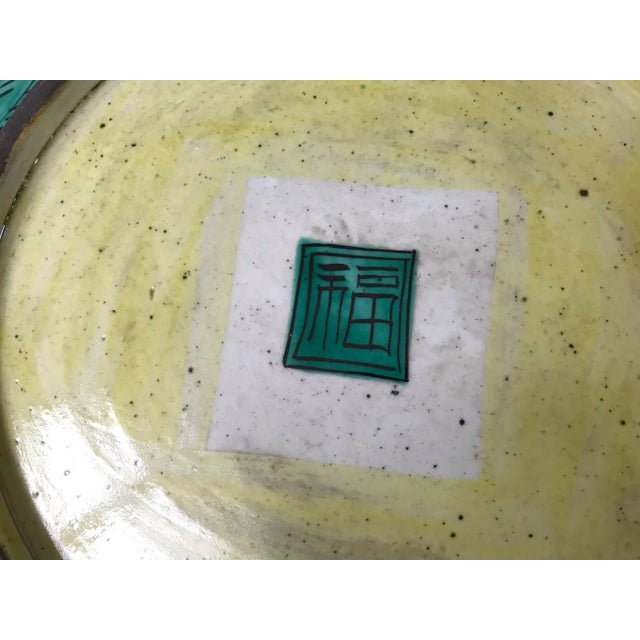
The Kutani kilns (meaning nine valleys) are located in Kaga, Ishikawa Prefecture on the southeast part of the Island of Honshu. The kilns has a long history of which the Ko-Kutani (old Kutani)pieces from the 17th and 18th century endeared themselves to the people of Japan by their use of bold designs or landscape depicted in the colors of green, yello, cobalt blue, aubergine and red. These colorful presentations added joy and brilliance to their every day lives. The surviving older Ko-Kutani pieces can only be seen only in Japanese collections in the Asian Art Museums in the US. Sometime in the early 19th century around 1807, several potters revived the ceramic production in the Kutani kilns and they created five different styles, and this Kutani charger presented here is in the Yoshidara style of Ko Kutani. Four of the five bold glazes covered the entire surface, green and cobalt blue predominate. The bold geometrc pattern in the center harks back to the 16th and 17th century designs, as do the repeat pattern that covered the outer rim. The underside is glazed in the typical green Kutani glaze and decorated with a repeat floral design in black glaze. A distinctive mark of a single character is painted inside the foot ring. This "FUKU" mark, meaning luck, identifies the piece as Kutani ware from the Meiji Period CE 1868 to 1912.
Among the five styles of Kutani wares produced in the 19th century, the Yoshidara style pieces are the least prevalent. I may have come across smaller pieces but larger chargers seldom circulate in the open market. This charger is very special.
See less
- Dimensions
- 14.5ʺW × 3.5ʺD × 14.5ʺH
- Styles
- Japanese
- Period
- Late 19th Century
- Country of Origin
- Japan
- Item Type
- Vintage, Antique or Pre-owned
- Materials
- Pottery
- Condition
- Good Condition, Original Condition Unaltered, Some Imperfections
- Color
- Green
- Condition Notes
- The object is an antique and has been handled, the patina is not brand new. There are no major flaws. The object is an antique and has been handled, the patina is not brand new. There are no major flaws. less
Questions about the item?
Returns & Cancellations
Return Policy - All sales are final 48 hours after delivery, unless otherwise specified in the description of the product.
Cancellation Policy - Prior to shipping or local pickup, buyers may cancel an order for up to 48 hours, unless otherwise specified.
Related Collections
- Ralph Lauren Decorative Plates
- Sherle Wagner Decorative Plates
- Nickel Decorative Plates
- Kenneth Ludwig Chicago Decorative Plates
- Soapstone Decorative Plates
- Pickard China Decorative Plates
- Silk Decorative Plates
- Tapio Wirkkala Decorative Plates
- Cantagalli Decorative Plates
- Joseph Holdcroft Decorative Plates
- Ox Bow Decor Decorative Plates
- Tatiana Alida Decorative Plates
- Japanese Decorative Plates
- Chinese Decorative Plates
- Fruit Plates
- Brass Decorative Plates
- Spanish Decorative Plates
- Copper Decorative Plates
- Italian Decorative Plates
- Blue Decorative Plates
- Piero Fornasetti Decorative Plates
- Chinoiserie Decorative Plates
- Wedgwood Decorative Plates
- Metal Decorative Plates
- Gold Decorative Plates