




Details
Description
"Homecoming": British Sailor's Woolwork of the Screw Frigate H.M.S. Fox,
Circa 1875
A charming and detailed British sailor's woolwork (or …
Read more
"Homecoming": British Sailor's Woolwork of the Screw Frigate H.M.S. Fox,
Circa 1875
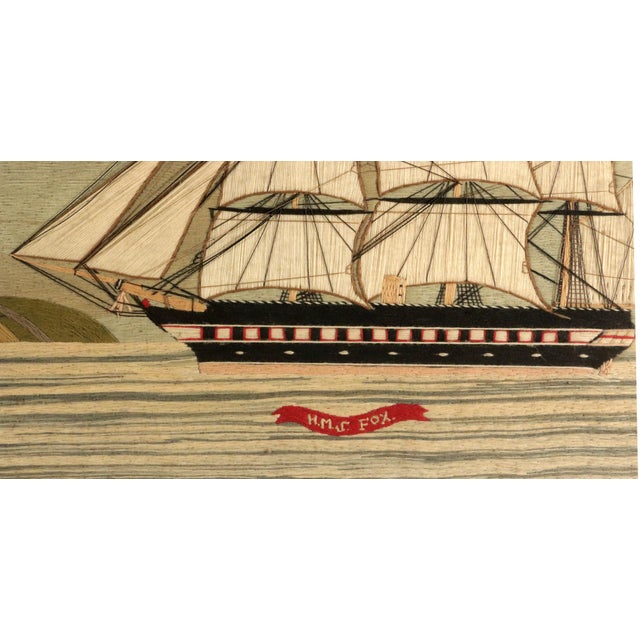
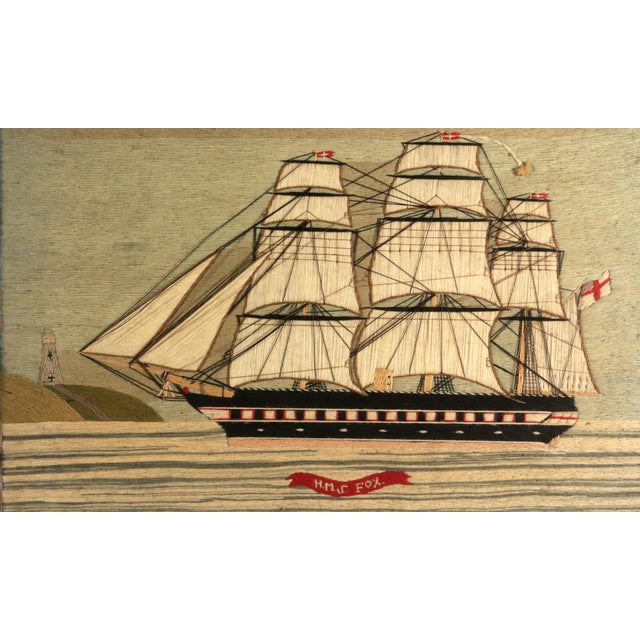
A charming and detailed British sailor's woolwork (or "woolie"), depicting a portside view of the Royal Navy vessel H.M.S. Fox under full sail, executed circa 1875.
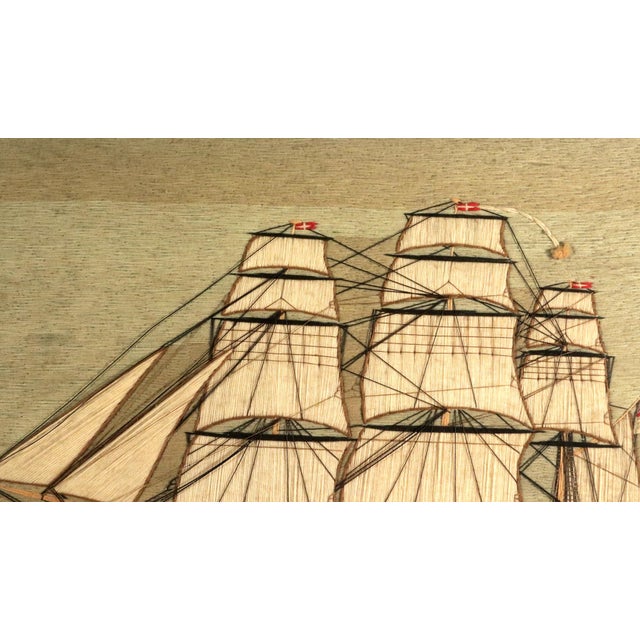
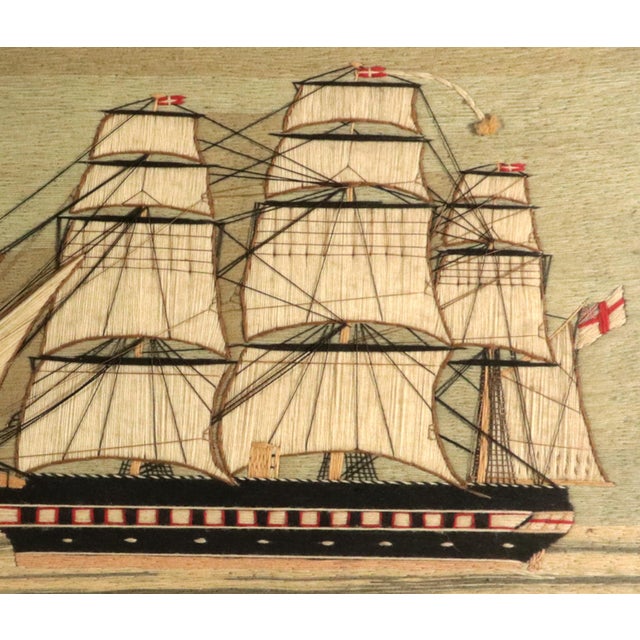
The composition captures a specific transitional era of naval warfare, showing the vessel equipped with both a full rig of sails and a steam funnel (visible amidships), identifying it as a steam-assisted screw frigate. The ship cuts through a calm sea patterned with white ripples, flying the White Ensign from the stern and a long, white commissioning pennant (complete with tassel) from the mainmast, indicating the ship is in active service.
The background features a prominent coastal landscape to the left, likely a home port or favorite station, detailed with a lighthouse perched on a green grassy hill and a path winding down to the shore. The title "H.M.S. FOX" is proudly embroidered in white wool on a red banner centered at the bottom of the work.
Measurements:
Height: 18 inches (45.7 cm)
Width: 22 3/4 inches (57.8 cm)
Condition: The woolwork now with Museum UV Glass to protect the wool from sun damage and significantly reduce reflection.
Historical Context:
The Ship The subject is the H.M.S. Fox, a vessel with a long and varied career that spanned the transition from sail to steam.
Origins: She was originally launched in 1829 at Portsmouth as a 46-gun Fifth Rate sailing frigate.
Service: In her early career under sail, she served extensively on the East Indies station and was notably involved in the Second Burmese War (1852), where she served as the flagship for Commodore G.R. Lambert.
Conversion: In 1856, acknowledging the changing technology of the Victorian Navy, she was converted into a screw frigate (fitted with a steam engine and propeller). It is this specific post-1856 configuration—retaining her masts but gaining a funnel—that is depicted in this woolwork.
Fate: She was eventually broken up in 1882. The "Circa 1875" date of this textile suggests it was likely created by a crew member towards the end of her long service life as a memento of a historic ship.
Condition: Excellent antique condition. The wool colors remain distinct. Housed in a period wooden frame. The wool now with Museum Glass which protects the wool from sun-damage and significantly reduced reflection.
(Ref: NY10991-iarp)
See less
- Dimensions
- 22.75ʺW × 1.5ʺD × 18ʺH
- Period
- Mid 19th Century
- Country of Origin
- United Kingdom
- Item Type
- Vintage, Antique or Pre-owned
- Materials
- Wool
- Condition
- Good Condition, Original Condition Unaltered, Some Imperfections
- Color
- Cream
- Condition Notes
- Good condition Good condition less
Questions about the item?
Returns & Cancellations
Return Policy - All sales are final 48 hours after delivery, unless otherwise specified in the description of the product.
Cancellation Policy - Prior to shipping or local pickup, buyers may cancel an order for up to 48 hours, unless otherwise specified.
Related Collections
- Loloi Rugs Textile Art
- Louis XIII Textile Art
- Resin Textile Art
- Workaday Handmade Textile Art
- Chanel Textile Art
- Antique Gold Finish Textile Art
- Kenneth Ludwig Chicago Textile Art
- Mid-Century Modern Textile Art
- Chinese Textile Art
- Japanese Textile Art
- Tapestry
- Framed Scarves
- Scandinavian Textile Art
- Aubusson Tapestry
- Edwardian Textile Art
- Cardboard Textile Art
- Ralph Lauren Textile Art
- Märta Måås-Fjetterström Textile Art
- Pablo Picasso Textile Art
- Space Age Textile Art
- Surrealism Textile Art
- Brutalist Textile Art