




Details
Description
This elegant Empire-period vase clock, conceived with strong architectural presence and refined sculptural balance, is attributed to Pierre-Philippe Thomire. Its …
Read more
This elegant Empire-period vase clock, conceived with strong architectural presence and refined sculptural balance, is attributed to Pierre-Philippe Thomire. Its form and decoration recall the celebrated Medici vase type, transformed here into a highly theatrical and ceremonial timepiece.
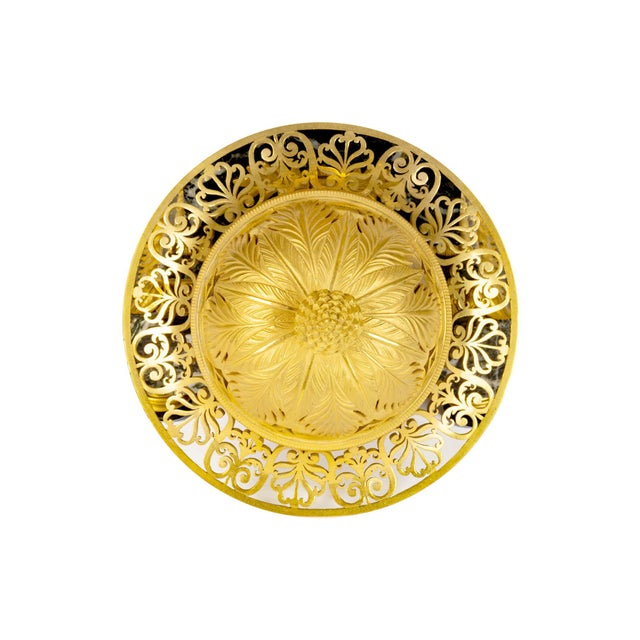
The clock takes the shape of a monumental vase surmounted by a finely pierced foliate domed cover, crowned with palm fronds and a pinecone finial—symbols of victory, immortality, and classical virtue. The circular bezel is topped by a ribbon-tie from which cascade delicately modelled floral swags. On either side stand a pair of classical female figures, gently inclined inward, each resting on individual plinths above elegantly scrolled handles.
Below the dial, a striking Mercury mask—evoking speed, eloquence, and the passage of time—is framed by floral swags. The composition flows downward to a spreading circular foot enriched with a wreath band, which rests upon a stepped square griotte marble base. The base is centred by an expressive Apollo head mask, surrounded by beaded and acanthus gilt-bronze bands, and supported on four turned feet, lending the entire structure both stability and rhythmic elegance.
Attribution to Pierre-Philippe Thomire
The exceptional quality of the chasing, gilding, and surface finishing, combined with close stylistic parallels to clocks preserved in royal residences, noble collections, and major scholarly publications, strongly supports the attribution of this vase clock to the workshop of Pierre-Philippe Thomire. Expert examination by specialists in European decorative bronzes further reinforces this conclusion.
Clock Movement
The movement is by the Parisian clockmaker Sirost, recorded at rue Bertin-Poiré between 1806–1810, and later at rue des Fontaines in 1840.
It features an anchor escapement, silk thread suspension, and strikes the hours and half-hours on a single bell, regulated by an outside count wheel—a robust and reliable construction typical of high-quality Parisian movements of the period.
Literature
• G. Wannenes, Le Più Belle Pendole Francesi. Da Luigi XIV all’Impero, 1991, p. 160, illustrating a clock of the same model.
• Pierre Kjellberg, Encyclopédie de la Pendule Française du Moyen Age au XXe Siècle, 1997, p. 327, pl. C, illustrating two identical clock cases by Thomire in the Musée François-Duesberg, Mons (Belgium).
• Elke Niehüser, Die Französische Bronzeuhr, 1997, p. 264, pl. 1311, illustrating an identical model.
See less
- Dimensions
- 7.09ʺW × 7.09ʺD × 22.83ʺH
- Styles
- Empire
- Period
- 19th Century
- Country of Origin
- France
- Item Type
- Vintage, Antique or Pre-owned
- Materials
- Bronze
- Condition
- Good Condition, Original Condition Unaltered, Some Imperfections
- Color
- Gold
Returns & Cancellations
Return Policy - All sales are final 48 hours after delivery, unless otherwise specified in the description of the product.
Cancellation Policy - Prior to shipping or local pickup, buyers may cancel an order for up to 48 hours, unless otherwise specified.
Related Collections
- Lapis Lazuli Clocks
- Driftwood Clocks
- Clocks in Monterey, CA
- Grandfather Clocks
- Howard Miller Clocks
- Antique Pendulum Wall Clocks
- French Clocks
- Art Deco Clocks
- Black Forest Clocks
- Antique Grandfather Clocks
- Seth Thomas Clock Company Clocks
- Sunburst Clocks
- Gustavian (Swedish) Clocks
- Italian Clocks
- Wood Clocks
- Bronze French Clocks
- Victorian Clocks
- Mid-Century Modern Clocks
- Ceramic Clocks
- Marble Clocks
- Brass Clocks
- Industrial Clocks
- Mantel Clocks
- Wind Up Clocks
- Carriage Clocks