


Details
Description
Shells of the Sea, Stones of the Past: Edwardian Shellwork Anchor Diorama ⚓
________________________________________
This is a wonderful and highly …
Read more
Shells of the Sea, Stones of the Past: Edwardian Shellwork Anchor Diorama ⚓
________________________________________
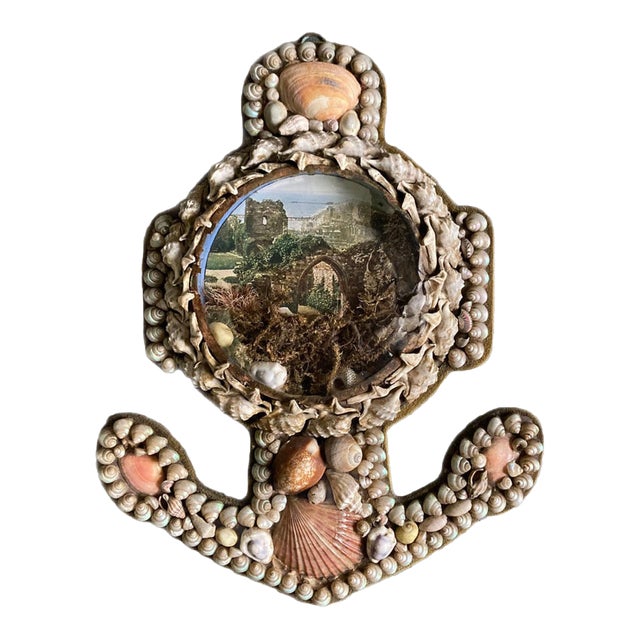
This is a wonderful and highly symbolic Edwardian Shellwork Diorama, dating from the transition between the Victorian and Edwardian periods. It represents a charming piece of seaside folk art and a sentimental souvenir.
• Form: The diorama is shaped like a ship's anchor, a classic maritime symbol representing hope, steadfastness, and security—qualities highly valued in a sailor's sweetheart.
• Frame: The entire anchor shape is created using densely applied sea shells, likely small whelks and periwinkles, arranged over a backing board, with larger, decorative shells used to emphasize the anchor's stock and flukes.
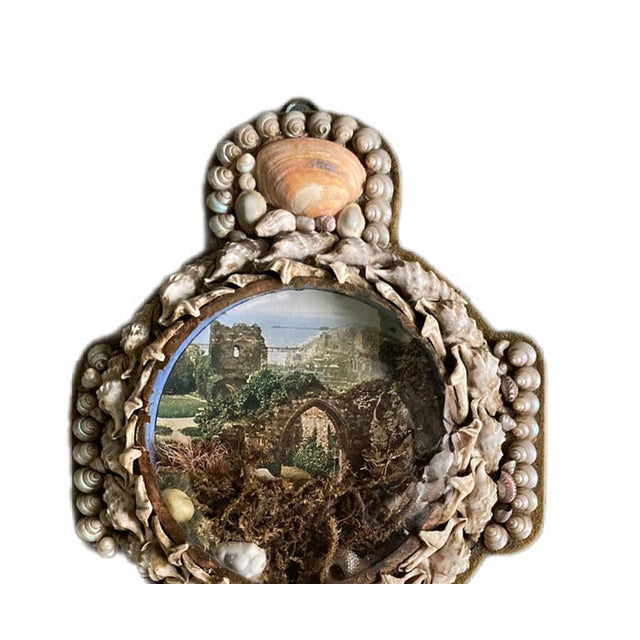
• Central Diorama: The circular, convex glass centerpiece, protected by beveled glass, frames a three-dimensional scene:
o Image: A chromolithograph depicting romantic architectural ruins or a garden folly.
o Foreground: The print is overlaid with actual small sea shells, dried coral, and seaweed (moss), creating a miniature habitat scene.
These items were popular souvenirs often bought by sailors as "sweetheart" tokens from coastal towns.
• Date: circa 1900 (Edwardian Period)
• Style: Coastal Folk Art / Sailor's Valentine Style
• Subject: Anchor Form, Romantic Ruins
• Material: Various Sea Shells, Coral, Chromolithograph, Beveled Glass
• Dimensions: 11 inches (27.9 cm) High x 8 3/4 inches (22.2 cm) Wide x 1 inch (2.5 cm) Deep
________________________________________
Historical Context: Maritime Tokens and Romantic Ruins
This piece is a classic example of shellwork art, which flourished during the Victorian era and into the early 20th century.
Symbolism and Sentiment
The Anchor motif was one of the most powerful and common symbols in maritime folk art. When presented as a gift to a romantic partner, it expressed deep fidelity and hope for a safe return from the sea.
The Ruin Motif
The image of architectural ruins—a theme popularized by 18th-century Romanticism and the Picturesque movement—was a surprisingly common feature in early English souvenir art. These ruins offered a contrast to the shells, lending the piece a sense of historical depth and artistic sophistication that elevated it beyond a simple trinket. The combination of shells (Nature) and ruins (History/Man) was considered an appealing decorative fusion for the home.
(Ref: NY10956-mrrx)
See less
Questions about the item?
Returns & Cancellations
Return Policy - All sales are final 48 hours after delivery, unless otherwise specified in the description of the product.
Cancellation Policy - Prior to shipping or local pickup, buyers may cancel an order for up to 48 hours, unless otherwise specified.
Related Collections
- Christian Dior Decorative Plates
- Saffron Decorative Plates
- Longwy Decorative Plates
- Cast Iron Decorative Plates
- Canvas Decorative Plates
- Oil Paint Decorative Plates
- 22K Gold Decorative Plates
- Sherle Wagner Decorative Plates
- Ralph Lauren Decorative Plates
- Louis XVI Decorative Plates
- Japanese Decorative Plates
- Brass Decorative Plates
- Chinese Decorative Plates
- Italian Decorative Plates
- Spanish Decorative Plates
- Copper Decorative Plates
- Gold Decorative Plates
- Green Decorative Plates
- Fruit Plates
- Piero Fornasetti Decorative Plates
- Blue Decorative Plates
- Wedgwood Decorative Plates
- Chinoiserie Decorative Plates
- Metal Decorative Plates
- Henriot Quimper Decorative Plates