




Details
Description
A fine pair of Austrian Secessionist bentwood chairs in walnut stained beechwood with upholstered seat and back.
Designed by Koloman …
Read more
A fine pair of Austrian Secessionist bentwood chairs in walnut stained beechwood with upholstered seat and back.
Designed by Koloman Moser: March 30, 1868 – October 18, 1918
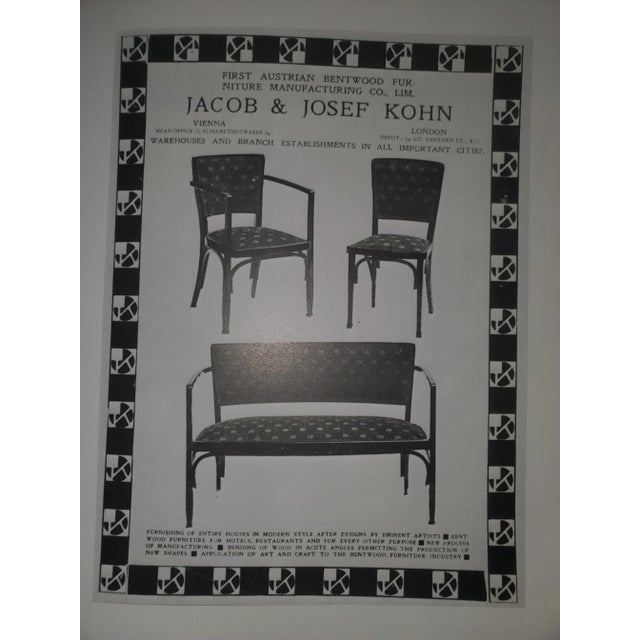
Manufactured by J & J Kohn in 1910 original paper label
Geometric arms and square back rests complement the sweeping curved surround featuring horizontal slat design which decorates the chair backs.
Austere planes and strict geometry typical of the Wiener Werkstätte are featured on this pair of armchairs. 719 . Elegantly curved and straight edged wooden elements provide stark architectural planes, timelessness, comfort and beauty.
The set's upholstery was from Backhausen, the famous, high end textile house that has been in business since 1849 and made fabric for these original designers during the period.
Moser was an important designer. He was a founding members and artistic director of the Jugenstil art movement.
Along with Josef Hoffman, Moser co founded the iconic Wiener Werkstätte ( Viennese workshop).
The Wiener Werkstätte was a workshop dedicated to the production of craftwork.
Art Deco armchairs, Club Chairs, bergere chairs, canapes, chairs, chaise longues, club chairs, corner chairs, daybeds, living room sets, Dining Room Chairs, Lounge Chairs, Office Chairs and Desk Chairs, foyer Chairs, Windsor Chairs, Corner Chairs. These can be used in any setting, Mid century, Italian Modern, Art Deco, Arts& Crafts, Rustic, Traditional... as they are versatile and adaptable to any style.
The chairs were manufactured by J&J Kohn during the period
In Vienna, Austria in 1849, Jacob Kohn (1791–1866) and his son Josef (1814–1884), founded J & J Kohn, a company that designed and made furniture.
J. & J. Kohn began working closely with the Wiener Werkstätte, the artisan workshop cofounded by the famous Austrian architect and designer Josef Hoffmann. The artists Gustav Klimt and Koloman Moser were also members.
It was through this partnership, that J. & J. Kohn produced an array of bentwood furniture in the Vienna Secession style. J&J Kohn's designs were also influenced by and reflected the Art Nouveau movement during the first decade of the 1900's.
Their main concentration was on bentwood furniture made of Austrian beechwood through a process of steaming lengths of wood and bending them in metal molds to dry thus making the shapes permanent. The sections were joined together with hardware instead of wooden joints.
Since these sections could be made separately, their components could be assembled after shipping and thus their furniture was ideal for export.
At that time, the process of standardized elements was a revolutionary principle in furniture production.
The firm produced seating, tables, coat and hat racks, plant stands…. and made their bentwood furniture available in many finishes and colors.
Beside the popular style, their furniture designs were also durable, light and relatively inexpensive and their designs were omnipresent in cafes, gardens, and of course domestic furnishing.
J &J Kohn’s designs were quickly gaining traction. they opened factories in several cities and became the leading furniture manufacturers of the Austro-Hungarian empire and a strong competitor to the Thonet brothers. They had showrooms and branches that sold their furniture all over Europe as well as in America and in Toronto, Canada, with the main office and showroom floors in New York City.
In 1914 they merged with Mundus and became Kohn-Mundus and later merged with Gebrüder Thonet in 1921. They then became the world’s leading furniture manufacturer.
The Kohns' received many awards and prizes for their work. They received a Spanish Royal Warrant of Appointment as purveyors of the royal house (Proveedor de la Real Casa).
Kohn's works can be seen in a number of museums today, including the Museum of Modern Art in New York, the Museum of Applied Arts in Vienna and Disseny Hub Barcelona.
These chairs are unsigned but documented as shown. Most Moser furniture are unsigned There are original paper labels : Jacob & Josef Kohn.
Could be used as accent or pull up chairs in a salon, living room, office, bedroom, foyer, library, near a fireplace, study, dining room ..
Armchairs measure:
20.5" wide x 19.5"- 20.5" deep maximum inclusive of rounded protruding back molding/ surround x 34.5" height
See less
- Dimensions
- 20.5ʺW × 19.5ʺD × 34.5ʺH
- Seat Interior Width
- 18.0 in
- Seat Height
- 18.0 in
- Arm Height
- 28.0 in
- Seat Interior Depth
- 18.0 in
- Number of Seats
- 1
- Designer
- Werner Max Moser
- Period
- Early 20th Century
- Country of Origin
- Austria
- Item Type
- Vintage, Antique or Pre-owned
- Materials
- Beech
- Bentwood
- Condition
- Good Condition, Restored, Some Imperfections
- Color
- Burnt Umber
- Condition Notes
- In good vintage condition w/ tiny imperfections, scuffs, marks. Refinished and reupholstered many years ago. Fabric in good condition, interior … moreIn good vintage condition w/ tiny imperfections, scuffs, marks. Refinished and reupholstered many years ago. Fabric in good condition, interior fill of cushions a bit flattened commensurate with age and use. less
Questions about the item?
Returns & Cancellations
Return Policy - All sales are final 48 hours after delivery, unless otherwise specified in the description of the product.
Cancellation Policy - Prior to shipping or local pickup, buyers may cancel an order for up to 48 hours, unless otherwise specified.
Related Collections
- Michael Graves Side Chairs
- Burke, Inc. Side Chairs
- Saffron Side Chairs
- Jonathan Charles Side Chairs
- Steel Finish Side Chairs
- Kenneth Ludwig Chicago Side Chairs
- Enzo Mari Side Chairs
- Medium-Density Fibreboard Side Chairs
- Peter Hvidt and Orla Mølgaard-Nielsen Side Chairs
- Berkey and Gay Side Chairs
- Victorian Side Chairs
- Bamboo Side Chairs
- Rush Side Chairs
- Empire Side Chairs
- Maple Side Chairs
- Eames Side Chairs
- Mohair Side Chairs
- Louis XVI Side Chairs
- Arhaus Side Chairs
- Folk Art Side Chairs
- Faux Bamboo Side Chairs
- Mother-of-Pearl Side Chairs
- French Side Chairs
- Velvet Side Chairs
- DESIGN FRERES Side Chairs