



Details
Description
Biedermeier picture clock with fountain mechanism
austria
oil on iron sheet
circa 1830
dimensions: h × w × d: 45 …
Read more
Biedermeier picture clock with fountain mechanism
austria
oil on iron sheet
circa 1830
dimensions: h × w × d: 45 × 53 × 14 cm
:
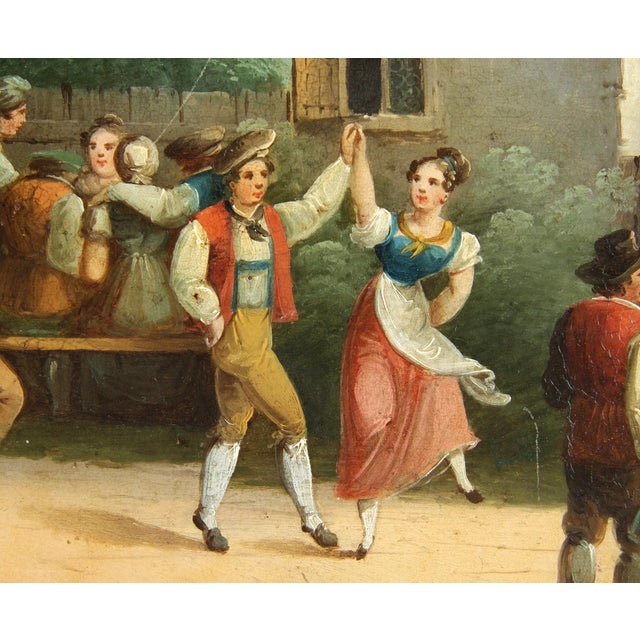
this rare picture clock depicts a village scene with figures dressed in festive attire. A dancing couple forms the centerpiece, with other villagers seated at a table behind them. The couple on the left is seated on a stool, apparently waiting for the next dance. Musical entertainment is provided by a bagpiper standing on a barrel and a violinist at his side.
in the background, we see houses and the village church tower, into whose front face the clock face is integrated. On the sides are two winding holes, through which the movement and striking mechanism can be wound with a square key. A red and white flag flies from the tower, emphasizing the festive atmosphere.
the fountain in the front left is a special attraction: when the striking mechanism is triggered, a disc mounted behind the fountain starts to move, creating the impression of a flowing stream of water. This pours into a wooden trough, overflows and forms a small stream where several ducks are resting.
the painting is executed in oil on sheet iron, finely detailed and rich in color. The original ox-eye frame, typical of the period and region, effectively frames the work.
on the back, a rear panel guided in a groove can be opened. The mechanism now visible is a typical austrian clockwork with a running time of about 36 hours, a short pendulum, and a striking mechanism with a tone spring. A single strike sounds on the half hour, and the number of hours is struck on the hour. The striking mechanism drives the aforementioned fountain disc via a simple cord.
interesting facts:
in the early 19th century, picture clocks combined the artistry of painting with the skill of clockmakers. Wonderful works of this kind were created, particularly in austria, switzerland, and southern germany, combining decorative genre paintings with clockworks and moving automata. The romanticized depiction of village life is characteristic of biedermeier interior design and reflects both the desire for rural idyll and the affinity for technology of the time.
in contrast to the alpine picture clocks, which were painted on iron or copper sheet, picture clocks with oil paintings on canvas were created at the same time in france, focusing on landscape and architectural scenes, while figurative representations were mostly dispensed with.
condition:
authentic, well-preserved painting with slight age-related craquelure, frame with slight plaster abrasion and normal signs of wear. The clockwork has been revised and is fully functional.
similar items can be found in specialist literature:
battenberg antiquitäten-kataloge - becker / küffner - uhren p. 144
See less
- Dimensions
- 20.87ʺW × 5.51ʺD × 17.72ʺH
- Period
- Early 19th Century
- Country of Origin
- Austria
- Item Type
- Vintage, Antique or Pre-owned
- Materials
- Iron
- Condition
- Good Condition, Unknown, Some Imperfections
- Color
- Green
- Condition Notes
- Patina Consistent with Age and Use,Completely Restored Patina Consistent with Age and Use,Completely Restored less
Returns & Cancellations
Return Policy - All sales are final 48 hours after delivery, unless otherwise specified in the description of the product.
Cancellation Policy - Prior to shipping or local pickup, buyers may cancel an order for up to 48 hours, unless otherwise specified.
Related Collections
- Lapis Lazuli Clocks
- Driftwood Clocks
- Polished Brass Finish Clocks
- Kenneth Ludwig Chicago Clocks
- Wrought Iron Clocks
- Grandfather Clocks
- Howard Miller Clocks
- Antique Pendulum Wall Clocks
- French Clocks
- Art Deco Clocks
- Black Forest Clocks
- Wood Clocks
- Seth Thomas Clock Company Clocks
- Antique Grandfather Clocks
- Sunburst Clocks
- Gustavian (Swedish) Clocks
- Italian Clocks
- Ceramic Clocks
- Bronze French Clocks
- Victorian Clocks
- Mid-Century Modern Clocks
- Industrial Clocks
- Carriage Clocks
- Brass Clocks
- Marble Clocks