



Details
Description
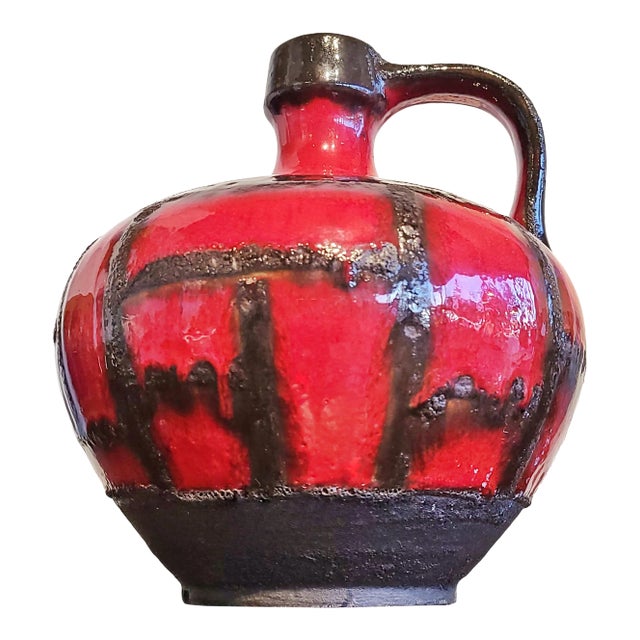
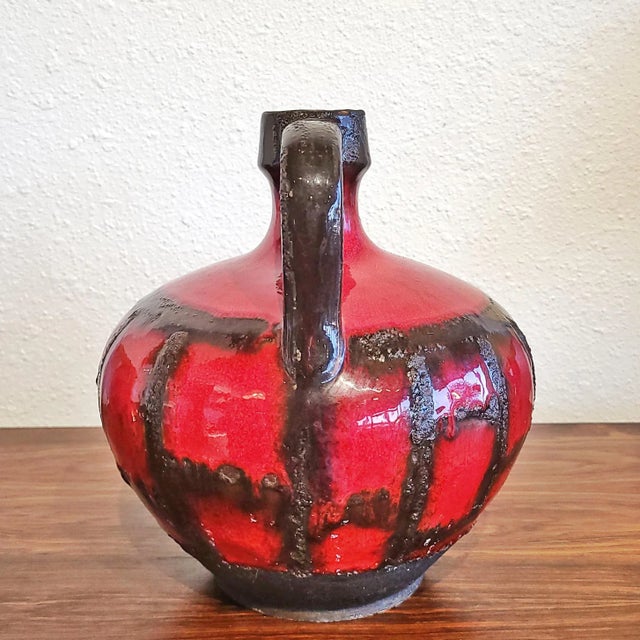
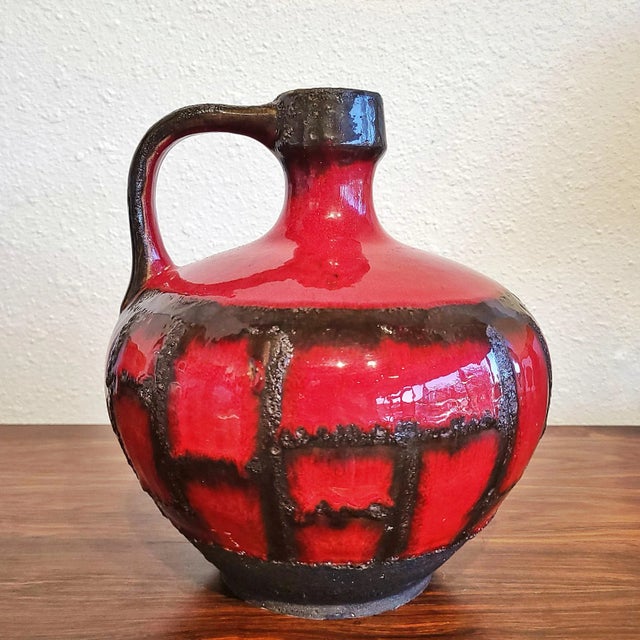
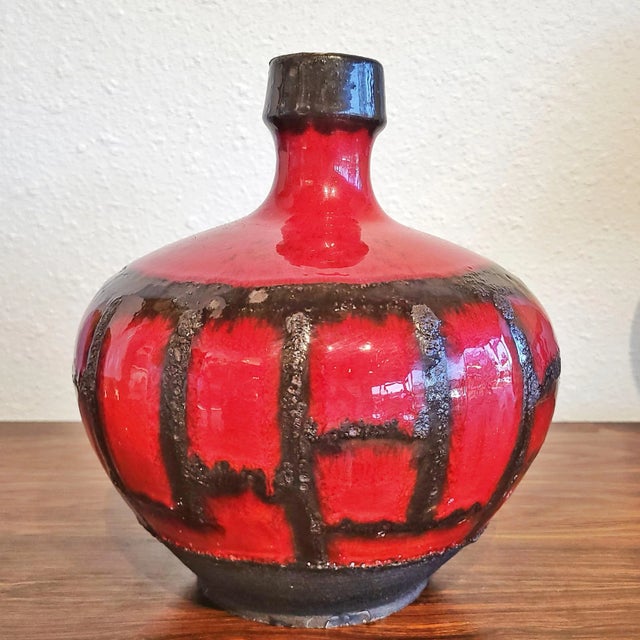
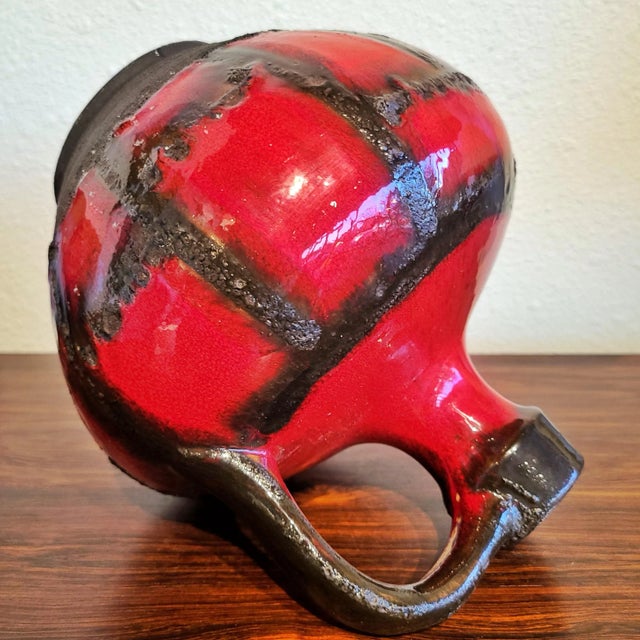
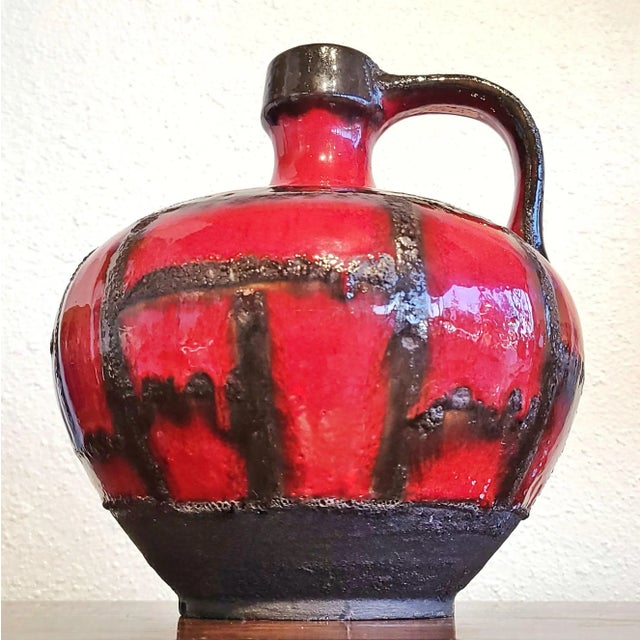
A large glossy red and volcanic black 'Costa' decor vase designed by Otto Gerharz (decor) and Kurt Tschörner (form) for …
Read more
A large glossy red and volcanic black 'Costa' decor vase designed by Otto Gerharz (decor) and Kurt Tschörner (form) for Ruscha Keramik. Mid 1960s.
RUSCHA KERAMIK was launched in 1948 when Rudolf Schardt assumed the management of Klein & Schardt, his father Georg's ceramics factory in the town of Rheinbach, located near Bonn in the German state of North Rhine-Westphalia. (RUSCHA is a syllabic abbreviation of his name.) The timing of the re-founding ensured that the company was in a good position to benefit from Germany's post-war growth boom. RUSCHA KERAMIK became a leading manufacturer during the "golden age" of Western German ceramics and is credited with some of the era's key developments. It produced some very successful and innovative forms and glazes, including the 'Vulcano' décor (Otto Gerharz, 1951)—which heralded the move towards thick, dripping fat-lava glazes—and the iconic no. 313 (Kurt Tschörner, 1954), probably the period's most famous shape. Hanns Welling, Adele Bolz, Heinz Siery, and Cilli Wörsdörfer were among other notable designers to work for RUSCHA.
RUSCHA KERAMIK was celebrated for exquisite wall plates, plaques, and tiles—manufactured for both indoor and outdoor applications—as well as its high-quality vases. Specimens from the 1970s will frequently exhibit remarkable lava and volcanic glazes. When RUSCHA closed its factory in 1996, Scheurich acquired many of its designs and molds; distinctive silver RUSCHA labels were sometimes applied to the subsequent production.
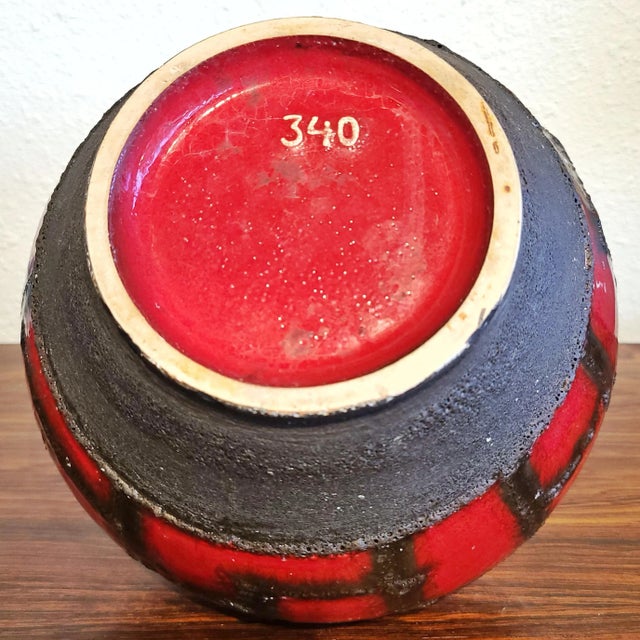
Notes on identification: White clay was used practically exclusively. The rare examples made with red-brown clay are thought to date from periods when normal supply sources ran out. Embossed and incised base-numbering was used for vessels. If a vase was made in more than one size, a single digit indicating relative size followed the form number. Low form numbers (< 100) were sometimes preceded by a letter. Like a few other manufacturers RUSCHA KERAMIK occasionally recycled form numbers, a cause of distress for some collectors. Pieces were never molded with "Germany" or "West Germany."
In rare instances, bases were hand-inscribed—less often, painted—with the name RUSCHA and a décor name (these tend to be earlier 1950s items). Where stickers are found they always read "Ruscha Art." Many items were not stickered. Sometimes a retailer's label was applied.
See less
- Dimensions
- 8.5ʺW × 8.5ʺD × 9.5ʺH
- Period
- 1970s
- Country of Origin
- Germany
- Item Type
- Vintage, Antique or Pre-owned
- Materials
- Ceramic
- Condition
- Good Condition, Original Condition Unaltered, Some Imperfections
- Color
- Red
- Condition Notes
- A large glossy red and volcanic black 'Costa' decor vase designed by Otto Gerharz (decor) and Kurt Tschörner (form) for … moreA large glossy red and volcanic black 'Costa' decor vase designed by Otto Gerharz (decor) and Kurt Tschörner (form) for Ruscha Keramik. Mid 1960s. RUSCHA KERAMIK was launched in 1948 when Rudolf Schardt assumed the management of Klein & Schardt, his father Georg's ceramics factory in the town of Rheinbach, located near Bonn in the German state of North Rhine-Westphalia. (RUSCHA is a syllabic abbreviation of his name.) The timing of the re-founding ensured that the company was in a good position to benefit from Germany's post-war growth boom. RUSCHA KERAMIK became a leading manufacturer during the "golden age" of Western German ceramics and is credited with some of the era's key developments. It produced some very successful and innovative forms and glazes, including the 'Vulcano' décor (Otto Gerharz, 1951)—which heralded the move towards thick, dripping fat-lava glazes—and the iconic no. 313 (Kurt Tschörner, 1954), probably the period's most famous shape. Hans Welling, Adele Bolz, Heinz Siery, and Cilli Wörsdörfer were among other notable designers to work for RUSCHA. RUSCHA KERAMIK was celebrated for exquisite wall plates, plaques, and tiles—manufactured for both indoor and outdoor applications—as well as its high-quality vases. Specimens from the 1970s will frequently exhibit remarkable lava and volcanic glazes. When RUSCHA closed its factory in 1996, Scheurich acquired many of its designs and molds; distinctive silver RUSCHA labels were sometimes applied to the subsequent production. Notes on identification: White clay was used practically exclusively. The rare examples made with red-brown clay are thought to date from periods when normal supply sources ran out. Embossed and incised base-numbering was used for vessels. If a vase was made in more than one size, a single digit indicating relative size followed the form number. Low form numbers (< 100) were sometimes preceded by a letter. Like a few other manufacturers RUSCHA KERAMIK occasionally recycled form numbers, a cause of distress for some collectors. Pieces were never molded with "Germany" or "West Germany." In rare instances, bases were hand-inscribed—less often, painted—with the name RUSCHA and a décor name (these tend to be earlier 1950s items). Where stickers are found they always read "Ruscha Art." Many items were not stickered. Sometimes a retailer's label was applied. less
Questions about the item?
Returns & Cancellations
Return Policy - All sales are final 48 hours after delivery, unless otherwise specified in the description of the product.
Cancellation Policy - Prior to shipping or local pickup, buyers may cancel an order for up to 48 hours, unless otherwise specified.
Related Collections
- Pink Fenton Art Glass Company Vases
- Pottery Barn Vases
- Red Fenton Art Glass Company Vases
- Mazzega Murano Vases
- Ikea Vases
- Licio Zanetti Vases
- Carlsbad Porcelain Vases
- Chase Brass and Copper Company Vases
- Westmorland Vases
- Glass Archimede Seguso Vases
- Lapis Lazuli Vases
- Blue Baccarat Vases
- Purple Fenton Art Glass Company Vases
- Queen Anne Vases
- Svenskt Tenn Vases
- Ruby Vases
- Giovanni Cenedese Vases
- Tomaso Buzzi Vases
- Dr. Wall Worcester Porcelain Vases
- Schneider Glass Vases
- Byzantine Vases
- Gesso Vases
- Diamond Vases
- Axel Salto Vases
- Dada Vases