






Details
Description
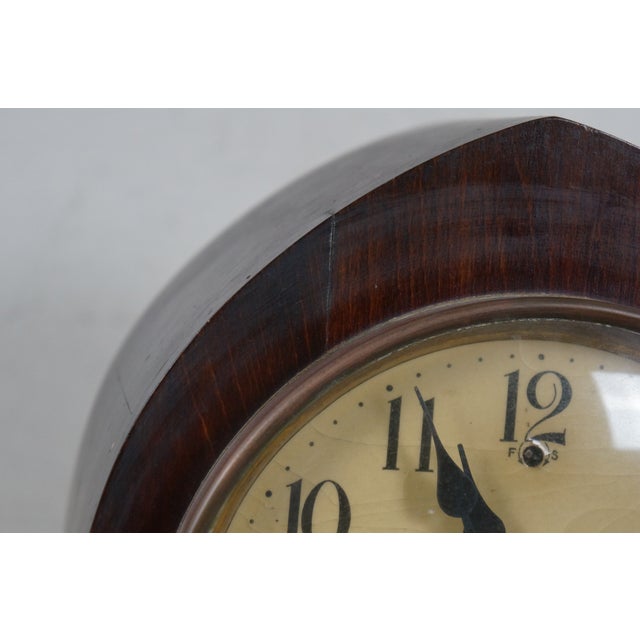
Early 20th century Sessions mantel clock. Cathedral / beehive shaped mahogany case. Off white face with black Arabic numerals and …
Read more
Early 20th century Sessions mantel clock. Cathedral / beehive shaped mahogany case. Off white face with black Arabic numerals and hands. Key wound, eight day, half hour strike, cathedral gong, turn back.
The Sessions Clock Company ("Sessions") was one of several notable American clock companies centered in Connecticut. Sessions and its predecessor (E.N. Welch Company), along with the E. Ingraham Company, the Ansonia Clock Company, the New Haven Clock Company, the Seth Thomas Clock Company, the William L. Gilbert Clock Company, and the Waterbury Clock Company collectively produced most of the mechanical clocks made in America between the mid-19th century and 1950. At about 1935, Sessions ended its production of mechanical clocks and produced electrical clocks exclusively. In 1902, William E Sessions and other family members purchased a controlling interest in the E.N. Welch Company, a clock manufacturer located in Forestville, Connecticut. Sessions' father owned a foundry located in Bristol, Connecticut that produced cases for E.N Welch Co. On January 9, 1903, the company was reorganized as The Sessions Clock Company. Within a few years the Sessions Clock Company was producing clock movements, cases, dials, artwork and castings for their line of mechanical clocks. Between 1903 and 1933 Sessions produced 52 models of mechanical clocks, ranging from Advertisers, large and small clocks with logos of various businesses, to wall, or regulator clocks, and shelf or mantel clocks, designed for the home. Many of the Session clocks from this period are prized by collectors. In 1930, the company expanded to produce electric clocks and timers for radios, while continuing to produce traditional brass mechanical movements. Beginning at the end of World War II Sessions W Model (electric) was widely used by various casting companies for their clocks. The dial of the W Model read Movement by Sessions. In the early 1950s Sessions begin to produce timers for television. In 1956, Sessions was absorbed by a company interested mainly in their timing devices. In 1959, William K. Sessions, grandson of William E. Sessions left the Sessions Clock Company and formed the New England Clock Company. In 1960, one of the Sessions Clock buildings was sold to the Bristol Instrument Gears Company. Kept as the Sessions Company, the new owners ran the operation until 1969 when changes in the market forced the Sessions Company into liquidation. In 1970, the remaining buildings were sold to Dabko Industries, a machine parts manufacturer.
Dimensions:
9" x 4.625" x 13.25" (Width x Depth x Height)
Chairish sells clocks only with display as the intended use. The mechanical elements are not guaranteed to be in working order by Chairish.
See less
- Dimensions
- 9ʺW × 4.62ʺD × 13.25ʺH
- Styles
- American
- Period
- Early 20th Century
- Country of Origin
- United States
- Item Type
- Vintage, Antique or Pre-owned
- Materials
- Glass
- Mahogany
- Condition
- Good Condition, Original Condition Unaltered, Some Imperfections
- Color
- Brown
- Condition Notes
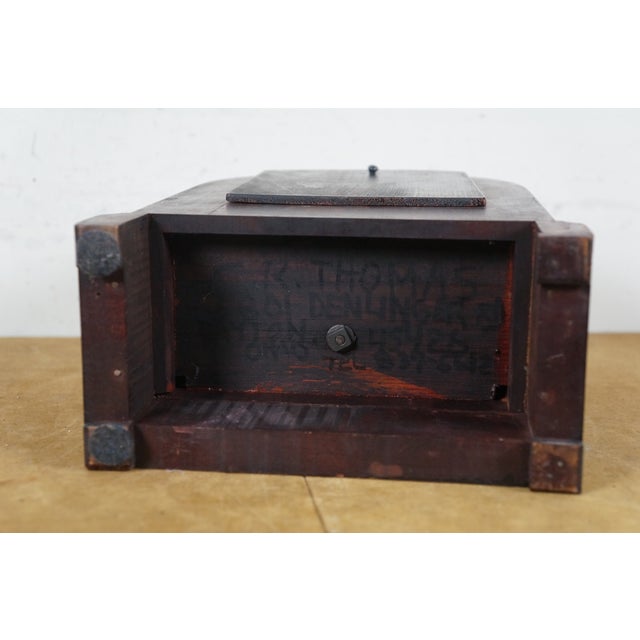
- Main spring broken, Good Overall - Gentle wear/scuffs; small split in top front Main spring broken, Good Overall - Gentle wear/scuffs; small split in top front less
Questions about the item?
Returns & Cancellations
Return Policy - All sales are final 48 hours after delivery, unless otherwise specified in the description of the product.
Cancellation Policy - Prior to shipping or local pickup, buyers may cancel an order for up to 48 hours, unless otherwise specified.
Related Collections
- Bronze French Clocks
- Waterford Crystal Clocks
- Mirrored Glass Clocks
- Clocks in Portland, ME
- Grandfather Clocks
- Howard Miller Clocks
- French Clocks
- Wood Clocks
- Black Forest Clocks
- Ceramic Clocks
- Carriage Clocks
- Industrial Clocks
- China Clocks
- Antique Pendulum Wall Clocks
- Art Deco Clocks
- Mid-Century Modern Clocks
- Victorian Clocks
- Seth Thomas Clock Company Clocks
- Sunburst Clocks
- Wind Up Clocks
- Mantel Clocks
- Brass Clocks
- General Electric Clocks
- Gustavian (Swedish) Clocks
- Marble Clocks