




Details
Description
18th C. Capodimonte Box, Views Royal Palace of Caserta & Belvedere di San Leucio Consisting of two pieces: the lid …
Read more
18th C. Capodimonte Box, Views Royal Palace of Caserta & Belvedere di San Leucio Consisting of two pieces: the lid and base.
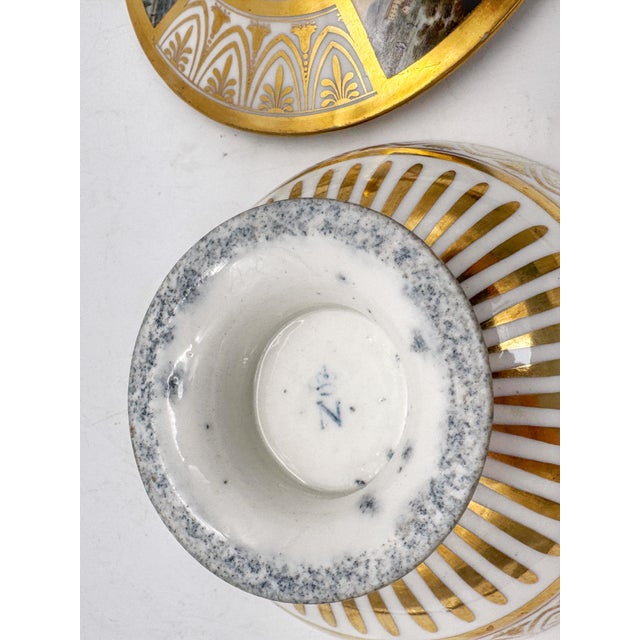
This elegant 18th-century Capodimonte porcelain covered box with a removable lid is a superb example of Italian artistry, featuring a refined, rounded form with a gently flared foot and a domed lid topped by a pointed finial. The harmonious proportions of the box are accentuated by rich gilded detailing, framing two finely hand-painted topographical views of significant Bourbon landmarks. The lid’s sloping surface provides an ideal canvas for these detailed scenic vignettes, separated by delicate gilt patterns that radiate from the central finial, enhancing the piece's sophisticated design.
One view showcases the Royal Palace of Caserta (Palazzo Reale di Caserta), an architectural masterpiece commissioned by Charles VII of Naples and designed by Luigi Vanvitelli in the mid-18th century. The scene vividly captures the grandeur of the palace’s monumental facade and sprawling landscaped gardens, complete with elegantly dressed figures strolling the grounds. This depiction reflects the Bourbon dynasty's aspiration to rival Europe's most magnificent royal residences, such as Versailles.
The opposing view features the Belvedere di San Leucio, a remarkable site linked to Ferdinand IV of Naples and his ambitious social experiment in silk production. The painting illustrates the neoclassical building surrounded by lush gardens and figures engaged in leisurely activities, representing the king’s vision for a progressive, meritocratic society where industry and enlightenment ideals flourished side by side.
The box is further embellished with gilded neoclassical motifs, echoing the grandeur of the depicted sites. The underside bears the iconic Capodimonte "crown over N" mark in underglaze blue, confirming its origin from the renowned Capodimonte manufactory in Naples, celebrated for producing some of the finest porcelain of the 18th century.
This exceptional work, likely produced shortly after the completion of the topographical views it celebrates, stands as a testament to the artistic, cultural, and industrial achievements of Bourbon Naples, offering both historical significance and refined decorative appeal.
Porcelain works like this were often produced as commemorative pieces for royal events or visits, luxury souvenirs for aristocratic guests visiting the palace and its grounds.
Further History of the Royal Palace of Caserta and the Belvedere di San Leucio:
The Royal Palace of Caserta (Palazzo Reale di Caserta) is one of the largest and most impressive royal residences in the world. Commissioned in 1752 by Charles VII of Naples (later Charles III of Spain) and designed by the famous architect Luigi Vanvitelli, the palace was intended to rival the grandeur of Versailles in France and El Escorial in Spain.
The palace complex includes 1,200 rooms decorated with frescoes and lavish furnishings. A grand park with fountains, waterfalls, and sculptures.
The English Garden is one of the earliest examples of informal English-style gardens in Italy. An aqueduct system (Caroline Aqueduct) to supply water to the palace and its extensive gardens. The Royal Palace of Caserta played a vital role as the main residence of the Bourbon kings of Naples. It was designed not only as a royal residence but also as a seat of government, reflecting the Bourbon ambition to centralize administration in the Kingdom of Naples.
The Belvedere di San Leucio, Located near the palace, the Belvedere di San Leucio is an extraordinary site with a unique social and industrial history. Initially conceived as a hunting lodge by the Bourbons, it later became part of a revolutionary social project.
Ferdinand IV of Naples, son of Charles VII, transformed San Leucio into a model town and a center of silk production. His goal was to create a utopian community where silk workers and their families could live and work under enlightened social reforms. Education was mandatory, including training in silk manufacturing techniques. Merit-based society: Ferdinand IV introduced progressive policies, including equal rights for men and women in work and education.
Overall Measurements:
5 inches in height and 5.75 inches in diameter, with an interior height of 2 inches and raised on a base diameter of 3 inches,
See less
- Dimensions
- 5.75ʺW × 5.75ʺD × 5ʺH
- Styles
- Baroque
- Brand
- Capodimonte
- Period
- 18th Century
- Country of Origin
- Italy
- Item Type
- Vintage, Antique or Pre-owned
- Materials
- Porcelain
- Condition
- Good Condition, Original Condition Unaltered, Some Imperfections
- Color
- Gold
- Condition Notes
- Good Wear consistent with age and use. Good Wear consistent with age and use. less
Questions about the item?
Returns & Cancellations
Return Policy - All sales are final 48 hours after delivery, unless otherwise specified in the description of the product.
Cancellation Policy - Prior to shipping or local pickup, buyers may cancel an order for up to 48 hours, unless otherwise specified.
Related Collections
- Ornamental and Decorative Materials Soup Tureens
- Soup Tureens in Little Rock
- Edwardian Soup Tureens
- Gold Leaf Soup Tureens
- Italian Soup Tureens
- Blue Soup Tureens
- Soup Tureens with Ladles
- Staffordshire Soup Tureens
- Royal Worcester Soup Tureens
- Ridgway Porcelain Soup Tureens
- Soup Tureens in Detroit
- Belgian Soup Tureens
- Soup Tureens in Orlando