




Details
Description
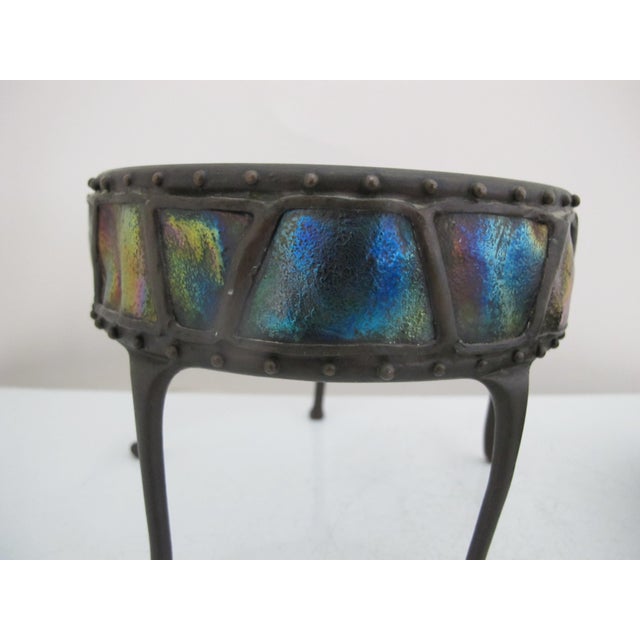
Tiffany studios bronze and turtle back favrile glass fernery bowl with copper removable insert. I can not find the Tiffany …
Read more
Tiffany studios bronze and turtle back favrile glass fernery bowl with copper removable insert. I can not find the Tiffany impression or signature on this piece, so I am attributing to Tiffany Studios. This item is under consignment with another similar style bronze Tiffany (listed separately). Both pieces are from the personal collection of Ray and Lee Grover who, in the 1960's and 1970's were the leading authorities of fine art glass in the US. They were full time dealers of Tiffany, Steuben, Lalique and other fine art glass, and wrote several books on the subject which were the most respected guides of their time, feel free to Google search. These pieces had been handed down to their daughter, our client, and we are selling on her behalf.
Dates early 20th century. Measures 6 1/2" x 5" tall. Excellent condition, surface scratching and light wear to bowl, mainly at interior of bow. Light patina showing at rim.
10756-24
As found on Wright: Louis Comfort Tiffany, artist, innovator, and pioneer of form and color, was born in New York City in 1848.
The son of celebrated jeweler and founder of Tiffany & Co., Charles Tiffany, Louis C. Tiffany began his career as a painter in the late 1860s studying under a series of masters including George Inness and Samuel Colman. In the mid-1870s, he turned his attention away from painting and toward the family business of decorative arts and interior design. He built a strong reputation with his exemplary work, even taking part in the 1882 redecoration of the White House.
Despite being highly regarded for his interior design work, Tiffany found he was increasingly drawn to the production of art glass, working for several glass manufacturers from 1875-1878 and honing his skills in the medium that would ultimately bring him the greatest recognition. In 1881, he filed his first patent in glass production, pioneering a new method in glass-tiled mosaic design. Tiffany continued to develop his craft and, in 1885, opened an affiliated interior design company, Tiffany Glass Company, which later changed its name to Tiffany Studios. This new company specialized in the design of private interiors and public spaces, working with numerous clients including Louisine and Henry Osborne Havemeyer and the Art Institute of Chicago.
In 1892, Tiffany received a patent for a new technique in glass production that would establish his place in art glass history: Favrile blown glass. Favrile glass is created by treating molten glass with metallic oxides in order to create a colored glass. Before the invention of Favrile glass, iridescent art glass was created by simply applying color, in the form of paint or enamel, over a piece of colorless glass. Tiffany displayed his Favrile glass at the 1900 Paris Exhibition where it won the Grand Prize.
In 1898, Tiffany Studios began manufacturing lighting fixtures and lamps. A year later, Tiffany added enamelwork to his firm’s repertoire, and later, ceramics. He continued to advance the use of Favrile glass, designing glass mosaics for use in interior settings, innovating as he did with new techniques of modeling, shading, and cutting. Upon his father's death in 1902, Tiffany assumed the roles of Vice-president and Art Director of Tiffany & Co. He watched the company’s bottom line fastidiously, ending production of any item that went unsold for one year.
No amount of careful accounting could safeguard Tiffany Studios against the shift in public taste during the 1920s. The scrolls and natural curves so integral to Tiffany’s designs gave way to the right angles of Modernism. Tiffany Studios declared bankruptcy in 1932. Louis C. Tiffany died a year later, personally bankrupt and in relative obscurity. That obscurity was not to last; scholars rediscovered Tiffany’s work in the 1950s, followed by the art market a decade later.
Today, works by Louis Comfort Tiffany and Tiffany Studios are highly sought after in the modern art market, with collectors valuing them for their high production quality, intricate and nature-inspired designs, and stunning use of colored glass.
10756-24
See less
- Dimensions
- 6.5ʺW × 6.5ʺD × 5ʺH
- Styles
- Arts & Crafts
- Brand
- Tiffany Studios
- Period
- Early 20th Century
- Country of Origin
- United States
- Item Type
- Vintage, Antique or Pre-owned
- Materials
- Bronze
- Glass
- Condition
- Good Condition, Original Condition Unaltered, Some Imperfections
- Color
- Bronze
- Condition Notes
- Excellent condition, light surface scratching and wear to bowl Excellent condition, light surface scratching and wear to bowl less
Questions about the item?
Returns & Cancellations
Return Policy - All sales are final 48 hours after delivery, unless otherwise specified in the description of the product.
Cancellation Policy - Prior to shipping or local pickup, buyers may cancel an order for up to 48 hours, unless otherwise specified.
Related Collections
- Port 68 Decorative Bowls
- Sèvres Porcelain Decorative Bowls
- Furstenberg Porcelain Decorative Bowls
- Arzbeg Porcelain Decorative Bowls
- Gucci Decorative Bowls
- Derby Porcelain Decorative Bowls
- Feather Decorative Bowls
- Hermès Decorative Bowls
- Classical Greek Decorative Bowls
- Nymphenburg Porcelain Decorative Bowls
- Brass Chinese Decorative Bowls
- Tiffany and Co. Decorative Bowls
- Lalique Decorative Bowls
- Fenton Art Glass Company Decorative Bowls
- Chinoiserie Decorative Bowls
- Brass Decorative Bowls
- Maitland - Smith Decorative Bowls
- Chinese Decorative Bowls
- Japanese Decorative Bowls
- Murano Glass Decorative Bowls
- Mixing Bowls
- Dough Bowls
- Crystal Mikasa Decorative Bowls
- Blown Glass Decorative Bowls
- Copper Decorative Bowls