

Details
Description
18th-Century Staffordshire Creamware Cauliflower Milk Jug and Cover, Greatbatch and Wedgwood Type
Circa 1765
This Staffordshire creamware milk jug and …
Read more
18th-Century Staffordshire Creamware Cauliflower Milk Jug and Cover, Greatbatch and Wedgwood Type
Circa 1765
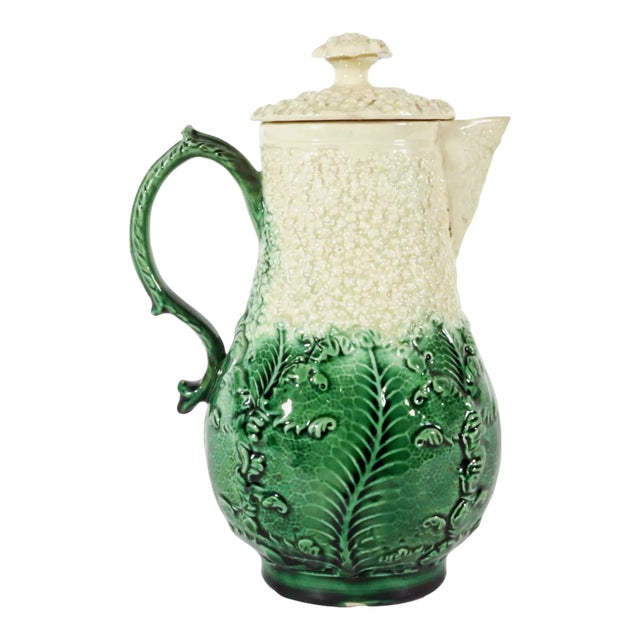
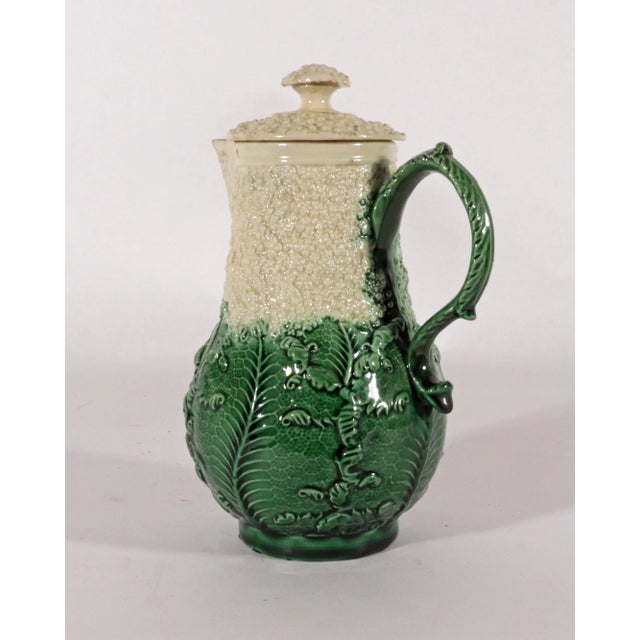
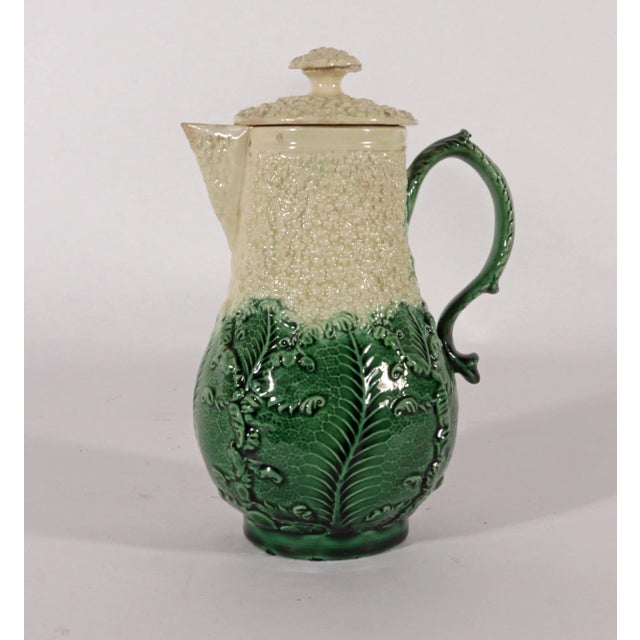
This Staffordshire creamware milk jug and cover is molded in the form of a cauliflower and dates from about 1765, when naturalistic fruit and vegetable tea wares were at the height of fashion. It is a fine example of cauliflower ware, the most distinctive of the colored-glaze wares made in the Potteries in the 1760s, and of the Rococo taste for forms taken directly from nature.
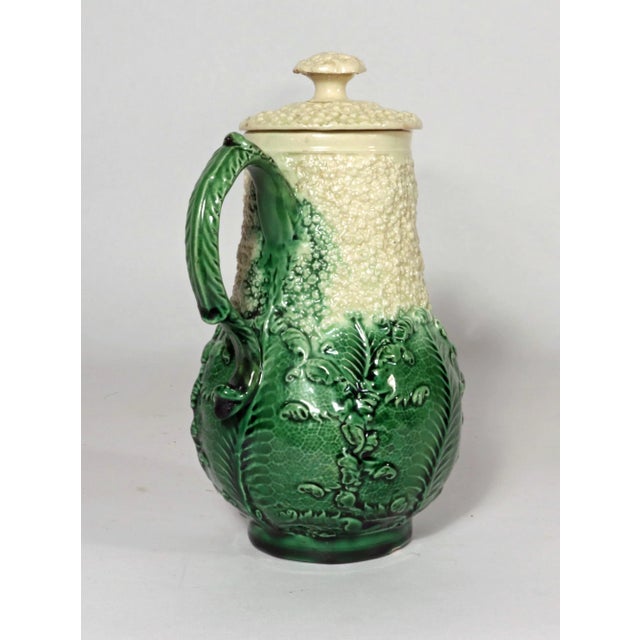
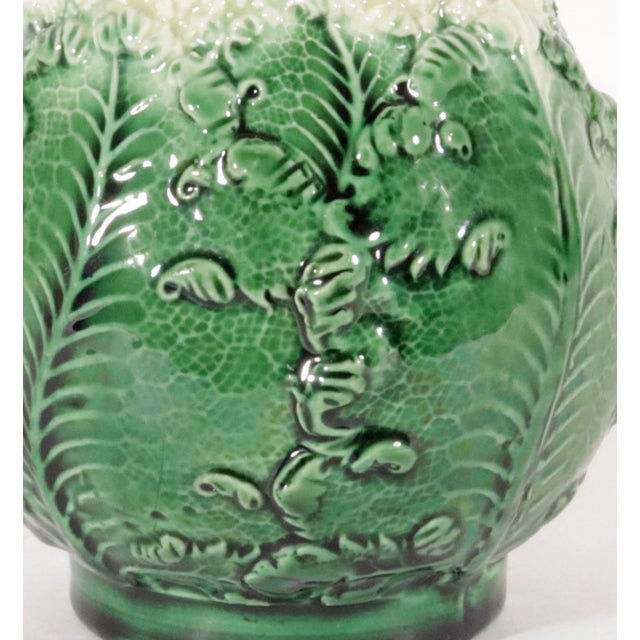
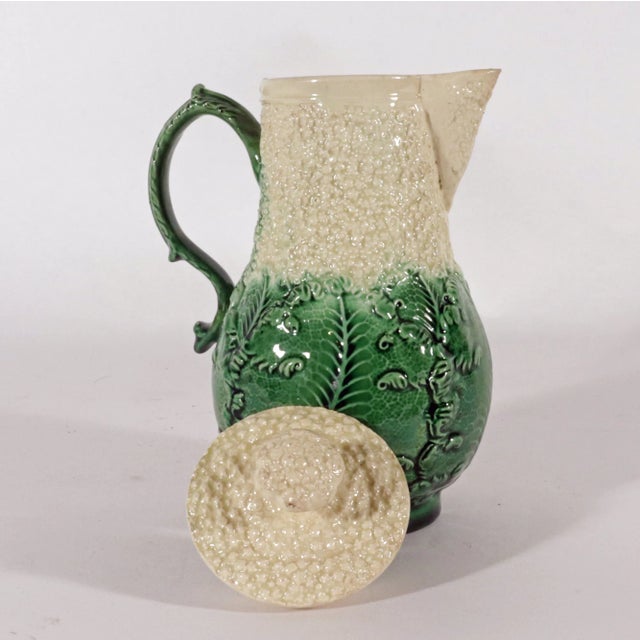
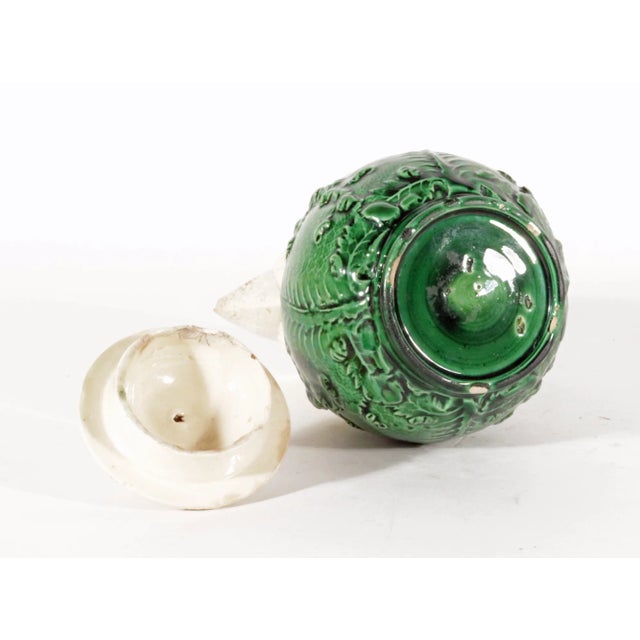
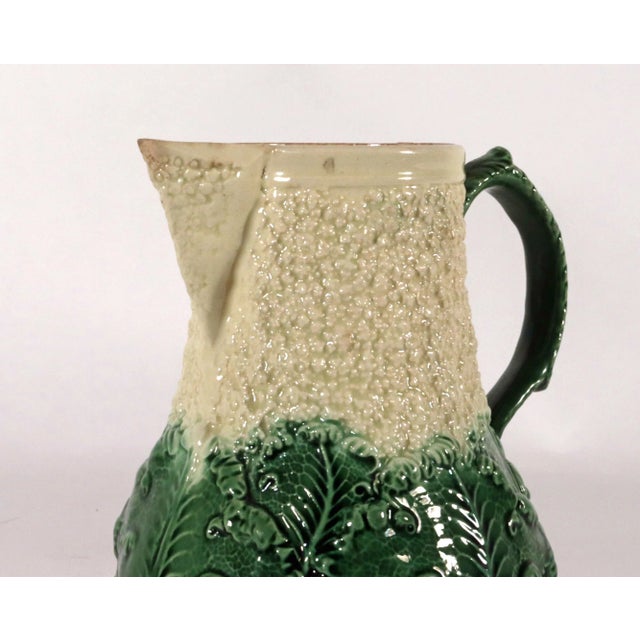
The baluster-shaped body rises from a short foot and is molded around its lower half with four overlapping leaves, each with a raised midrib, feathered veins and curled edges over a finely netted ground, all covered in a rich translucent green glaze. The neck, the pointed spout and the domed cover are molded with the close, pebbled texture of the florets and left in the cream color of the body beneath a clear lead glaze. The cover has a floret knop and a small steam hole, and the leaf-molded S-scroll handle, with thumb rest and lower kick, is glazed green, as is the underside.
The green was made by coloring a lead glaze with copper oxide and applying it to the once-fired biscuit body; Josiah Wedgwood entered his formula for a green glaze for white biscuit ware as number 7 in his Experiment Book on March 23, 1759. The jug would have been made en suite with a teapot, coffee pot, tea canister, cream jug and bowls.
Wares of this kind are traditionally associated with William Greatbatch and Josiah Wedgwood. Greatbatch, working at Lower Lane, Fenton, is documented supplying Wedgwood with molded shapes in the early 1760s, which Wedgwood glazed and finished at Burslem, and cauliflower wares were recovered from the Greatbatch factory site. Cauliflower wares were, however, made by several Staffordshire potters, and an unmarked example such as this is best described as of Greatbatch and Wedgwood type.
At 6¼ inches high, the jug sits well on a bookshelf, in a cabinet or on a side table, and groups naturally with other green-glazed leaf, cauliflower and pineapple wares or with plain creamware of the same period.
Dimensions
Height: 6¼ inches (15.9 cm)
Width: 4¼ inches (10.8 cm)
Depth: 3¼ inches (8.3 cm)
Marks
Unmarked.
Provenance
Earle D. Vandekar of Knightsbridge
Condition
Good antique condition, with a tiny frit to one side of the tip of the spout, commensurate with age.
References
Colonial Williamsburg Foundation, milk jug and lid, Staffordshire, 1765–1775, object number 2005-152,A&B, gift of Mr. Harry H. Coon: a closely comparable baluster-form cauliflower milk jug with four green-glazed leaves, floret-molded neck, spout and domed cover, floret knop and green S-scroll foliate handle.
V&A Wedgwood Collection, Barlaston, cauliflower teapot and cover, Staffordshire, around 1765, for the green glaze and Wedgwood’s Experiment Book entry of March 23, 1759.
Fitzwilliam Museum, Cambridge, cauliflower covered bowl, accession number C.6 & A-1951, for the making of cauliflower wares by several Staffordshire potters and the finds from the Greatbatch site.
David Barker, William Greatbatch: A Staffordshire Potter (London: Jonathan Horne, 1991).
Robin Hildyard, English Pottery 1620–1840 (London: V&A Publications, 2005).
Historical Context
Cauliflower ware belongs to the mid-eighteenth-century fashion for naturalism, a theme that Colonial Williamsburg notes ran through the decorative arts of the period. The Meissen and Chelsea porcelain factories had made tureens and dishes as cauliflowers, cabbages and melons in the 1750s, and the Staffordshire potters brought the idea to tea wares in refined cream-colored earthenware, alongside pineapple and melon wares and the tortoiseshell and agate wares of the same years, at prices within reach of a far wider market.
At Wedgwood’s own works the fashion was brief. By 1766 he was clearing his warehouse of colored wares in favor of the plain cream-colored earthenware he was then refining as Queen’s ware, and in that year he sold cauliflower block molds to John Baddeley of Shelton. Other Staffordshire potters continued to make the ware into the 1770s and later.
(Ref: NY10644-nrrr)
See less
- Dimensions
- 4.25ʺW × 3.25ʺD × 6.25ʺH
- Period
- Mid 18th Century
- Country of Origin
- United Kingdom
- Item Type
- Vintage, Antique or Pre-owned
- Materials
- Creamware
- Pottery
- Condition
- Good Condition, Original Condition Unaltered, Some Imperfections
- Color
- Green
- Condition Notes
- Good Good less
Questions about the item?
Returns & Cancellations
Return Policy - All sales are final 48 hours after delivery, unless otherwise specified in the description of the product.
Cancellation Policy - Prior to shipping or local pickup, buyers may cancel an order for up to 48 hours, unless otherwise specified.
Related Collections
- Bottles and Jars and Jugs in Lexington, KY
- Khaki Bottles and Jars and Jugs
- Port 68 Bottles and Jars and Jugs
- Roger Capron Bottles and Jars and Jugs
- Acrylic Bottles and Jars and Jugs
- Ralph Lauren Bottles and Jars and Jugs
- Gold-Plate Bottles and Jars and Jugs
- Medieval Bottles and Jars and Jugs
- Cherry Wood Bottles and Jars and Jugs
- Borosilicate Glass Bottles and Jars and Jugs
- Crocks
- Wicker Bottles and Jars and Jugs
- Apothecary Jars
- Cookie Jars
- Japanese Bottles and Jars and Jugs
- 1800s Perfume Bottles
- Candy Jars
- Antique Water Jugs
- Murano Glass Bottles and Jars and Jugs
- 1950s Perfume Bottles
- Apothecary Bottles
- Deruta Bottles and Jars and Jugs
- Portieux Vallerysthal Bottles and Jars and Jugs
- Lead Bottles and Jars and Jugs
- Mottahedeh Bottles and Jars and Jugs