




Details
Description
The Japanese artisans appeared to have mastered this cloisonne technique named plique-a-jour, a French word that means letting in daylight. …
Read more
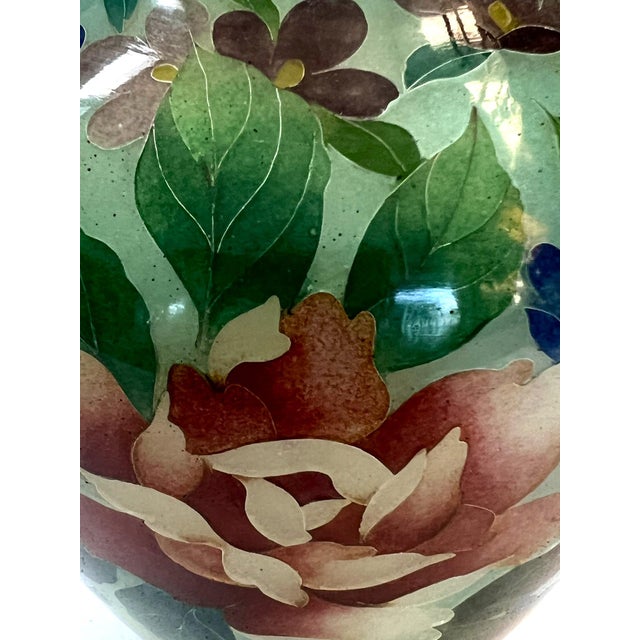
The Japanese artisans appeared to have mastered this cloisonne technique named plique-a-jour, a French word that means letting in daylight. It is a very challenging form of enameling, whereby the enamel is applied in cells, just like in cloisonne, but the backing is removed so light can shine through the transparent or translucent enamel. Perhaps it is easier to understand that the technique is very similar to stain glass windows but in miniature. The process is slow and failure is high. This is an old technique that goes all the way back to the Byzantine period, Eastern Roman Empire.
The name for Japanese plique-a-jour os Shotai shippo. It can be surmised that the technique was brought to Japan by a German who helped out-of-work Japanese metalsmith, as a result of the Meiji Restoration, learned a new skill. (from Wikipedia)
Shotai shippo ("Japanese plique-à-jour"): A layer of flux (clear enamel) is fired over a copper form. Wires are fired onto the flux (similar to cloisonné) and the resulting areas are enameled in the colors of choice. When all the enameling is finished, the copper base is etched away leaving a translucent shell of plique-à-jour.
This vase here has a globular form which tapers to a round foot. Flowers and leaves covered the surface - roses, lilies, are two of the recognizable flowers on a light green background. with a short neck, tapering towards the base. Clusters of multicolor hydrangeas fill the light green/turquoise background. The neck and base have white metal rims. It does not have a maker's mark.
The last photo shows plique-a-jour door panels done in flowers on exhibition at the Museum of Art of Catalonia in Barcelona, Spain. It was part of the art exhibition at the Barcelona World Exposition in 1922. Truly, it is a magnificent example of this art form.
See less
- Dimensions
- 3.75ʺW × 3.75ʺD × 5.25ʺH
- Styles
- Japanese
- Period
- 1920s
- Country of Origin
- Japan
- Item Type
- Vintage, Antique or Pre-owned
- Materials
- Glass
- Condition
- Good Condition, Original Condition Unaltered, Some Imperfections
- Color
- Red
- Condition Notes
- The vase comes in its own custom made brocade covered box. Please note the white metal rim and base have … moreThe vase comes in its own custom made brocade covered box. Please note the white metal rim and base have some tarnish. I left it as is because some collectors like the condition the piece is in without cleaning. The base has some marks left by labels. less
Questions about the item?
Returns & Cancellations
Return Policy - All sales are final 48 hours after delivery, unless otherwise specified in the description of the product.
Cancellation Policy - Prior to shipping or local pickup, buyers may cancel an order for up to 48 hours, unless otherwise specified.
Related Collections
- Clarice Cliff Vases
- Franco Bucci Vases
- Dorothy Draper Vases
- Workaday Handmade Vases
- Arcore Ceramica Vases
- Poltronova Vases
- Surface Ceramics Vases
- Libbey Glass Co. Vases
- Raymor Import Vases
- Bimini Glass Vases
- Liz Marsh Vases
- The American School Vases
- Karl Springer Vases
- Southeast Asia Vases
- St. Louis Crystal Vases
- From Vienna Vases
- Graphite Vases
- Gambone Vases
- Lenox Vases
- Blenko Vases
- Swung Vases
- Fenton Art Glass Company Vases
- Haeger Vases
- Viking Glass Company Vases
- Italian Vases