




Details
Description
The ¼” Leaf-Green or Blue stem and letter formation mark on the bottom of this vase shows that it was …
Read more
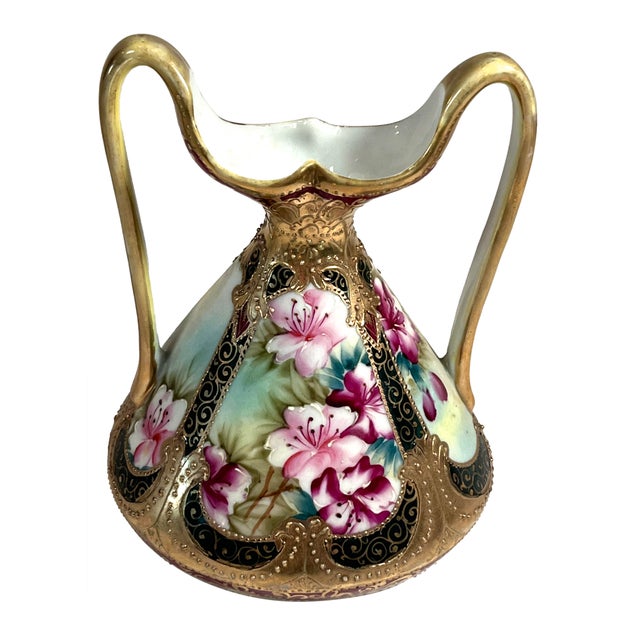
The ¼” Leaf-Green or Blue stem and letter formation mark on the bottom of this vase shows that it was produced between 1891 to 1911. This vase features the rare and sought-after “whiplash” shaped handles and a large amount of “moriage”. The decoration that is most appealing to collectors is the raised enamel or moriage (pronounced "mori-ah-gay") which is raised paste enamel applied as tubes, dots or modeled in just the same way as one would decorate a cake. The most sought after moriage is called "coralene" which is applied decoration made up of densely packed glass beads.
Nippon potters created porcelain that displayed elaborate, flourished motifs and ornate designs. Japanese potters of the time, including employees of the company that evolved into Noritake, received training in European decorative styles. These artisans skillfully imitated the styles of fine European potters, including Belleek, Limoges, and R.S. Prussia. Nippon porcelain works did not feature traditional Japanese designs often found on Kutani ware china or Asian ceramics.
In 1891, the McKinley Tariff Act prohibited the import of foreign products that did not display the country of origin in easily readable English words. Many Japanese porcelain pieces were required to feature the word Nippon on the base’s underside. From the mid-19th century until the present, Japanese porcelain has been manufactured and exported to the United States. In 1891, there was a significant change in the laws that regulated the identification of goods imported into the United States. The U.S. Customs inspectors and cost-conscious exporters alike adhered to the new laws.
During the late 19th century, most finely-painted porcelain reflected curved, Victorian-style designs and muted floral motifs. Collectively, these elements were examples of the art nouveau style. Other art nouveau pieces, such as large, hand-painted Nippon vases, exhibited bolder-looking floral design components.
See less
- Dimensions
- 5ʺW × 5ʺD × 6.5ʺH
- Styles
- Art Nouveau
- Period
- 1910s
- Country of Origin
- Japan
- Item Type
- Vintage, Antique or Pre-owned
- Materials
- Porcelain
- Condition
- Good Condition, Original Condition Unaltered, Some Imperfections
- Color
- Gold
- Condition Notes
- This vase is in excellent condition. The gilding is in very good shape and does not show significant wear. This vase is in excellent condition. The gilding is in very good shape and does not show significant wear. less
Questions about the item?
Returns & Cancellations
Return Policy - All sales are final 48 hours after delivery, unless otherwise specified in the description of the product.
Cancellation Policy - Prior to shipping or local pickup, buyers may cancel an order for up to 48 hours, unless otherwise specified.
Related Collections
- Clarice Cliff Vases
- Franco Bucci Vases
- Dorothy Draper Vases
- From Vienna Vases
- St. Louis Crystal Vases
- Arcore Ceramica Vases
- Poltronova Vases
- Surface Ceramics Vases
- Graphite Vases
- Bimini Glass Vases
- Libbey Glass Co. Vases
- Raymor Import Vases
- Karl Springer Vases
- Southeast Asia Vases
- The American School Vases
- Workaday Handmade Vases
- Liz Marsh Vases
- Lenox Vases
- Blenko Vases
- Swung Vases
- Fenton Art Glass Company Vases
- Haeger Vases
- Viking Glass Company Vases
- Italian Vases
- Orrefors Vases