

Details
Description
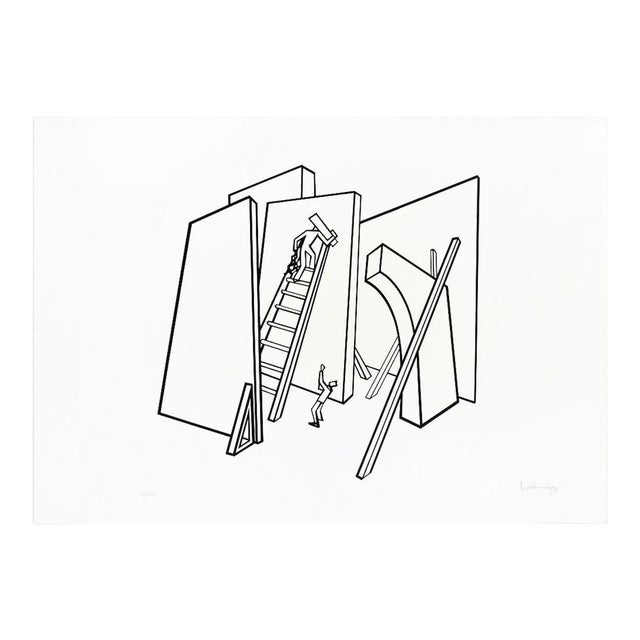
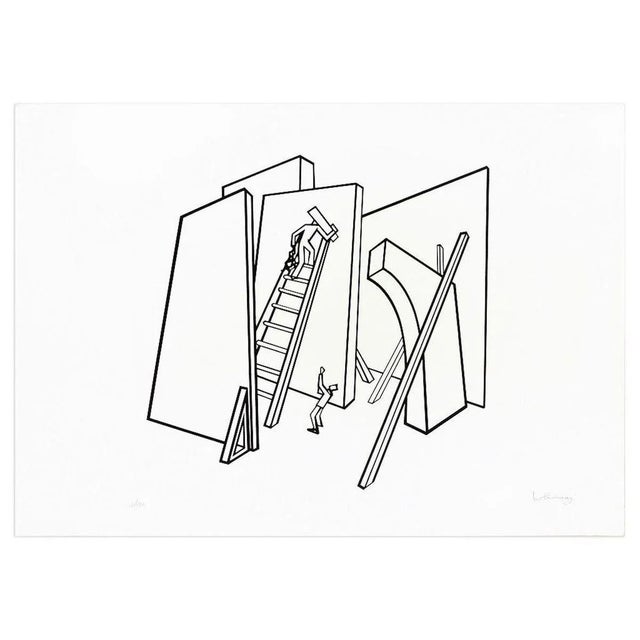
The Builders is an extraordinary lithograph realized by the artist Ivo Pannaggi. Edition of 100 copies around 1975 from an … Read more The Builders is an extraordinary lithograph realized by the artist Ivo Pannaggi. Edition of 100 copies around 1975 from an original drawing of the 1920s. The state of preservation is excellent, except for some barely visible folds on the paper on the right margin at the center. “56/100” is written on the lower left in pencil, whilst the signature “Ivo Pannaggi” appears on the lower right. The warranty of the publishing house “La Nuova Foglio/Pollenza di Macerata” is glued on the lower right of the back. The 1970s are the years of rediscovery of Futurism in the Italian and international art critique. Thus, he drew out some original works of the 1920s and proposed them as lithographs with limited editions, just like this one. The builders, therefore, besides being a wonderful lithograph, assumes a deep meaning for who loves Futurist art and the work of an important artist like Ivo Pannaggi in the sphere of European artistic avantgarde. Ivo Pannaggi (Macerata, 1901-1981) was an eclectic artist who debuted, very young, in the Futurist sphere. In 1922, he published the newspaper Noi together with Paladini, and later, with Prampolini, the Manifesto Futurista dell’Arte Meccanica (Futurist Manifesto of Mechanical Art), for which the drawing that inspired this lithograph was realized. The Manifesto sanctions and officializes a fundamental aspect of Futurist aesthetics, already delineated clearly in the manifesto of F.T. Marinetti of 1909, subsequently developed in 1915 in the Manifesto of Ricostruzione futurista dell'universo (Futurist Reconstruction of the Universe) of Giacomo Balla and Fortunato Depero. Human figures, animals, and landscapes acquire mechanical artificial forms, paying an enthusiastic homage to technical progress and modernity. The artist, during those years, is also architect of interiors, graphic designer, advertiser, innovator in the caricature field, which becomes a real Futurist artistic genre, as well as precursor of Mailing Art. Pannaggi exhibited his works with Futurists also in the USA, but he also felt close, both ideologically and artistically, to Soviet avantgardes. From 1927 to 1939, he was in Germany, where he attended the Bauhaus of Weimar. He started working as correspondent from Lapland taking part in arctic expeditions, a task that he would document as photojournalist during the war, travelling around Germany, Norway, Venezuela, Brazil, and Africa. After the war, he moved to Norway, where he resumed his artistic activity especially as architect and designer. In the 1970s, he decided to go back to Italy and to settle in Macerata. See less
- Dimensions
- 27.56ʺW × 0.79ʺD × 19.69ʺH
- Art Subjects
- Abstract
- Period
- 1970s
- Item Type
- Vintage, Antique or Pre-owned
- Condition
- Good Condition, Unknown, Some Imperfections
- Color
- Black
- Condition Notes
- Very Good — This vintage item has no defects, but it may show slight traces of use\. Please note that … moreVery Good — This vintage item has no defects, but it may show slight traces of use\. Please note that an additional handling period of up to 4 weeks may apply to this item less
Returns & Cancellations
Return Policy - All sales are final 48 hours after delivery, unless otherwise specified in the description of the product.
Cancellation Policy - Prior to shipping or local pickup, buyers may cancel an order for up to 48 hours, unless otherwise specified.
Related Collections
- George Barbier Original Prints
- Gustave Baumann Original Prints
- Silver Finish Original Prints
- Robert Kipniss Original Prints
- Rattan Original Prints
- Dye Transfer Original Prints
- Louis XIII Original Prints
- Johannes Kip Original Prints
- Medium-Density Fibreboard Original Prints
- Original Prints in Lexington, KY
- Soicher Marin Original Prints
- Sam Francis Original Prints
- Botanical Prints
- Framed Prints
- Bird Prints
- Woodblock Prints
- Screen Prints
- Japanese Woodblock Prints
- Thomas McKnight Original Prints
- Frank Stella Original Prints
- Teak Original Prints
- Chaim Gross Original Prints