

Details
Description
George Brookshaw Plums, Pomona Britannica Plate XVII, Hand-Colored Aquatint,
English, London, Dated 1806
This hand-finished color aquatint of four varieties …
Read more
George Brookshaw Plums, Pomona Britannica Plate XVII, Hand-Colored Aquatint,
English, London, Dated 1806
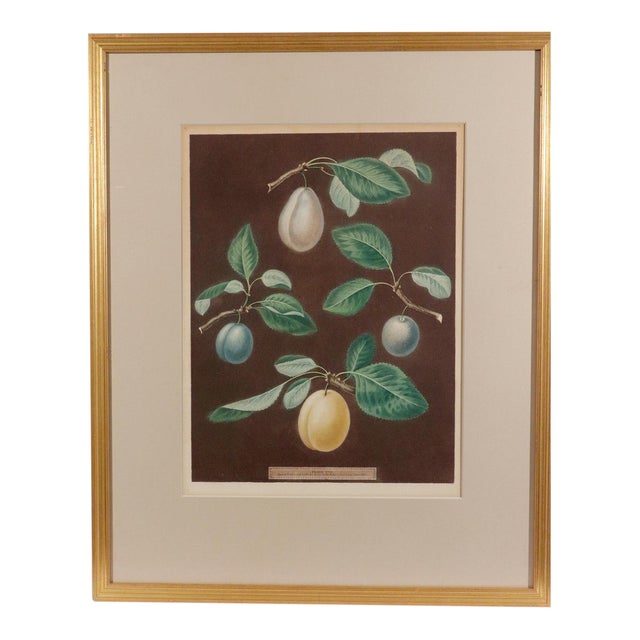
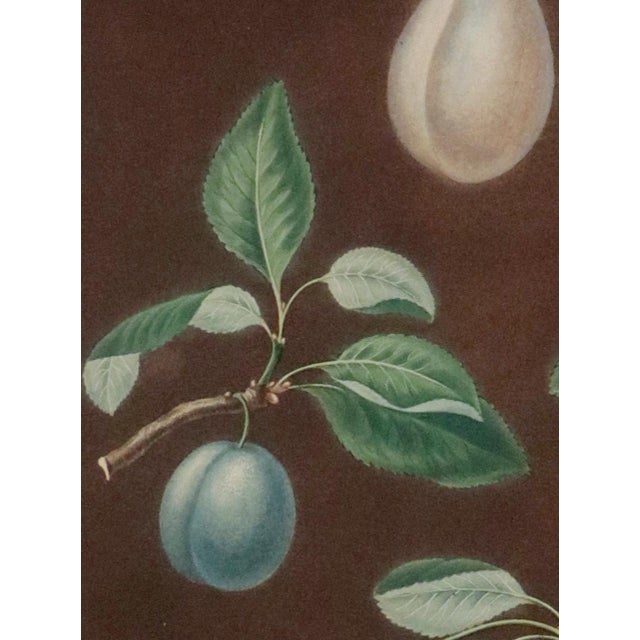
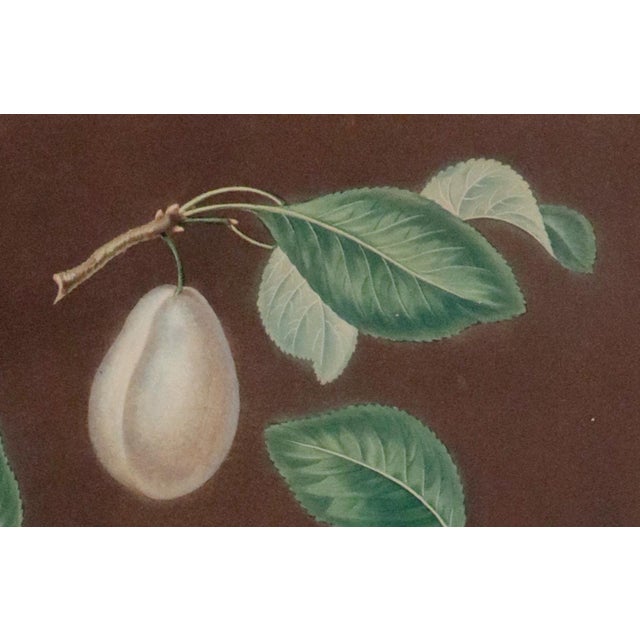
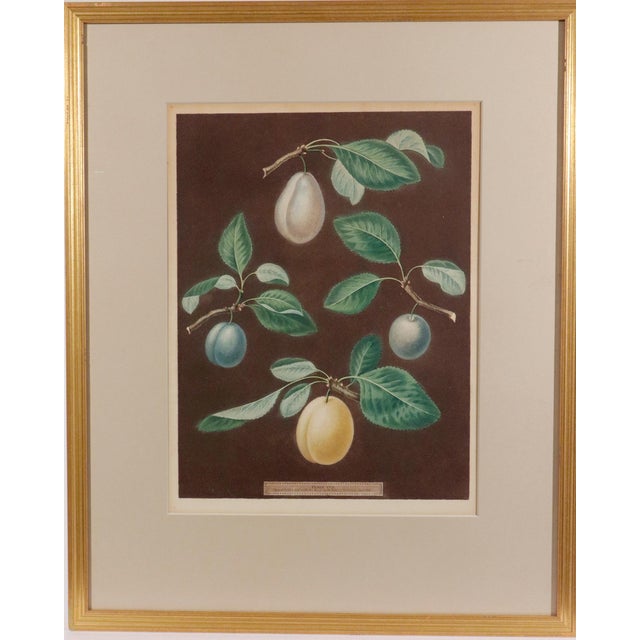
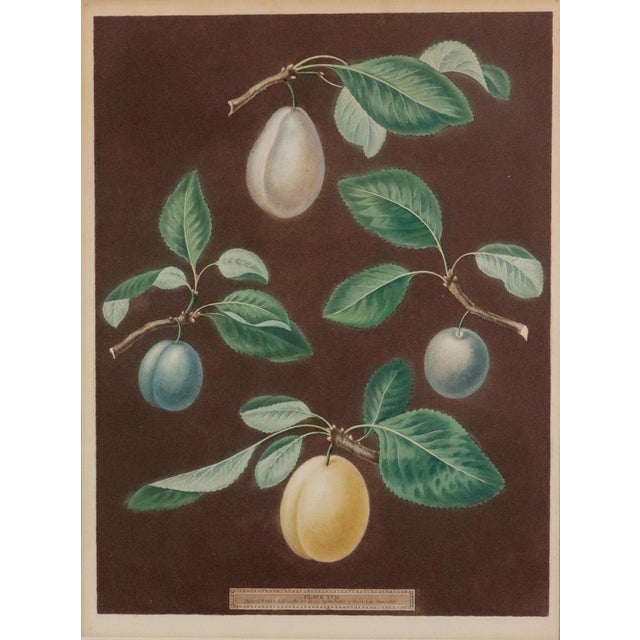
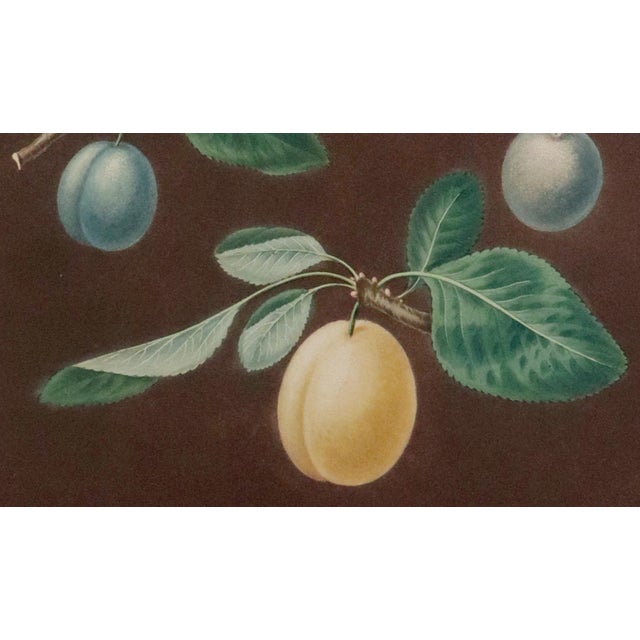
This hand-finished color aquatint of four varieties of plum is Plate XVII of George Brookshaw’s Pomona Britannica, the most sumptuous English fruit book of its period. Brookshaw presents the fruit as he presents every subject in the work, cut from the tree and suspended against a deep brown aquatint ground that throws the color and bloom of the plums into relief. Four short lengths of woody branch, each with a cluster of buds and a spray of finely serrated leaves, carry a single fruit: at the top a large oval plum of pale green and cream with a faint rosy flush, at the left a round plum of deep blue with a silvery bloom, at the right a smaller plum of violet-blue, and at the foot a large golden-yellow plum with a russet blush on its shoulder. The varieties are the Red Magnum Bonum, the Blue Perdrigon, Le Royal and the White Magnum Bonum, as Brookshaw names them in the text of the work.
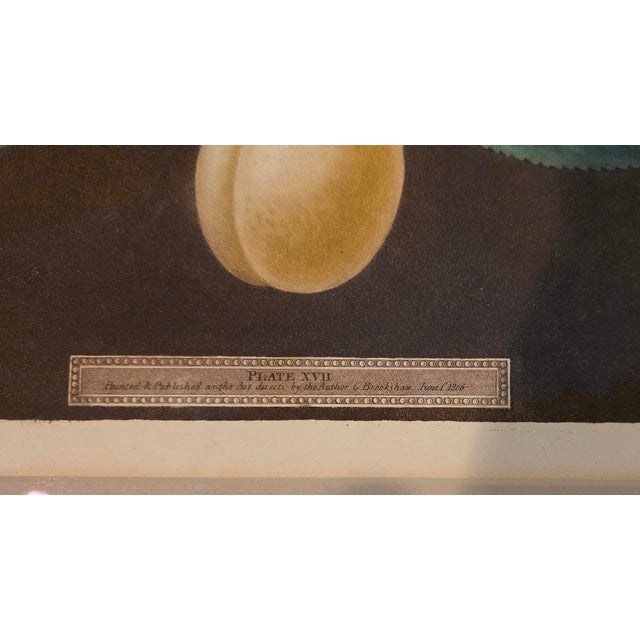
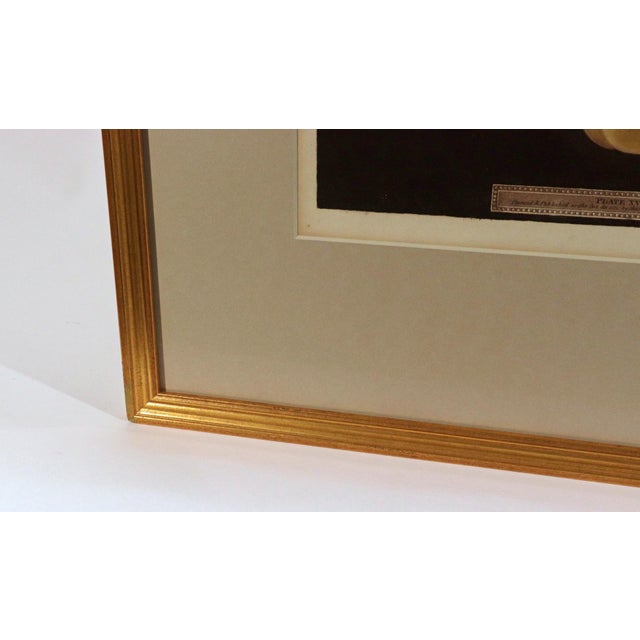
The plate was printed in colors from a single copper plate worked in aquatint with passages of stipple, and then finished by hand in watercolor, which accounts for the soft gradations of the fruit skins and the powdery bloom that Brookshaw was particularly admired for capturing. The lettered label at the foot, framed by a beaded border, reads “PLATE XVII. Painted & Published as the Act directs by the Author G. Brookshaw June 1 1806.” The print is presented in a cream mat within a molded gilt frame.
Framed to the same size as the firm’s other Brookshaw plates, it hangs well alone in a kitchen, breakfast room or dining room, and works equally as part of a group of Pomona fruit, where the shared dark grounds hold a wall together.
Dimensions:
Framed height: 26 1/4 inches (66.7 cm)
Framed width: 21 1/4 inches (54 cm)
Framed depth: 3/4 inch (1.9 cm)
Provenance:
Earle D. Vandekar of Knightsbridge
Condition:
Good
References:
George Brookshaw, Pomona Britannica; or, A Collection of the Most Esteemed Fruits at Present Cultivated in this Country, London, printed by T. Bensley for the author, issued in parts from 1804, completed 1812, Plate XVII.
Cleveland Museum of Art, Pomona Britannica: No. 17 – Plums, 1806, accession number 1955.310, an impression of the same plate.
New York Public Library, Rare Book Division, Red magnum, Blue perdrigon, Le Royal and the White magnum bonum plums, from the Library’s copy of Pomona Britannica.
S. T. Prideaux, Aquatint Engraving: A Chapter in the History of Book Illustration, London, 1909, where the Pomona is called one of the finest color plate books in existence.
Gordon Dunthorne, Flower and Fruit Prints of the 18th and Early 19th Centuries, Washington, 1938, no. 50.
Claus Nissen, Die botanische Buchillustration, Stuttgart, 1951, no. 244.
Sacheverell Sitwell and Wilfrid Blunt, Great Flower Books 1700–1900, revised edition, London, 1990, p. 81.
Historical Context:
George Brookshaw (1751–1823) began his career as a London cabinetmaker, working in the 1780s for a fashionable clientele that is recorded to have included the Prince of Wales, and specializing in painted furniture decorated with borders of flowers and fruit. He disappeared from view in the 1790s, resurfacing under the name G. Brown as the author of A New Treatise on Flower Painting (1797), before returning to his own name with the Pomona Britannica, which he drew, engraved and published himself. Issued in parts from 1804 and completed in 1812, the folio was dedicated to his former patron, by then Prince Regent, and contains ninety plates recording 256 varieties of fifteen fruits, drawn chiefly from the Royal Gardens at Hampton Court and Kensington and from other gardens around London, among them the Princess of Wales’s at Blackheath. It was intended as a practical guide to the best fruit then grown in England, but its scale, its cost and above all its dark aquatint grounds made it a luxury production, and it is the only English botanical book of its generation that is regularly set beside Thornton’s Temple of Flora. Ten of the plates are given to plums and apricots.
(Ref: NY09426-klrr)
See less
- Dimensions
- 21.25ʺW × 0.75ʺD × 26.25ʺH
- Art Subjects
- Botanic
- Frame Type
- Framed
- Period
- Early 19th Century
- Country of Origin
- United Kingdom
- Item Type
- Vintage, Antique or Pre-owned
- Materials
- Aquatint
- Paper
- Condition
- Good Condition, Original Condition Unaltered, Some Imperfections
- Color
- Dark Green
- Condition Notes
- Good condition Good condition less
Questions about the item?
Returns & Cancellations
Return Policy - All sales are final 48 hours after delivery, unless otherwise specified in the description of the product.
Cancellation Policy - Prior to shipping or local pickup, buyers may cancel an order for up to 48 hours, unless otherwise specified.
Related Collections
- Medium-Density Fibreboard Original Prints
- Rattan Original Prints
- Ralph Lauren Original Prints
- Soicher Marin Original Prints
- Rosenthal Original Prints
- Silver Finish Original Prints
- Bunny Williams Home Original Prints
- Dye Transfer Original Prints
- John Kiraly Original Prints
- Original Prints in Panama City, FL
- Original Prints in Salt Lake City
- Original Prints in Lexington, KY
- Sam Francis Original Prints
- Framed Prints
- Botanical Prints
- Bird Prints
- Woodblock Prints
- Screen Prints
- Japanese Woodblock Prints
- Thomas McKnight Original Prints
- Frank Stella Original Prints
- Gustave Baumann Original Prints
- George Barbier Original Prints
- Teak Original Prints
- Robert Kipniss Original Prints