

Details
Description
Johann Wilhelm Weinmann Mezzotint Prints of Aloe Plants in Pots after Ehret, from Phytanthoza Iconographia, Set of Twelve
Circa 1736
…
Read more
Johann Wilhelm Weinmann Mezzotint Prints of Aloe Plants in Pots after Ehret, from Phytanthoza Iconographia, Set of Twelve
Circa 1736
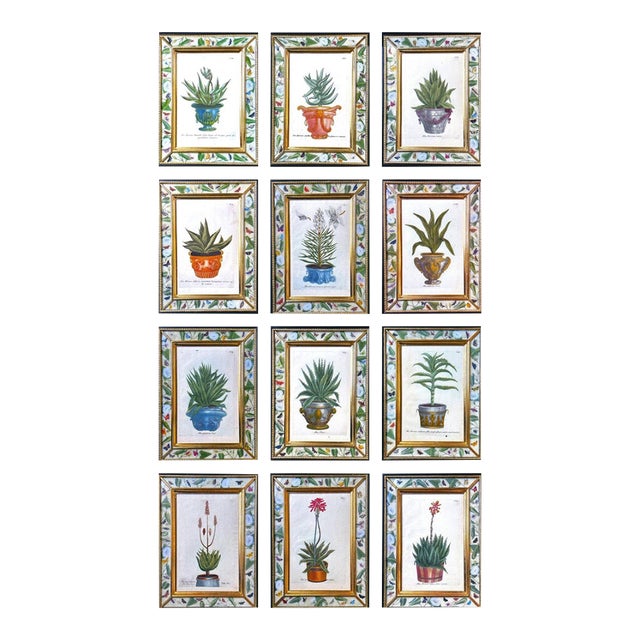
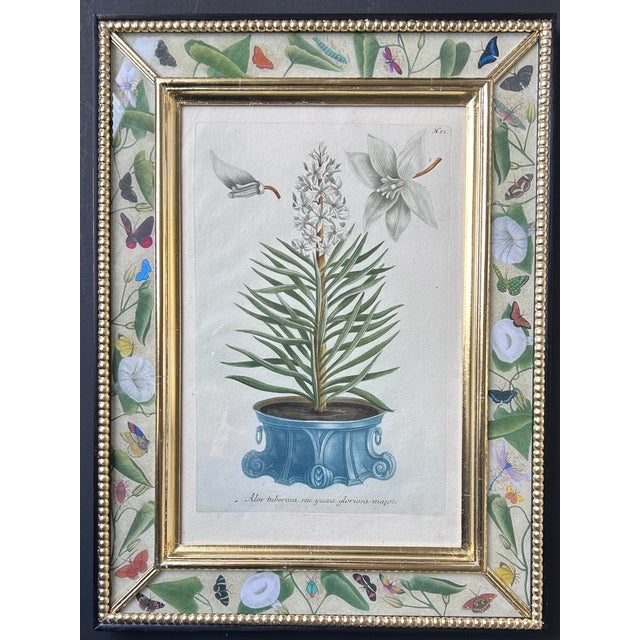
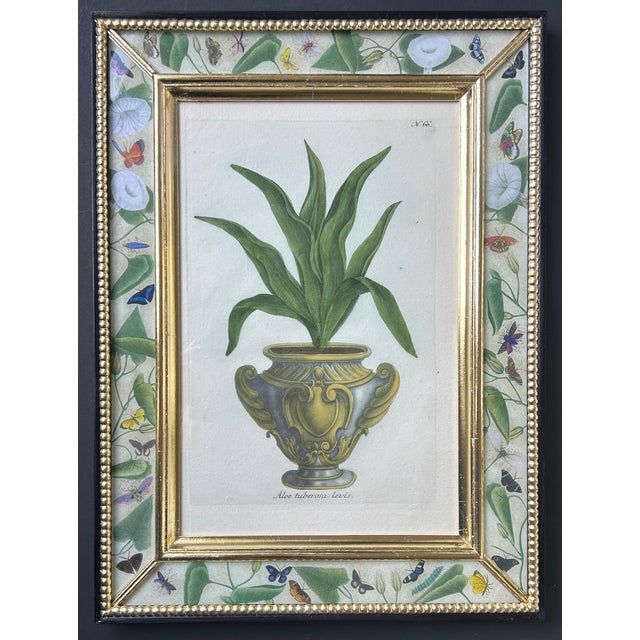
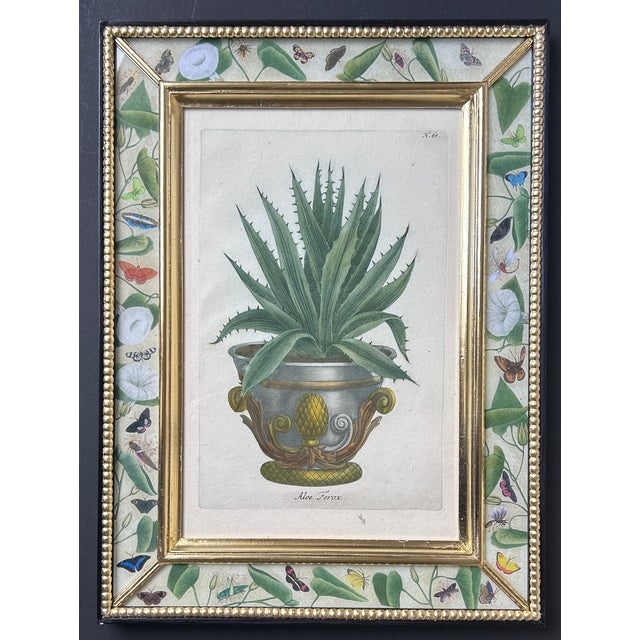
These rare and wonderful mezzotint prints of exotic plants in ceramic and metal pots were engraved after drawings by the young Georg Dionysius Ehret for Johann Wilhelm Weinmann’s florilegium Phytanthoza iconographia, then printed in color and finished by hand.
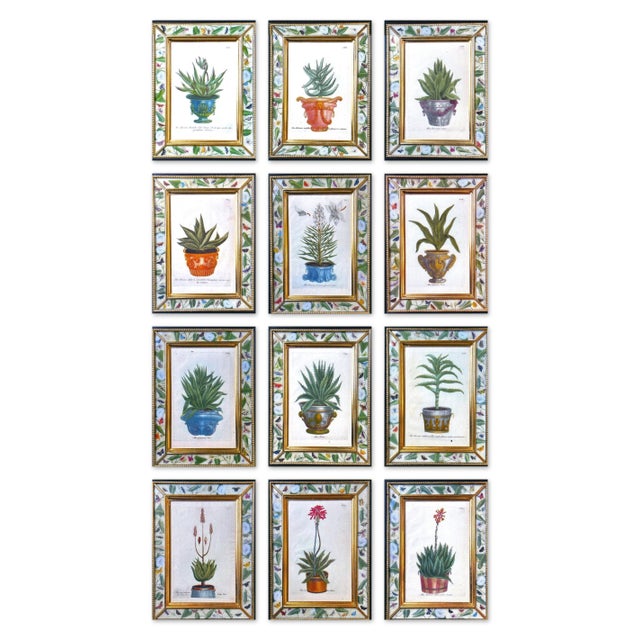
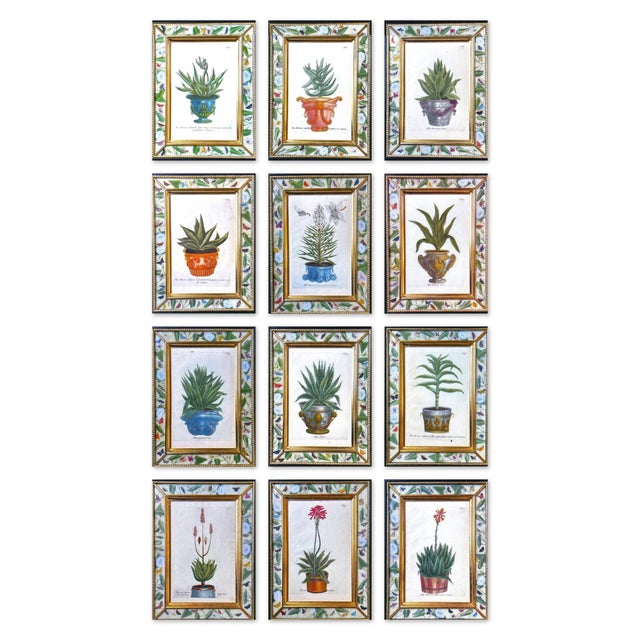
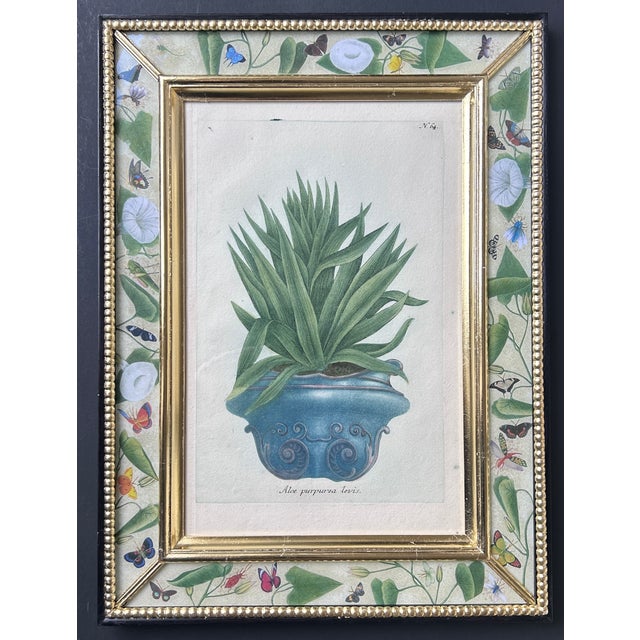
Each plant stands in its own ornamental container, from a blue urn with a scallop shell and lion-mask ring handles and a coral-pink jardinière hung with gilt swags to a silvered urn applied with a gilt pineapple and a coopered tub painted in red and cream stripes, and several are shown in flower. They are named beneath in the pre-Linnaean Latin of the day, when the aloes still took in the American agaves and yuccas, and the names include Aloe Americana minor, Aloe Ferox, Aloe purpurea levis, Aloe tuberosa levis and Aloe vera vulgaris, the last also lettered with its German name, Leber Aloe.
The twelve are now framed within decoupage and églomisé frames scattered with morning glories, butterflies, moths and other insects, between beaded gilt outer moldings and gilt inner slips.
The set comprises plates 42, 47, 49, 52, 55, 59, 60, 61, 63, 64, 73 and 75.
Hung together in a grid of three rows of four, or two rows of six, the set makes a commanding wall in a dining room, library or garden room. The twelve can equally be divided into pairs and groups within one room, flanking a chimneypiece, doorway or pair of windows, where the painted pots and the insect-strewn frames carry the scheme from wall to wall.
Dimensions (each, framed)
Height: 19¼ inches (48.9 cm)
Width: 14½ inches (36.8 cm)
Marks
Each plate numbered at the upper right and titled in Latin beneath the image.
Provenance
Earle D. Vandekar of Knightsbridge
References
Claus Nissen, Die botanische Buchillustration (1951–1966), no. 2126
Gordon Dunthorne, Flower and Fruit Prints of the 18th and Early 19th Centuries (1938), no. 327
Sacheverell Sitwell and Wilfrid Blunt, Great Flower Books 1700–1900 (1990), p. 151
Hunt Botanical Catalogue, vol. II (1961), no. 494
Frans A. Stafleu and Richard S. Cowan, Taxonomic Literature, 2nd edition (TL-2), no. 17050
G. A. Pritzel, Thesaurus Literaturae Botanicae, no. 10140
Wilfrid Blunt and William T. Stearn, The Art of Botanical Illustration, revised edition (1994)
Sotheby’s New York, The Magnificent Botanical Library of D. F. Allen, October 26, 2017, lot 67
The Royal Society, London, MS/668, aloe paintings by Georg Dionysius Ehret and Jacobus van Huysum, 1737
Hunt Institute for Botanical Documentation, “Georg Dionys Ehret (1708–1770)”
Historical Context
Johann Wilhelm Weinmann (1683–1741), a Regensburg apothecary, published Phytanthoza iconographia in four folio volumes between 1737 and 1745, after a preliminary issue of 1734–1735. Its 1,025 numbered plates, arranged alphabetically by plant name with the aloes in the first volume, were engraved in Augsburg by Bartholomäus Seuter, Johann Elias Ridinger and Johann Jakob Haid in a combination of engraving and mezzotint, printed in color and finished by hand, and the Hunt Botanical Catalogue calls it “the first botanical book to use colour-printed mezzotint successfully.”
Georg Dionysius Ehret (1708–1770), the son of a Heidelberg gardener, was a young gardener earning his way with plant drawings when Weinmann engaged him in Regensburg. Poorly paid for the five hundred or so drawings he supplied, Ehret withdrew from the project and is acknowledged nowhere in the book, but his hand is evident throughout it and above all in the aloes and cacti in ornamental pots. Widely regarded as the finest botanical artist of the eighteenth century, he worked with Linnaeus at George Clifford’s estate in Holland in 1736 before settling in London, where the Royal Society, which elected him a Fellow in 1757, holds twenty-two of his paintings of the Chelsea Physic Garden’s aloes, dated 1737.
(Ref: NY11285-lkku-kmr)
See less
- Dimensions
- 14.5ʺW × 1ʺD × 19.25ʺH
- Styles
- Traditional
- Art Subjects
- Botanic
- Frame Type
- Framed
- Designer
- Weinmann
- Period
- Mid 18th Century
- Country of Origin
- Germany
- Item Type
- Vintage, Antique or Pre-owned
- Materials
- Paper
- Condition
- Good Condition, Original Condition Unaltered, Some Imperfections
- Color
- Dark Green
- Condition Notes
- Good condition Good condition less
Questions about the item?
Returns & Cancellations
Return Policy - All sales are final 48 hours after delivery, unless otherwise specified in the description of the product.
Cancellation Policy - Prior to shipping or local pickup, buyers may cancel an order for up to 48 hours, unless otherwise specified.
Related Collections
- Medium-Density Fibreboard Original Prints
- Soicher Marin Original Prints
- Rattan Original Prints
- John Kiraly Original Prints
- Original Prints in Panama City, FL
- Original Prints in Salt Lake City
- Rosenthal Original Prints
- Ralph Lauren Original Prints
- Original Prints in Lexington, KY
- Bunny Williams Home Original Prints
- Silver Finish Original Prints
- Dye Transfer Original Prints
- Sam Francis Original Prints
- Framed Prints
- Botanical Prints
- Bird Prints
- Woodblock Prints
- Screen Prints
- Japanese Woodblock Prints
- Thomas McKnight Original Prints
- George Barbier Original Prints
- Frank Stella Original Prints
- Gustave Baumann Original Prints
- Teak Original Prints
- Chaim Gross Original Prints