

Details
Description
Francisco de Goya y Lucientes. 'El sí pronuncian y la mano alargan al primero que llega' (They Say Yes and …
Read more
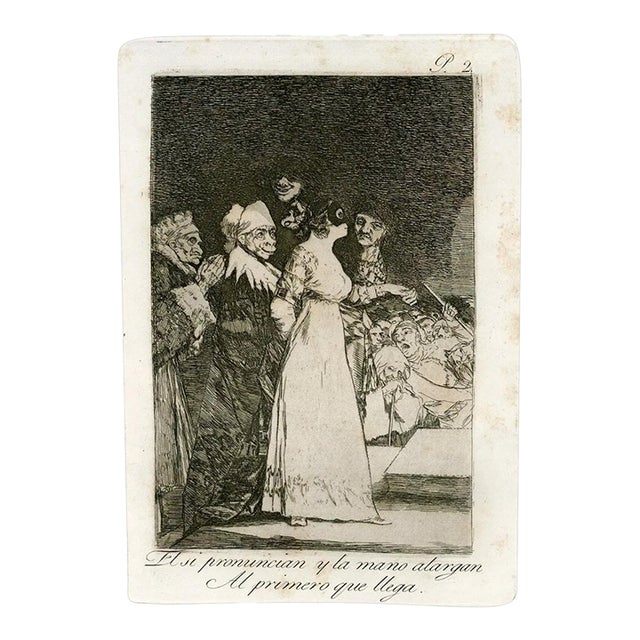
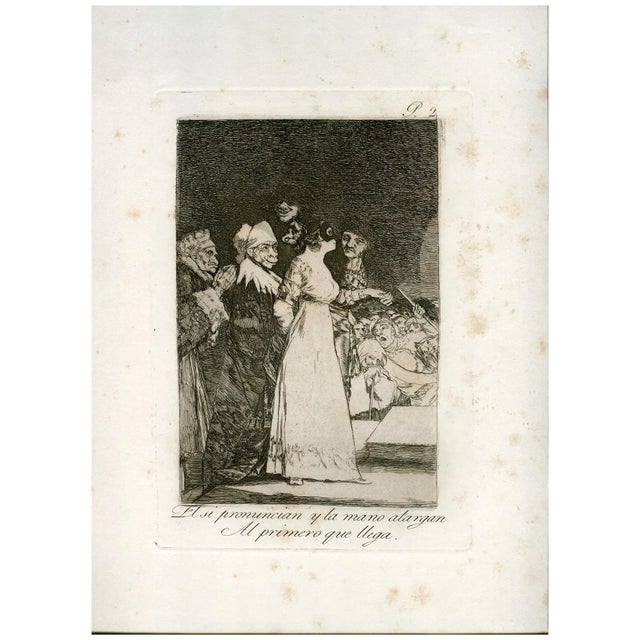
Francisco de Goya y Lucientes. 'El sí pronuncian y la mano alargan al primero que llega' (They Say Yes and Give Their Hand to the First Comer). Plate 2 from Los Caprichos. 5th edition (1881-1886)
This fifth edition of Los Caprichos was printed between 1881 and 1886 in the Calcografía de la Real Academia, stamped in etching and aquatint and with drypoint, in soft sepia ink. The plates were beveled and the binding was done at the top of the prints. The edition consists of 210 copies. Very clean and correct tinted stamping; aquatint allows shadows to be nuanced by creating grayscale gradation and dramatic, haunting lighting. The strong paper used does not have a water mark as usual as Harris catalogs it. The original folder in which the complete collection was presented was made of cream cardboard with the portrait of Goya stamped on the cover and the Title: “Fran.co Goya y Lucientes Pintor”.
'El sí pronuncian y la mano alargan al primero que llega' (Plate 2) is part of The Caprichos. A young woman, her face covered by a mask that only partly disguises a coarser, animal-like visage beneath, gives her hand in marriage to an elderly, evidently wealthy suitor, while a knot of onlookers, some of them themselves masked or beast-faced, look on with amused complicity. Goya is thought to have drawn on contemporary satires, such as Jovellanos's poem 'A Arnesto', which condemned parents who married off their daughters to the first convenient suitor regardless of affection, sacrificing the young woman's happiness for financial security. The mask is the print's central irony: rather than concealing the bride's true feelings, it exposes them, and the plate stands as the series' opening indictment of marriages contracted for interest rather than love.
Plate size: 15x21,5 cm.
Paper size: 26x36,5 cm.
It has rust stains that can be seen in the image.
Los caprichos (The Caprices) is a set of 80 prints in aquatint and etching created by the Spanish artist Francisco Goya in 1797-1798, and published as an album in 1799 (first edition). The prints were an artistic experiment: a medium for Goya's condemnation of the universal follies and foolishness in the Spanish society in which he lived.
Thirteen official editions are known: that of 1799, five in the 19th century, and seven in the 20th century. Being the last one in 1970 carried out by the Royal Academy of Fine Arts of San Fernando
See less
- Dimensions
- 10.24ʺW × 0.1ʺD × 14.37ʺH
- Styles
- Baroque
- Frame Type
- Unframed
- Art Subjects
- Figure
- Period
- Late 19th Century
- Item Type
- Vintage, Antique or Pre-owned
- Materials
- Aquatint
- Etching
- Condition
- Good Condition, Original Condition Unaltered, Some Imperfections
- Color
- Cream
- Condition Notes
- It has rust stains that can be seen in the image. It has rust stains that can be seen in the image. less
Questions about the item?
Returns & Cancellations
Return Policy - All sales are final 48 hours after delivery, unless otherwise specified in the description of the product.
Cancellation Policy - Prior to shipping or local pickup, buyers may cancel an order for up to 48 hours, unless otherwise specified.
Related Collections
- Medium-Density Fibreboard Original Prints
- Rattan Original Prints
- Soicher Marin Original Prints
- Ralph Lauren Original Prints
- Original Prints in Salt Lake City
- Rosenthal Original Prints
- Original Prints in Lexington, KY
- Silver Finish Original Prints
- Bunny Williams Home Original Prints
- Dye Transfer Original Prints
- Original Prints in Panama City, FL
- John Kiraly Original Prints
- Sam Francis Original Prints
- Framed Prints
- Botanical Prints
- Bird Prints
- Woodblock Prints
- Screen Prints
- Japanese Woodblock Prints
- Thomas McKnight Original Prints
- Frank Stella Original Prints
- Gustave Baumann Original Prints
- George Barbier Original Prints
- Teak Original Prints
- Robert Kipniss Original Prints