

Details
Description
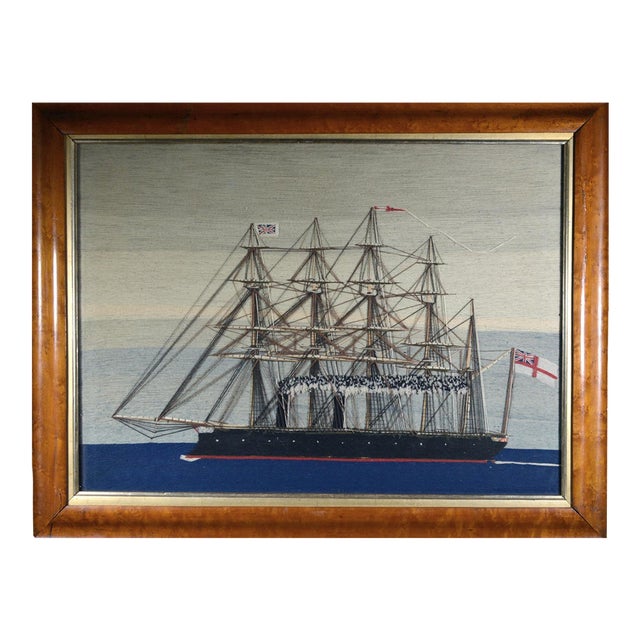
British Sailor’s Woolwork of a Royal Navy Five-Masted Ironclad HMS Minotaur in Her Trials Rig, Minotaur Class
Circa 1865–1868
This …
Read more
British Sailor’s Woolwork of a Royal Navy Five-Masted Ironclad HMS Minotaur in Her Trials Rig, Minotaur Class
Circa 1865–1868
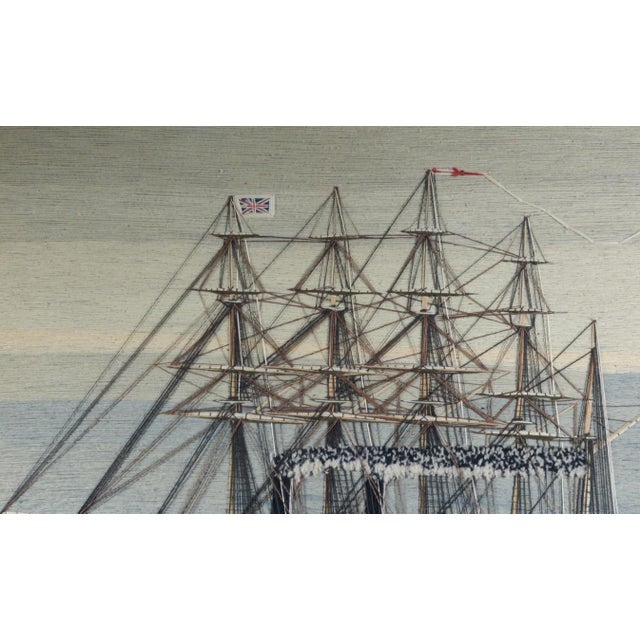
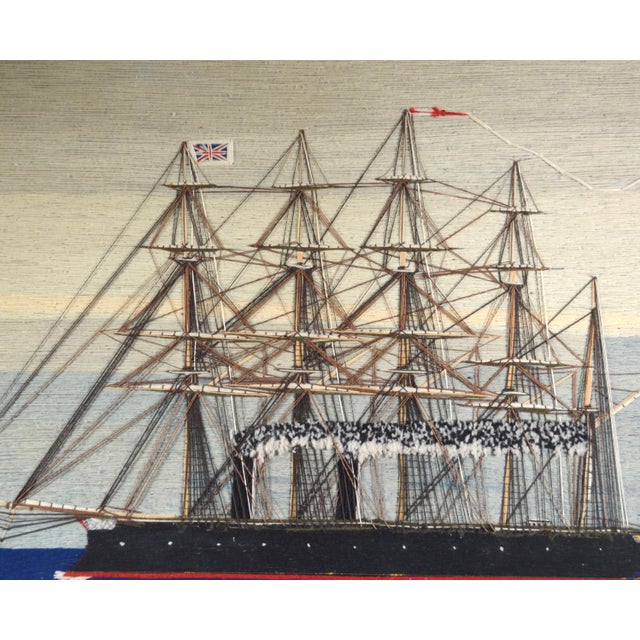
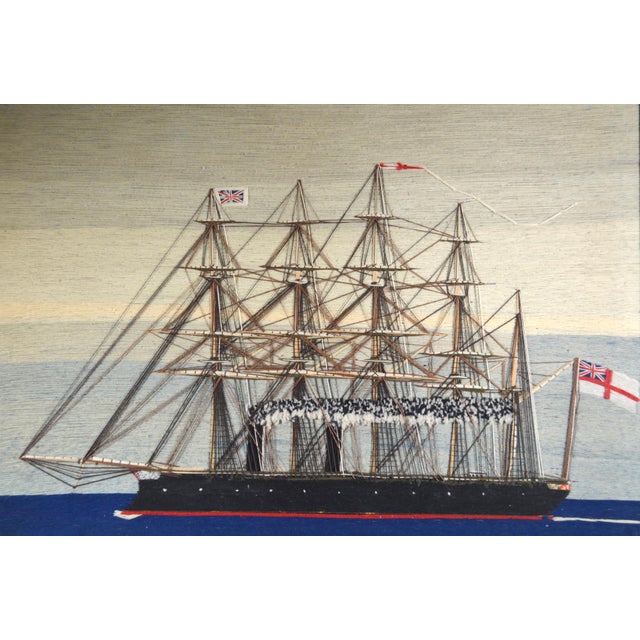
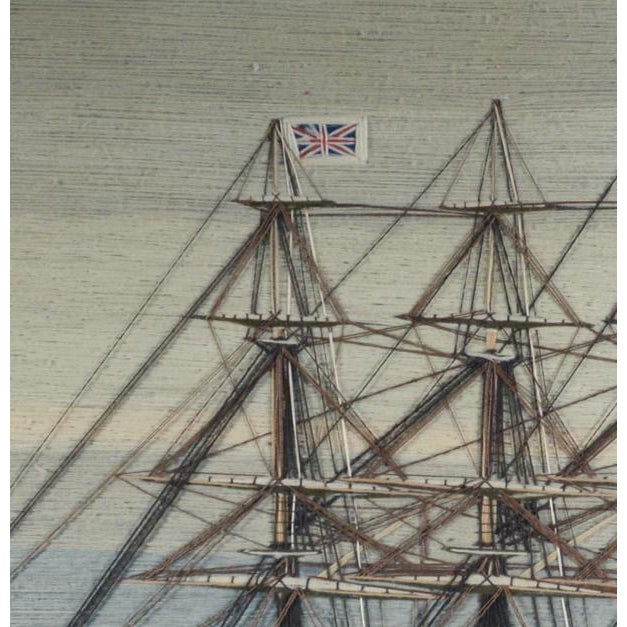
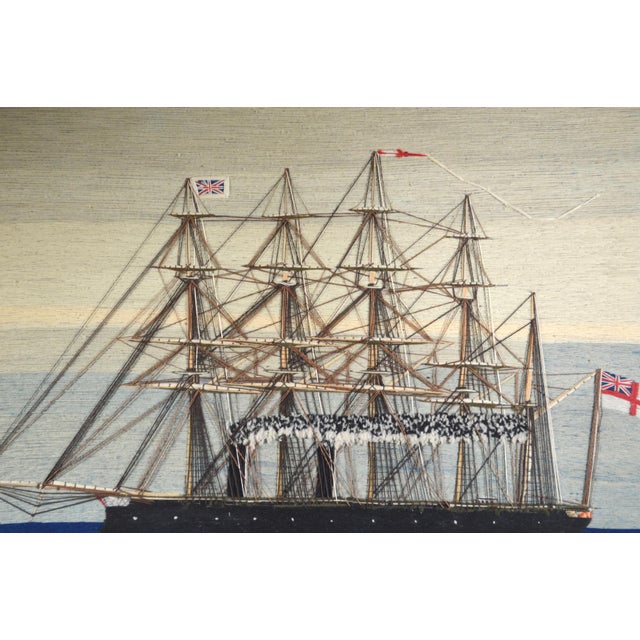
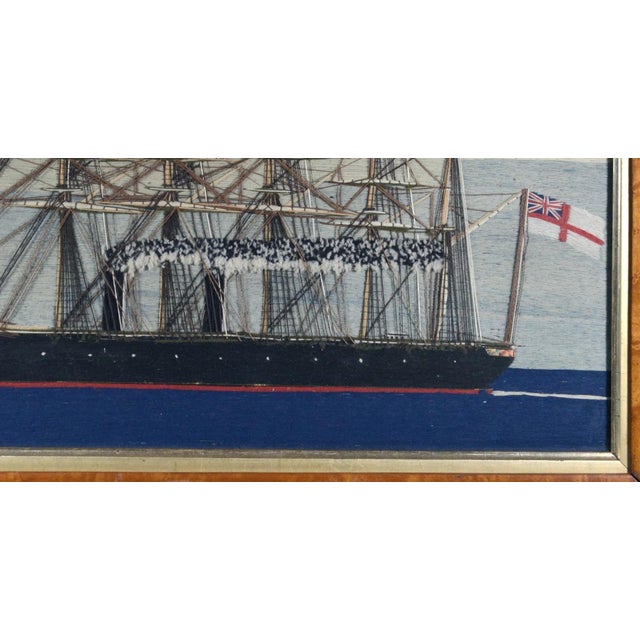
This large and rare British sailor’s woolwork, or “woolie,” presents a port-side view of a five-masted Royal Navy broadside ironclad of the Minotaur class, here identified as HMS Minotaur in the rig with which she was first completed. Five masts were carried by only three ships in the Royal Navy, the armored frigates Minotaur, Agincourt and Northumberland, and the rig makes the class unmistakable. The ship is shown with her sails furled and under steam. The standing and running rigging is laid in long, taut threads of brown, black and white over a sky of horizontal stitches that shade from pale gray-green through cream to blue. The smoke from the two funnels is worked in raised French knots of black and white wool, which stand proud of the surface and drift aft along the length of the ship.
The identification rests on the yards. The maker has crossed square yards on the first four masts and given only the fifth a fore-and-aft rig. Minotaur alone was rigged in this way, and only briefly: she was completed with a square rig on four masts and a spanker on the fifth, but the arrangement proved unsatisfactory in her sea trials and the yards were taken off the fourth mast before she entered regular service in 1867. Agincourt and Northumberland were completed with the altered rig from the outset. A woolwork showing four square-rigged masts therefore records Minotaur as she appeared during her trials, and the picture is dated accordingly.
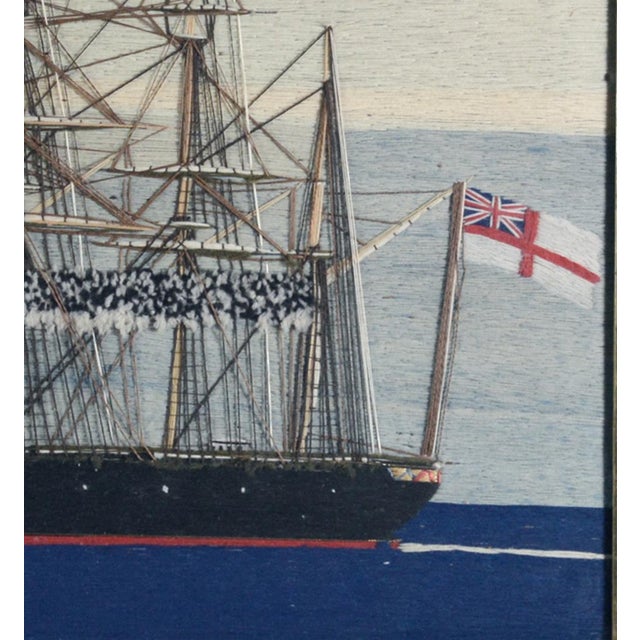
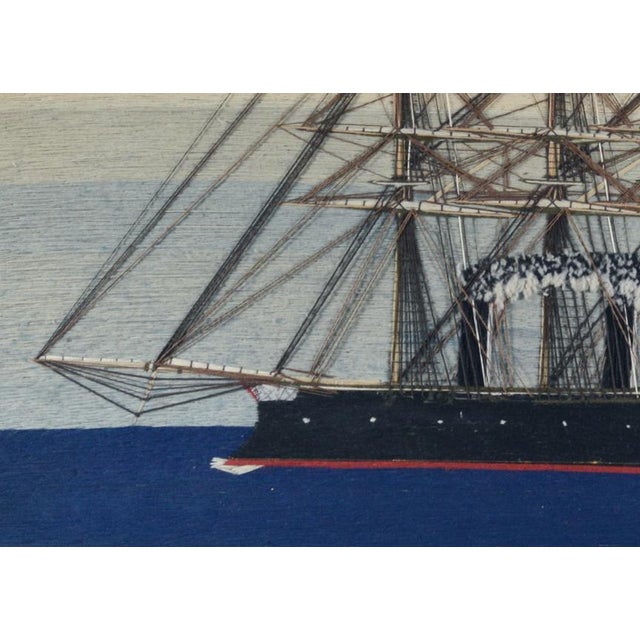
She is underway on a deep blue sea, with a fleck of white at the foot of her ram bow and a white wake drawn out astern. The black hull is pierced by a row of white ports and finished with a red line at the waterline, and there are touches of colored wool at the bow and stern. Three flags identify her as a ship of the Royal Navy: the Union Flag at the fore masthead, the long masthead pennant with its red St. George’s cross streaming from the main, and the White Ensign at the stern, worn by all ships of the Royal Navy from 1864. The picture is in a bird’s-eye maple frame with a gilt slip. The scale of the work and the care taken over the rig suggest a maker who knew these ships at first hand, whether he worked the picture aboard or ashore.
At nearly thirty inches wide, the picture has the presence to hang alone above a mantel, console or desk. It suits a library, study or coastal interior, and sits well within a group of maritime pictures.
Dimensions
Height: 22½ inches (57.2 cm)
Width: 29½ inches (74.9 cm)
Depth: 1¾ inches (4.4 cm)
Provenance: Private maritime collection.
Condition: The woolwork is in good antique condition, with strong color retention in the blues and reds. The original frame shows minor surface wear consistent with its age.
References
Oscar Parkes, British Battleships, “Warrior” 1860 to “Vanguard” 1950: A History of Design, Construction and Armament (new and revised edition, Naval Institute Press, 1990), pp. 60–63.
G. A. Ballard, The Black Battlefleet (Naval Institute Press, 1980).
John Roberts, “Great Britain,” in Conway’s All the World’s Fighting Ships 1860–1905 (1979), p. 10.
Harper’s Weekly, 1866, engraving of HMS Minotaur showing the ship with square rig on her first four masts (reproduced by the Naval History and Heritage Command, Washington, Online Library of Selected Images).
Historical Context
The Minotaur class, comprising Minotaur, Agincourt and Northumberland, was the last and largest of the first generation of British broadside ironclads that began with HMS Warrior in 1860. Launched between 1863 and 1866 and entering service in 1867–1868, the ships were 407 feet long overall, the longest single-screw warships ever built, and it was this great length of hull that called for a sail plan spread over five masts, named fore, second, main, fourth and mizzen. The rig was more impressive than effective. The ships made only nine or ten knots under sail, and Admiral G. A. Ballard wrote that “no ships ever carried so much dress to so little purpose.” They were nonetheless steady sea boats and were much used as flagships.
Minotaur, launched at Blackwall in December 1863, spent nearly four years between launch and commissioning while she was used to evaluate her armament and a succession of sailing rigs. She was first completed with square yards on four masts and a spanker on the fifth, but the yards were removed from the fourth mast after her trials, and it was in that altered rig that she commissioned in April 1867 as flagship of the Channel Squadron, a position she held for most of the next twenty years, including at Queen Victoria’s Golden Jubilee Review at Spithead on July 23, 1887. Woolworks of the class are scarce, and one that records the short-lived trials rig is scarcer still.
(Ref: NY9611-umrx)
See less
- Dimensions
- 29.5ʺW × 1.75ʺD × 22.5ʺH
- Period
- Mid 19th Century
- Country of Origin
- United Kingdom
- Item Type
- Vintage, Antique or Pre-owned
- Materials
- Maple
- Wool
- Condition
- Good Condition, Original Condition Unaltered, Some Imperfections
- Color
- Blue
- Condition Notes
- Good Good less
Questions about the item?
Returns & Cancellations
Return Policy - All sales are final 48 hours after delivery, unless otherwise specified in the description of the product.
Cancellation Policy - Prior to shipping or local pickup, buyers may cancel an order for up to 48 hours, unless otherwise specified.
Related Collections
- Loloi Rugs Textile Art
- Louis XIII Textile Art
- Resin Textile Art
- Workaday Handmade Textile Art
- Antique Gold Finish Textile Art
- Kenneth Ludwig Chicago Textile Art
- Chanel Textile Art
- Mid-Century Modern Textile Art
- Chinese Textile Art
- Japanese Textile Art
- Tapestry
- Framed Scarves
- Scandinavian Textile Art
- Aubusson Tapestry
- Edwardian Textile Art
- Cardboard Textile Art
- Märta Måås-Fjetterström Textile Art
- Ralph Lauren Textile Art
- Surrealism Textile Art
- Space Age Textile Art
- Pablo Picasso Textile Art