

Details
Description
French Marble-Top Guéridon in the Manner of Adam Weisweiler, Louis XVI Style
An exceptionally elegant French marble-top guéridon in the …
Read more
French Marble-Top Guéridon in the Manner of Adam Weisweiler, Louis XVI Style
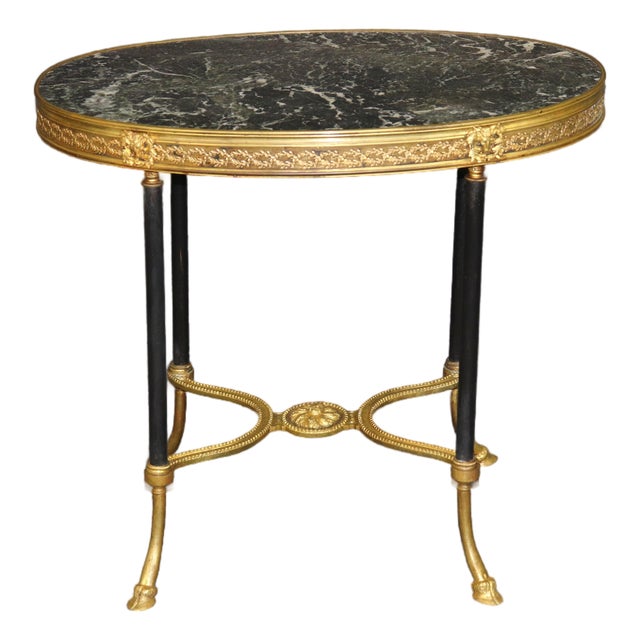
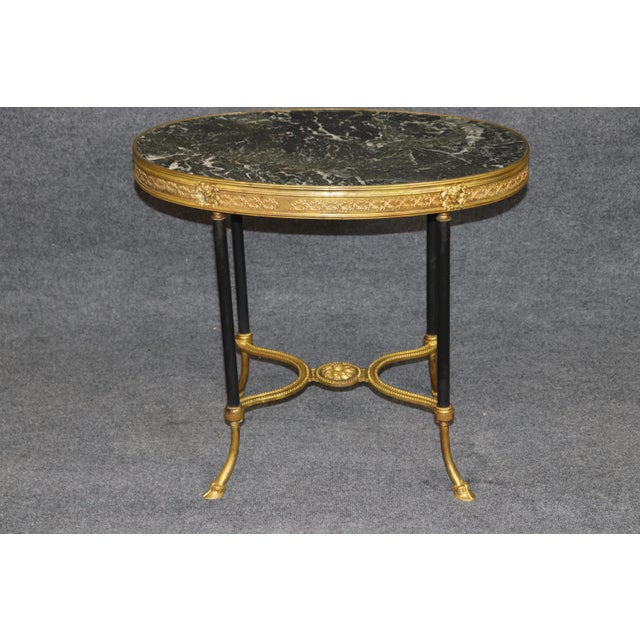
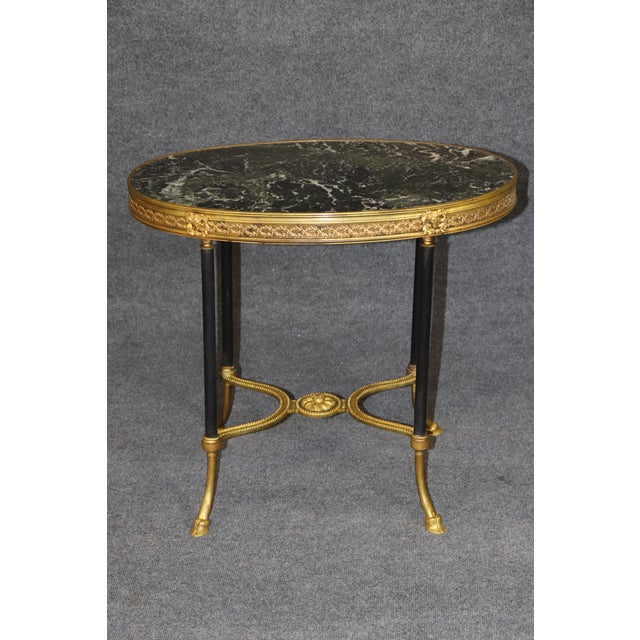
An exceptionally elegant French marble-top guéridon in the manner of Adam Weisweiler, conceived in the refined neoclassical taste associated with the celebrated Parisian cabinetmaker. Although sometimes broadly described as Louis XV in period-inspired interiors, the table’s restrained symmetry, columnar supports, classical ornament and interlaced stretcher place its design vocabulary more specifically within the Louis XVI and Neoclassical tradition for which Weisweiler became renowned.
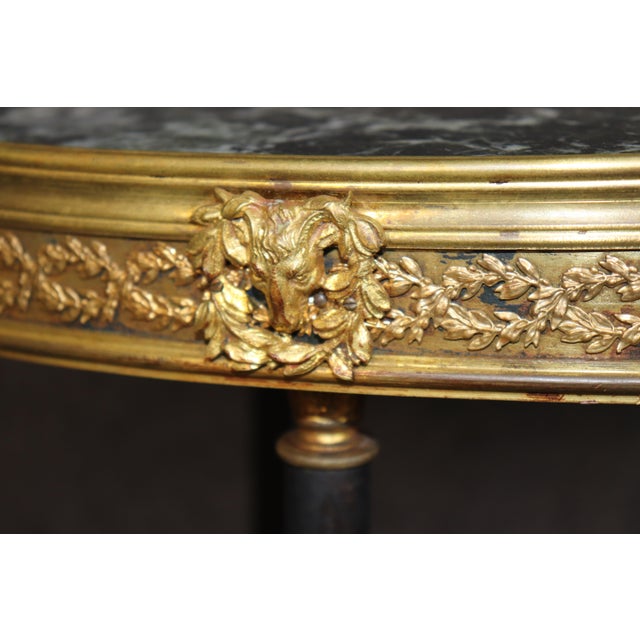
The table is surmounted by a beautifully figured circular dark marble top, dramatically veined in contrasting shades of white and pale gray. The stone provides a sophisticated visual counterpoint to the brilliant gilt-metal or gilt-bronze ornament beneath. Its generous circular form makes the table suitable as a center, occasional, lamp or salon table while retaining the delicacy and lightness characteristic of French luxury furniture.
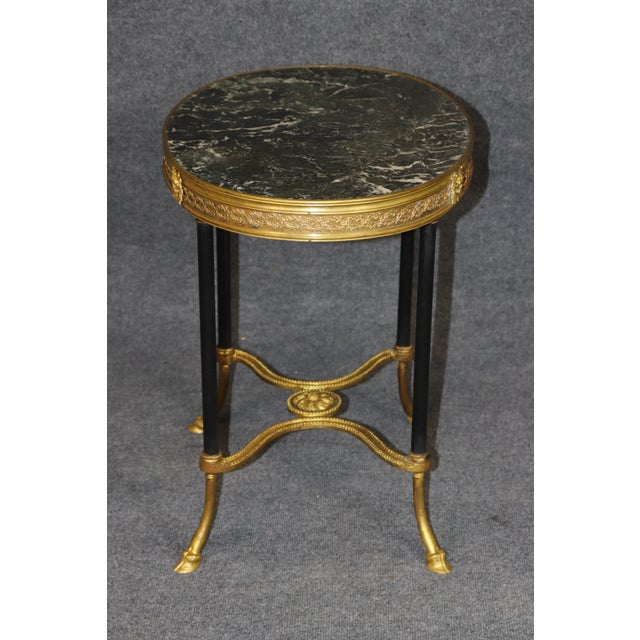
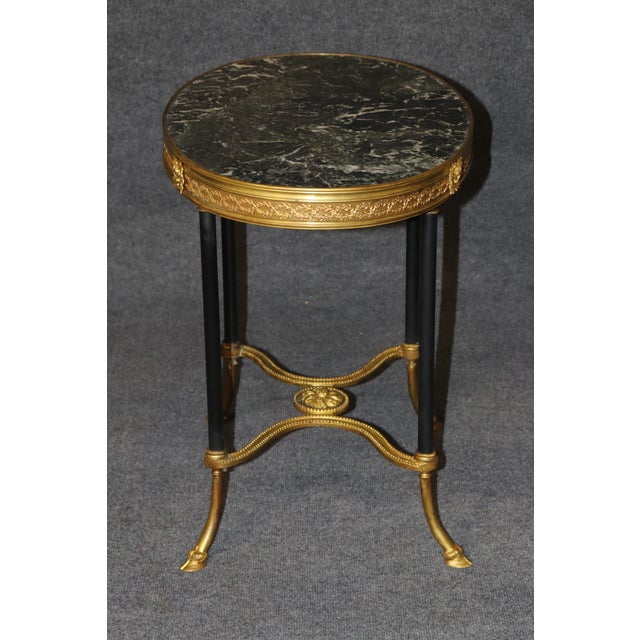
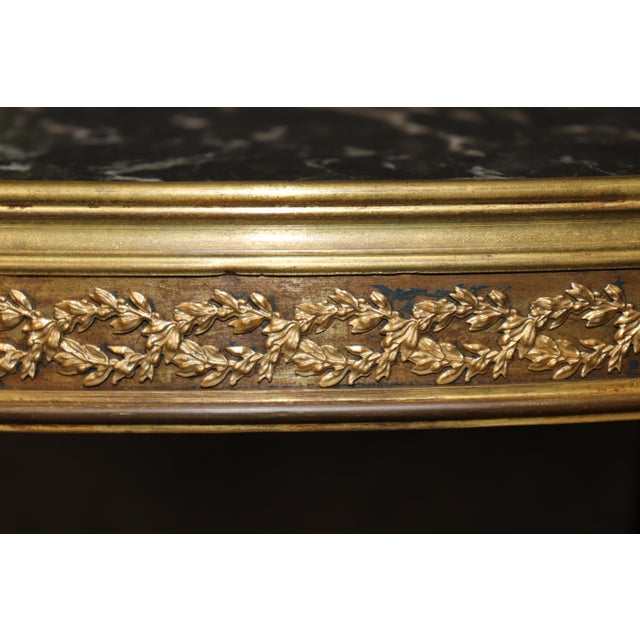
Encircling the marble is an elaborate gilt-bronze gallery and frieze, one of the most striking features of the piece. The border is richly decorated with a continuous classical garland of foliage and flowers, punctuated at intervals by more pronounced floral or foliate mounts. The crisp gilded ornament creates the appearance of a jeweled band surrounding the dark marble and establishes the luxurious character of the table immediately.
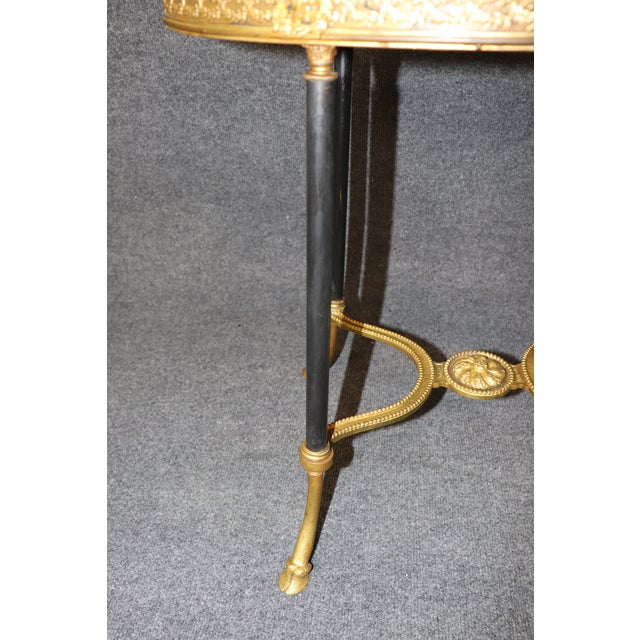
Supporting the top are four exceptionally slender dark columnar legs, their near-black finish producing a dramatic contrast with the gilt-bronze details. Each column is capped and footed with gilt mounts, recalling the architectural vocabulary of antiquity. The deliberate combination of dark vertical supports and brilliant gilded ornament is particularly evocative of late eighteenth-century French neoclassicism.
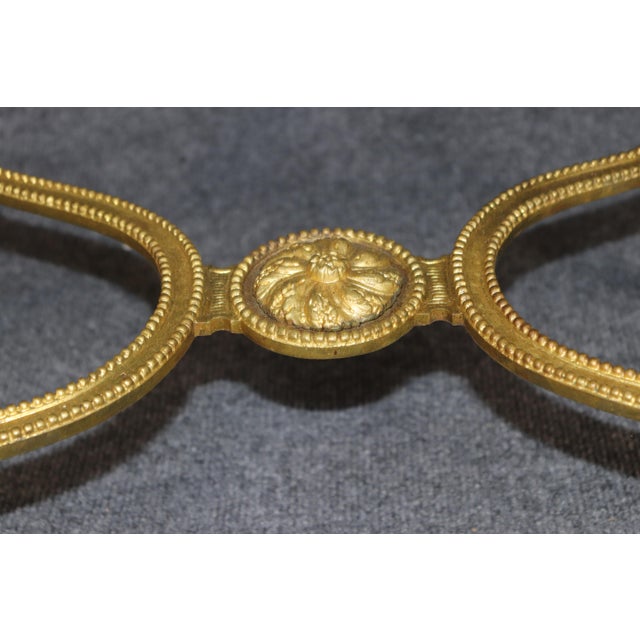
The lower portion is especially characteristic of furniture inspired by Adam Weisweiler. The four legs are united by an elaborate interlacing gilt-bronze stretcher, its curving elements forming a symmetrical arrangement around a central oval medallion. Beaded borders emphasize the flowing outline, while the central ornament introduces a classical focal point. Interlaced stretchers are documented as a characteristic feature of Weisweiler's work, appearing on important surviving examples attributed to his Paris workshop. The Metropolitan Museum of Art
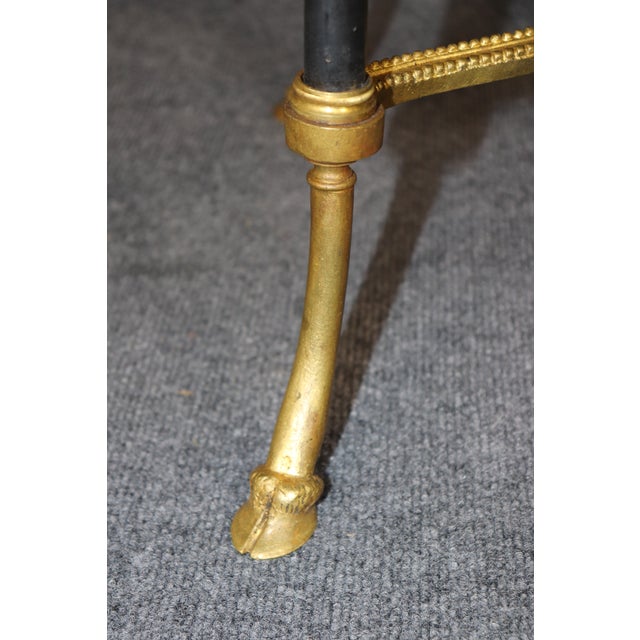
Below the stretcher, the supports continue into slender outward-curving legs terminating in small hoof-like or stylized classical feet. Their delicate construction gives the table an almost weightless quality despite the substantial marble top. This carefully controlled contrast between structural lightness and luxurious materials was fundamental to the most sophisticated French furniture of the Louis XVI period.
The table is particularly successful in its use of contrasting materials. The cool, richly veined marble, dark supports and warm gilded metal create three distinct visual layers. Rather than relying upon elaborate marquetry, the design achieves its richness through proportion, metalwork and architectural construction. This approach closely reflects the aesthetic associated with Weisweiler, whose documented furniture frequently combined exotic veneers or lacquer with marble and finely executed gilt-bronze mounts. The Metropolitan Museum of Art
Adam Weisweiler
Adam Weisweiler (1744–1820) was one of the distinguished cabinetmakers working in Paris during the final decades of the eighteenth century. German-born, he established himself in Paris and was admitted as a maître-ébéniste, or master cabinetmaker, in 1778, subsequently operating from the important furniture-making district of the Faubourg Saint-Antoine. The Metropolitan Museum of Art
Weisweiler specialized in exceptionally refined luxury furniture. Rather than dealing primarily and directly with his eventual clientele, he worked extensively through the powerful marchands-merciers, the fashionable merchant-dealers who commissioned and coordinated some of the most luxurious decorative objects produced in Paris. He was particularly associated with Dominique Daguerre, who supplied Weisweiler's sophisticated neoclassical furniture to an international clientele. The Metropolitan Museum of Art
His furniture is celebrated for its elegant proportions and sophisticated combinations of materials. Surviving pieces incorporate mahogany, ebony, thuya and other veneers, Japanese and French lacquer, marble, Sèvres porcelain and exceptionally fine gilt-bronze mounts. A circa-1790 table attributed to Weisweiler in the Metropolitan Museum of Art, for example, combines ebony veneer, Japanese lacquer, gilt bronze and verde antico marble and features tapered legs joined by an interlacing stretcher. The Metropolitan Museum of Art
Weisweiler's work was produced for the highest levels of European society, and examples associated with his workshop entered important royal and aristocratic interiors. His furniture supplied through Daguerre included pieces made for Ferdinand IV's royal palace at Caserta, illustrating the international reach of Parisian luxury furniture during the closing years of the ancien régime. The Metropolitan Museum of Art
The present table should therefore be described carefully as “in the manner of Adam Weisweiler” rather than as a work by Weisweiler himself unless documentary evidence, a recognizable stamp or further examination establishes such an attribution. Its design nevertheless draws strongly upon the vocabulary associated with his celebrated furniture: slender architectural supports, contrasting dark and gilded surfaces, a marble top, finely detailed metal mounts and, most significantly, the graceful interlaced stretcher.
The result is an unusually sophisticated French guéridon with considerable decorative presence. Its richly veined dark marble top, elaborate gilt-bronze floral frieze, slender dark columns and beautifully composed interlacing stretcher create an elegant balance between luxury and restraint. Whether placed beside a sofa, between a pair of chairs, beneath a mirror or used as a central accent table, it embodies the refined neoclassical taste that made Weisweiler's designs among the most recognizable achievements of late eighteenth-century French cabinetmaking.
Dimensions: 23.25 inches high x 26 inches wide x 16.75 inches deep
See less
- Dimensions
- 26ʺW × 16.75ʺD × 23.25ʺH
- Styles
- Louis XVI
- Table Shape
- Oval
- Period
- 1940s
- Country of Origin
- France
- Item Type
- Vintage, Antique or Pre-owned
- Materials
- Bronze
- Marble
- Condition
- Good Condition, Original Condition Unaltered, Some Imperfections
- Color
- Brown
- Condition Notes
- The piece is in good antique/vintage condition with the exception of some light surface scratches, Minor finish loss and normal … moreThe piece is in good antique/vintage condition with the exception of some light surface scratches, Minor finish loss and normal age related wear. As to be expected with items of age and use. less
Questions about the item?
Returns & Cancellations
Return Policy - All sales are final 48 hours after delivery, unless otherwise specified in the description of the product.
Cancellation Policy - Prior to shipping or local pickup, buyers may cancel an order for up to 48 hours, unless otherwise specified.
Related Collections
- Mid-Century Modern Walnut Side Tables
- Fine Arts Furniture Co. Side Tables
- Charles Limbert Side Tables
- Hans Olsen Side Tables
- Edmond J. Spence Side Tables
- Pierre Guariche Side Tables
- Black African Side Tables
- R. J. Horner and Co. Side Tables
- Palladio Side Tables
- Fiber Concrete Side Tables
- Jorge Zalszupin Side Tables
- Hermès Side Tables
- Guillerme et Chambron Side Tables
- Leighton Hall Furniture Side Tables
- Hemp Side Tables
- Romweber Side Tables
- Otto Wagner Side Tables
- Pistachio Side Tables
- Vatne Møbler Side Tables
- Polyester Side Tables
- Concrete Side Tables in Los Angeles
- Chrome Glass Side Tables
- Black Asian Side Tables
- Mid-Century Modern Teak Side Tables
- Black Side Tables in Los Angeles