

Details
Description
Italian Rococo-Style Olive Wood Secretary Desk, Late 19th/Early 20th Century
A remarkably decorative Italian olive wood secretary desk, dating from …
Read more
Italian Rococo-Style Olive Wood Secretary Desk, Late 19th/Early 20th Century
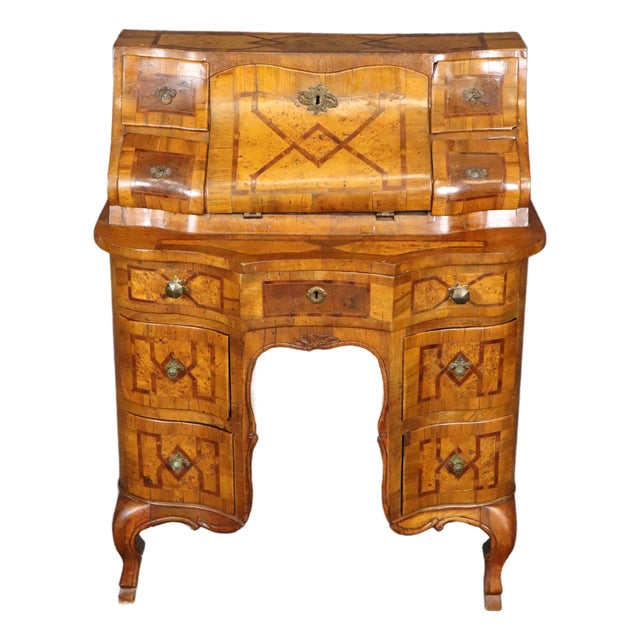
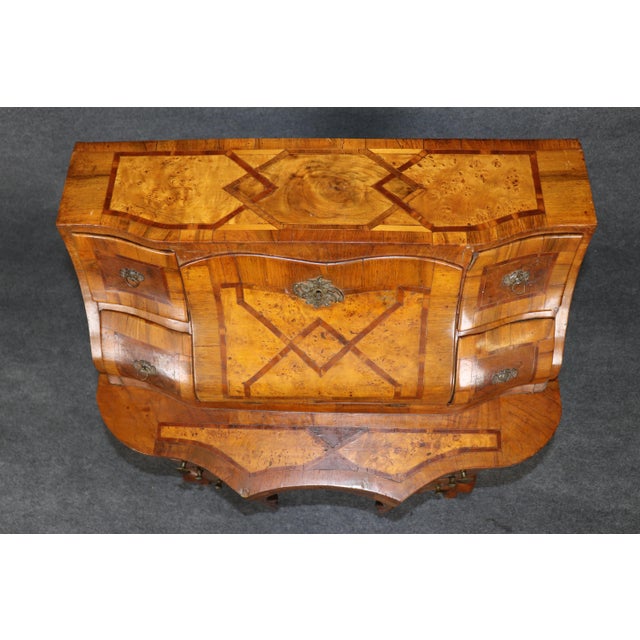
A remarkably decorative Italian olive wood secretary desk, dating from the late nineteenth to early twentieth century, conceived in an exuberant Rococo-inspired form and distinguished by an extensive program of geometric marquetry and contrasting veneers. Compact in scale yet extraordinarily rich in visual detail, this unusual writing desk combines the warmth and distinctive figuring of olive wood with the curvilinear forms and playful asymmetry associated with the Italian interpretation of eighteenth-century Rococo furniture.
The secretary is constructed in two principal sections, with an elevated writing cabinet resting above a serpentine-fronted desk and storage section. Throughout the piece, the cabinetmaker has made exceptional decorative use of the natural color and grain of the timber. Olive wood, prized for its warm golden and amber tones and often dramatic figuring, provides much of the visual character. Contrasting darker woods have been carefully introduced as borders, geometric bands and marquetry details, producing a sophisticated patchwork of honey, caramel, reddish-brown and golden hues.
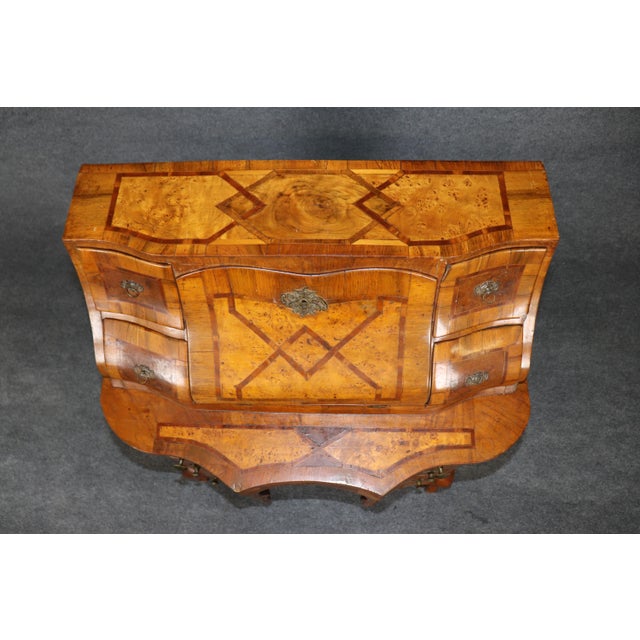
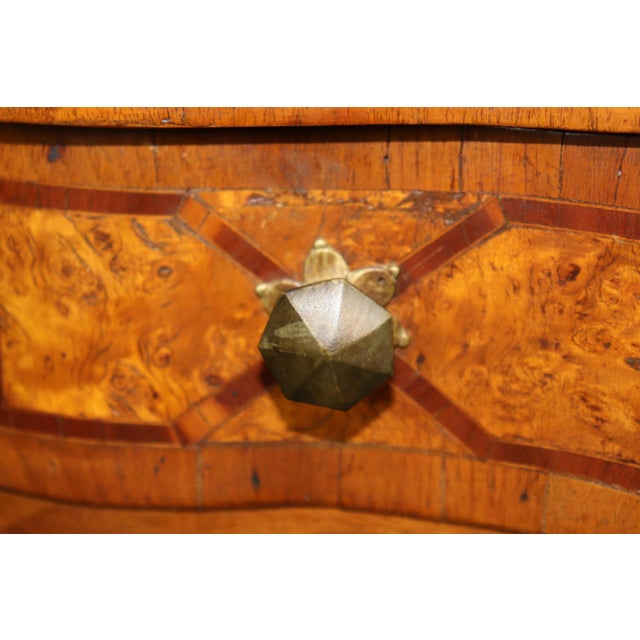
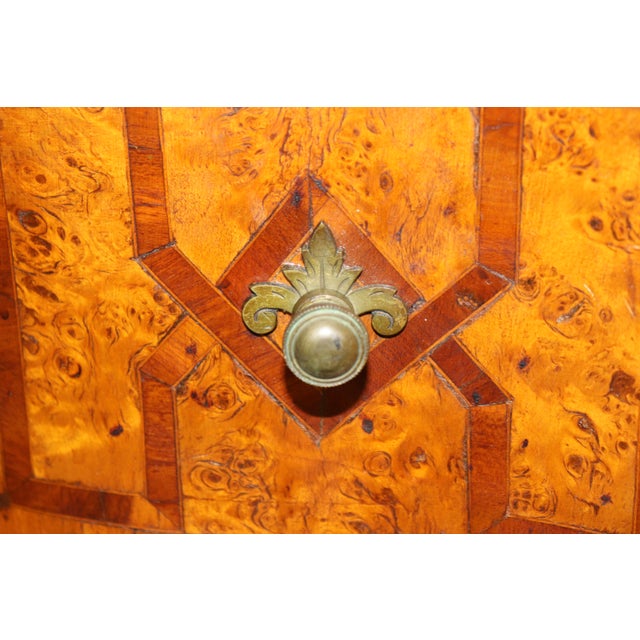
The upper section is particularly striking. At its center is a broad fall-front writing compartment, its gently shaped upper edge following the flowing Rococo outline of the cabinet. The fall is decorated with an elaborate geometric marquetry composition centered upon a richly figured panel. Angular bands of contrasting veneer create a series of interlocking diamond and ribbon-like motifs, demonstrating the cabinetmaker's considerable skill in cutting and arranging veneers.
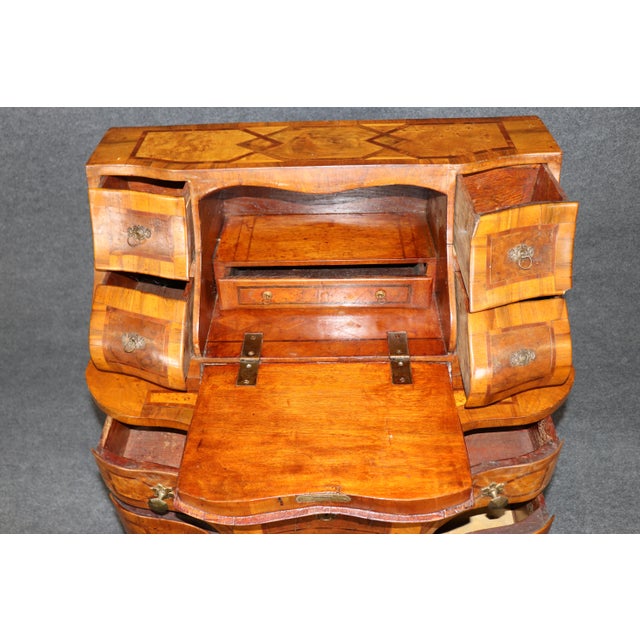
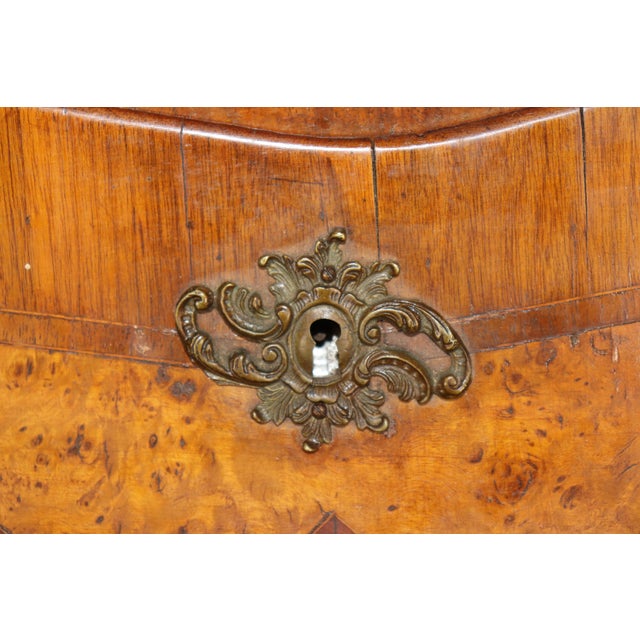
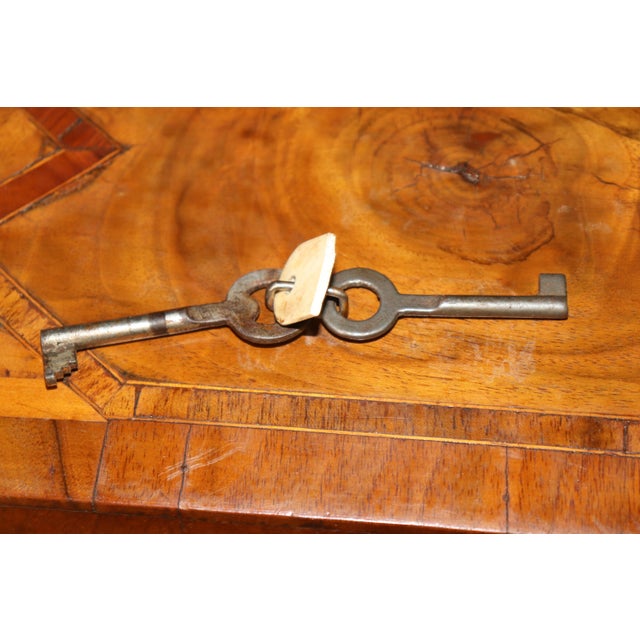
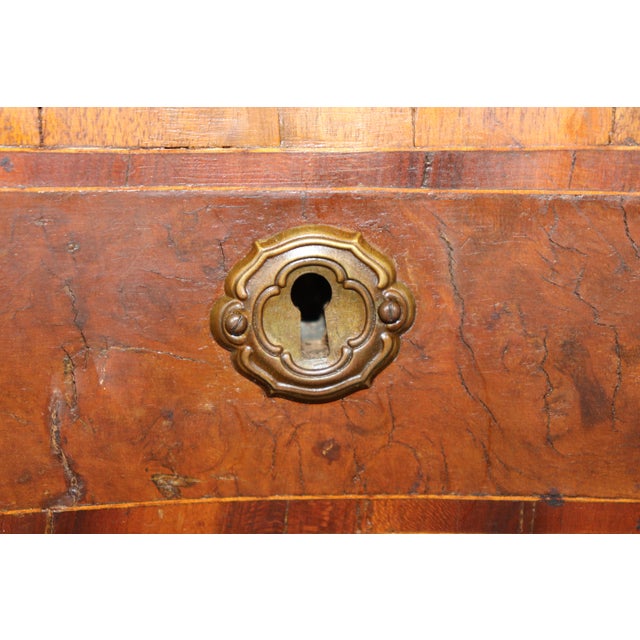
A decorative brass escutcheon marks the central lock. When lowered, the fall would provide a convenient writing surface while revealing the fitted interior of the secretary. This dual-purpose construction allowed such furniture to serve as both a handsome cabinet and a private writing station.
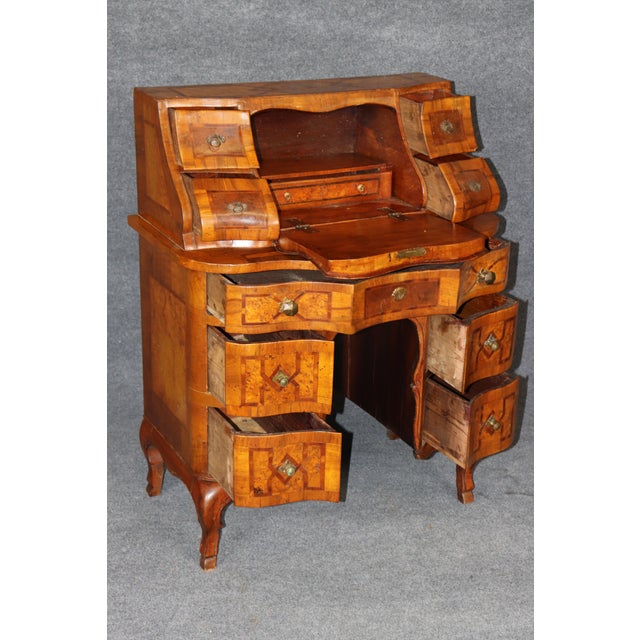
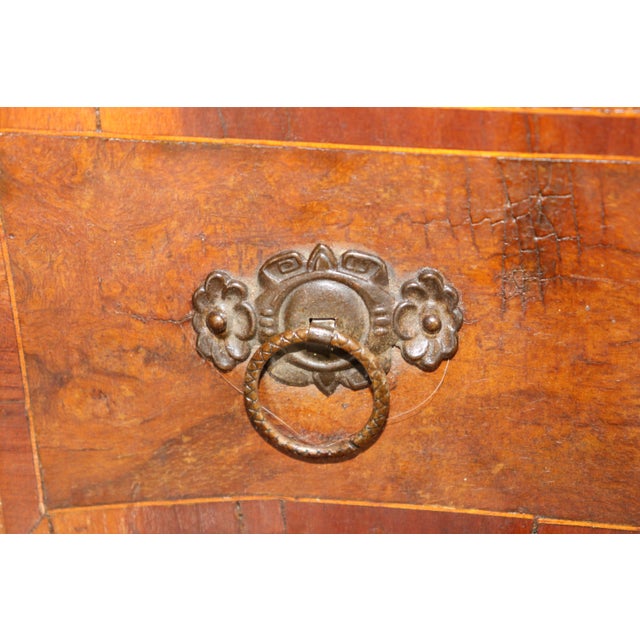
Flanking the fall front are four small drawers, arranged two to either side. Their subtly bowed fronts contribute greatly to the sculptural quality of the upper cabinet. Each drawer is individually decorated with contrasting veneers and fitted with period-style metal hardware. The combination of convex and concave surfaces prevents the façade from appearing static, allowing light to move continually across both the polished timber and the marquetry.
The lower portion continues this sophisticated treatment. A broad, shaped writing ledge projects outward beneath the upper cabinet, its serpentine outline emphasized by contrasting inlaid banding. Beneath this is a central drawer fitted with a brass escutcheon and framed by further geometric veneer work.
To either side are substantial banks of curved drawers and storage compartments, creating the characteristic kneehole configuration of the desk. The drawer fronts are beautifully ornamented with repeated geometric patterns incorporating highly figured olive wood panels surrounded by darker linear borders. The symmetry of the marquetry provides a pleasing counterpoint to the more fluid Rococo outline of the furniture itself.
The central kneehole is especially attractive, framed by gently curving inner supports and surmounted by a small carved shell motif. The shell is one of the most recognizable elements of the Rococo vocabulary and provides an appropriately delicate decorative accent. Similar carved details appear around the lower edges of the desk, reinforcing its eighteenth-century inspiration without competing with the elaborate veneered surfaces.
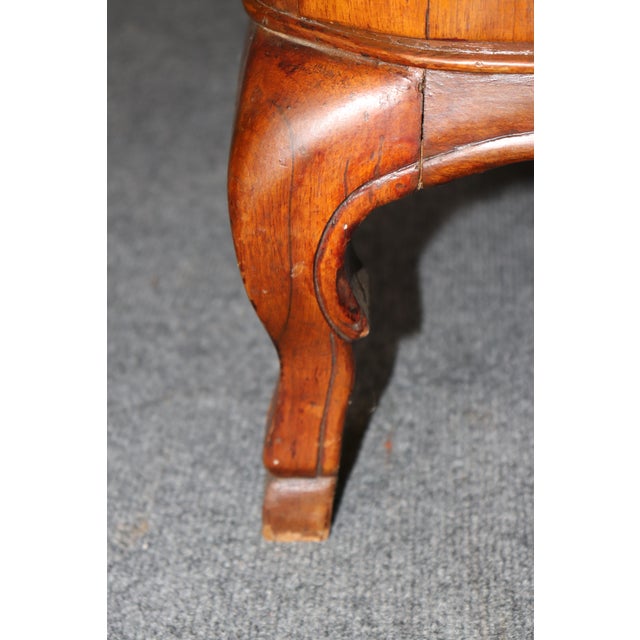
The desk is raised upon slender cabriole-form legs, whose graceful curves give the relatively substantial cabinet a surprisingly light appearance. The legs flow naturally from the shaped lower case and terminate in restrained feet, creating an elegant transition from the heavily decorated body to the floor.
One of the most appealing aspects of this secretary is the relationship between its Rococo form and geometric marquetry. Rather than relying on extensive carved ornament or gilt-bronze mounts, the maker has allowed the different woods themselves to provide the decoration. The flowing silhouette, serpentine fronts, curved drawers and cabriole legs clearly recall eighteenth-century Italian furniture, while the complex arrangement of veneers introduces an almost architectural precision.
Italian furniture makers had a long tradition of exploiting indigenous and exotic woods for decorative effect, and olive wood was particularly well suited to this approach. Its naturally expressive grain can range from relatively quiet golden surfaces to highly figured, almost burl-like passages. Here, these variations have been deliberately positioned within the marquetry to create focal points across the façade.
Dating from approximately the late 1800s to early 1900s, this secretary belongs to a period when European cabinetmakers enthusiastically revisited the great furniture styles of the eighteenth century. Rather than being a straightforward reproduction, however, this piece has considerable individuality. Its combination of Rococo curves, Italian craftsmanship, elaborate geometric inlay and richly figured olive wood gives it a distinctive personality.
Both functional and highly decorative, the secretary offers an impressive amount of storage within relatively compact proportions. The numerous drawers and compartments would originally have accommodated correspondence, writing implements, documents and personal effects, while the fall front provided a practical surface for writing.
Today, it is equally compelling as a statement piece of Italian decorative furniture. The glowing olive wood, elaborate marquetry, gently bowed cabinetry, serpentine writing surface, Rococo shell ornament and elegant cabriole legs create a desk that rewards close inspection. With its abundance of hand-worked detail and wonderfully warm range of natural wood tones, this 18th century Italian secretary is an unusually charming interpretation of the Rococo tradition and a highly decorative piece from every angle.
Dimensions: 40.5 inches high x 31.75 inches wide x 18.5 inches deep
See less
- Dimensions
- 31.75ʺW × 18.5ʺD × 40.5ʺH
- Styles
- Rococo
- Table Shape
- Rectangle
- Table Knee Clearance
- 16.0 in
- Period
- 18th Century
- Country of Origin
- Italy
- Item Type
- Vintage, Antique or Pre-owned
- Materials
- Wood
- Condition
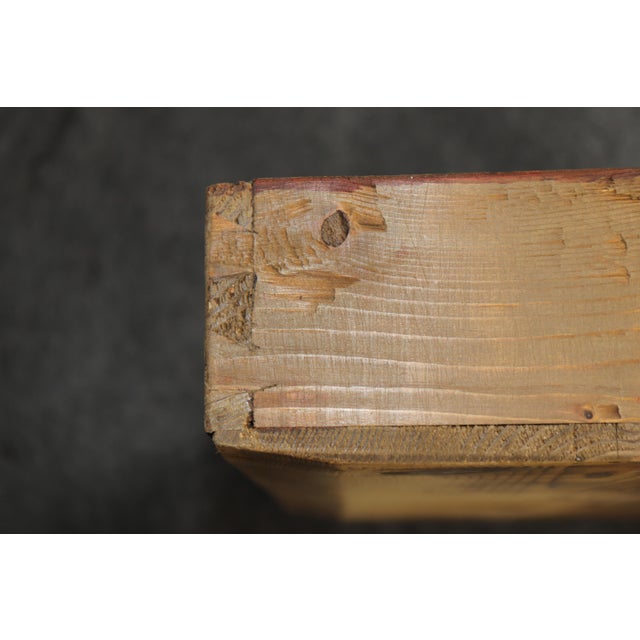
- Good Condition, Original Condition Unaltered, Some Imperfections
- Color
- Brown
- Condition Notes
- The piece is in good antique/vintage condition with the exception of some light surface scratches, Minor finish loss and normal … moreThe piece is in good antique/vintage condition with the exception of some light surface scratches, Minor finish loss and normal age related wear. As to be expected with items of age and use. less
Questions about the item?
Returns & Cancellations
Return Policy - All sales are final 48 hours after delivery, unless otherwise specified in the description of the product.
Cancellation Policy - Prior to shipping or local pickup, buyers may cancel an order for up to 48 hours, unless otherwise specified.
Related Collections
- Vinde Mobelfabrik Secretary Desks
- Pink Secretary Desks
- Asian Secretary Desks
- Blue Secretary Desks
- Oak Secretary Desks
- Cherry Wood Secretary Desks
- Mahogany Secretary Desks
- French Secretary Desks
- Queen Anne Secretary Desks
- Victorian Secretary Desks
- Georgian Secretary Desks
- Chippendale Secretary Desks
- Kindel Furniture Secretary Desks
- Mid-Century Modern Secretary Desks
- Federal Secretary Desks
- Chinoiserie Secretary Desks
- Walnut Secretary Desks
- Traditional Secretary Desks
- 1920s Secretary Desks
- Empire Secretary Desks
- Wood Secretary Desks
- Secretary Desks in Philadelphia
- Teak Secretary Desks
- White Secretary Desks
- Secretary Desks in New York