

Details
Description
This extraordinary English mahogany serpentine commode, conceived in the grand Georgian tradition associated with Thomas Chippendale, is an imposing example …
Read more
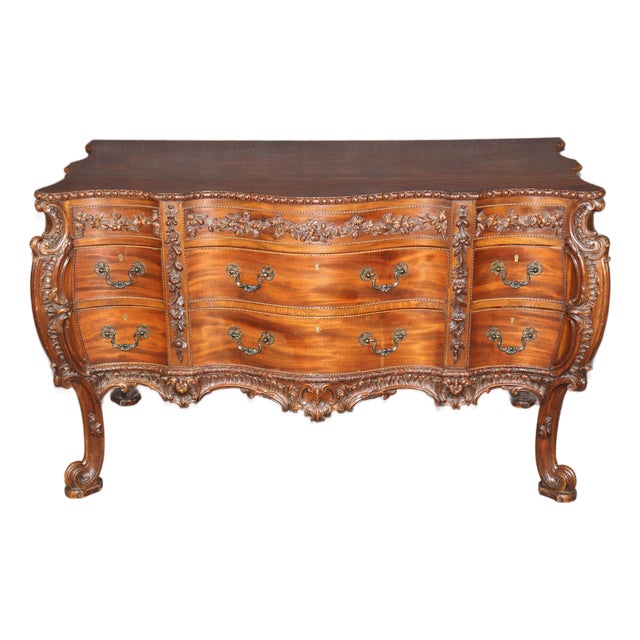
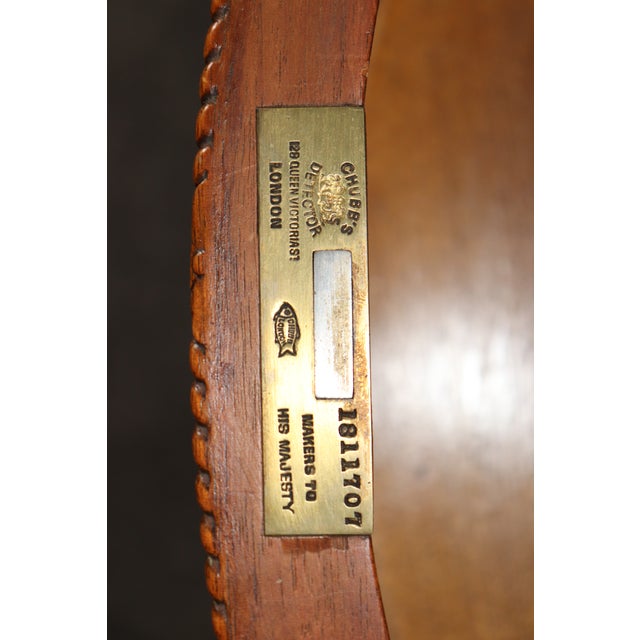
This extraordinary English mahogany serpentine commode, conceived in the grand Georgian tradition associated with Thomas Chippendale, is an imposing example of the type of cabinet furniture intended to evoke the aristocratic interiors of Britain's great houses. With its dramatically serpentine façade, richly figured mahogany, profuse hand-carved floral and Rococo ornament, substantial cabriole supports, and locks by Chubb of London, the commode possesses a quality and presence far removed from ordinary utilitarian furniture.
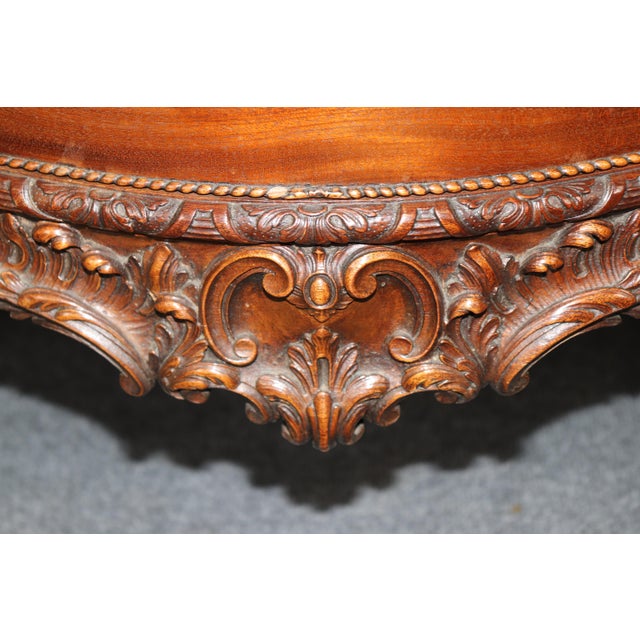
The cabinet is constructed on an unusually broad and impressive scale. Its substantial mahogany top follows the complex outline of the case, projecting gently above the front and sides and terminating in boldly shaped corners. Immediately beneath is a deeply carved egg-and-dart or bead-and-reel-like molding, establishing the exceptionally rich decorative treatment that continues throughout the façade.
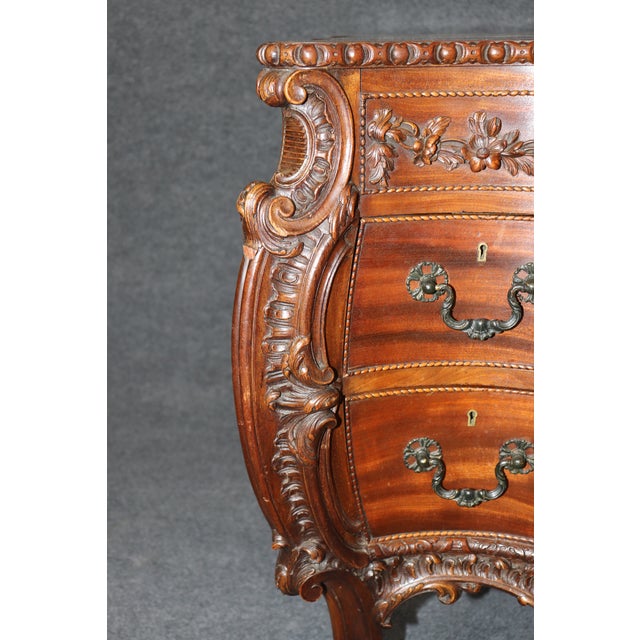
The upper frieze is divided into several shaped panels, each carved in high relief with abundant flowering branches, leaves, blossoms, and scrolling foliage. Narrow vertical divisions are likewise carved with pendant floral ornament, giving the entire front an architectural rhythm while emphasizing the cabinet's considerable width.
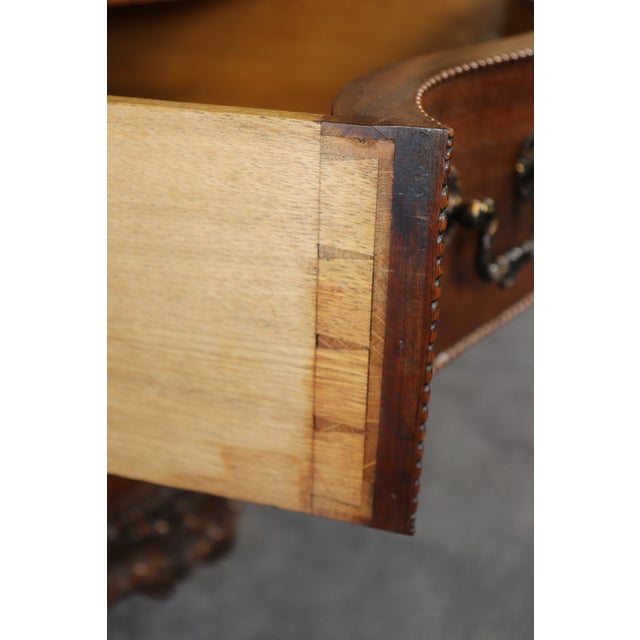
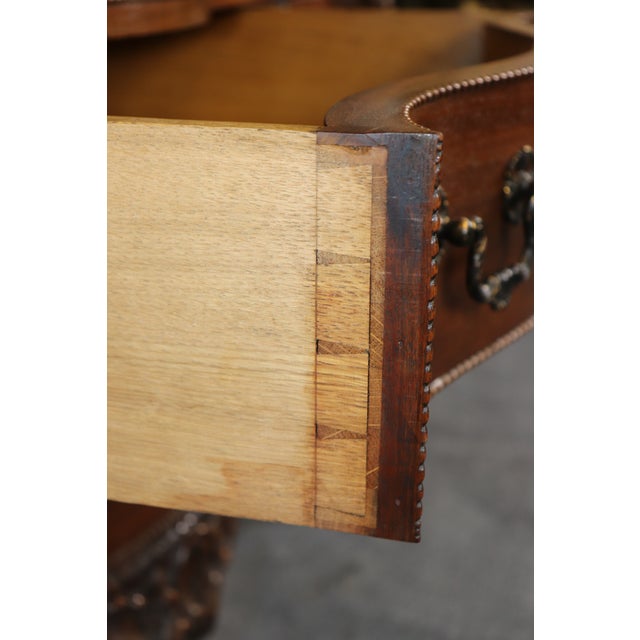
Below, the drawers form a wonderfully animated serpentine front, swelling and receding in broad curves. The rich mahogany displays beautiful variations of amber, honey, reddish brown, and deep chestnut. Each drawer is outlined with delicate carved or beaded moldings and fitted with elaborate metal bail handles suspended from circular foliate backplates. Small key escutcheons punctuate the drawer fronts with restrained symmetry.
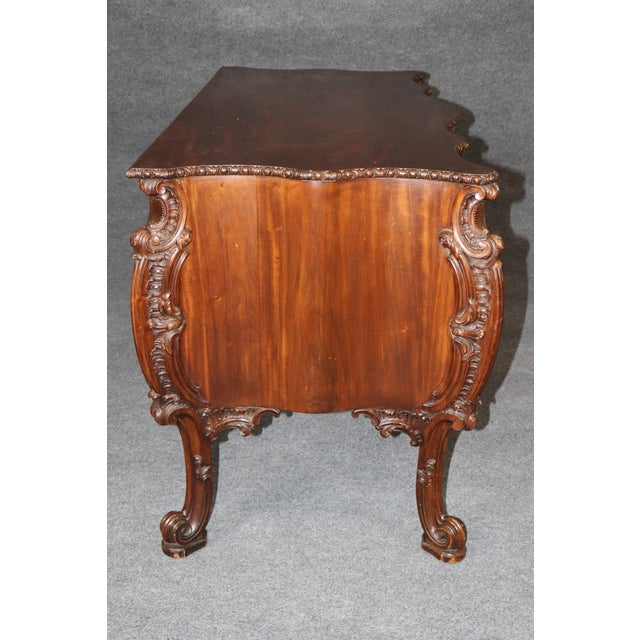
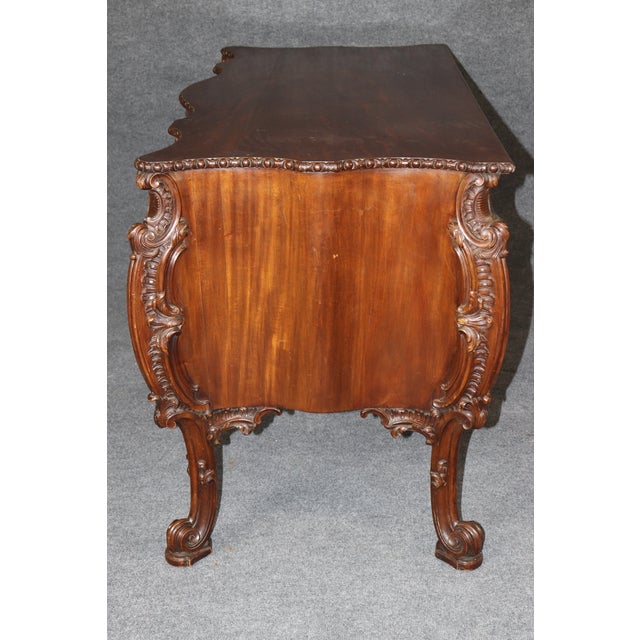
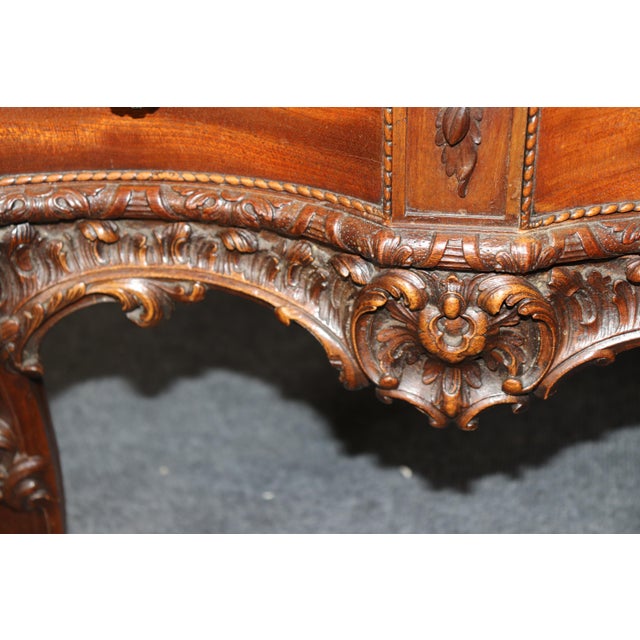
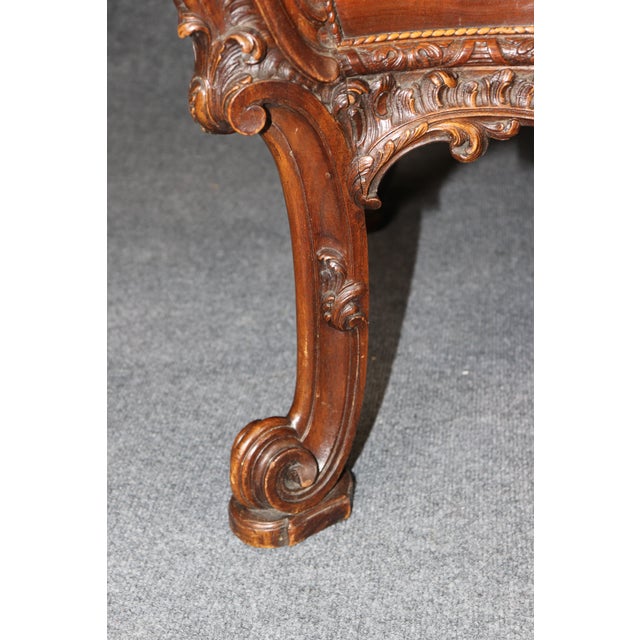
The cabinet's sides are particularly sculptural. Massive scrolling corner elements incorporate C-scrolls, acanthus leaves, molded volutes, and deeply undercut Rococo carving, visually connecting the drawer case with the shaped apron below. The lower rail is a tour de force of carving, with vigorous acanthus leaves and shell-like ornament sweeping toward a prominent central pendant. The whole is raised on powerful cabriole legs terminating in boldly scrolling feet.
The design belongs to the broad Thomas Chippendale and Georgian Rococo tradition. Thomas Chippendale (1718–1779) became the most famous name in English cabinetmaking largely through the publication of The Gentleman and Cabinet-Maker's Director in 1754 and its later editions. The Metropolitan Museum of Art notes that Chippendale did not invent the style bearing his name; rather, he codified the fashionable combination of French Rococo, Gothic, Chinese, and English design. Mahogany became particularly associated with the Chippendale era, prized for its strength, rich color, and ability to take exceptionally crisp carving.
Significantly, Chippendale himself published designs for French commodes and commode tables, including elaborate examples appearing in the third edition of the Director in 1762. Thus, the combination of a serpentine case, elaborate carving, rich mahogany, and an almost sculptural treatment of the cabinet is entirely appropriate to the Chippendale-inspired tradition.
Of exceptional interest is the presence of a Chubb lock. Chubb was not simply an ordinary hardware manufacturer. The company traces its origins to brothers Charles and Jeremiah Chubb, who developed the celebrated patented Detector Lock in 1818. Its mechanism was designed so that an attempt to manipulate the lock improperly would trigger the detector and render it inoperable until correctly reset. Chubb's own history records that the company subsequently patented a burglar-resistant safe in 1835.
The firm's reputation rapidly became extraordinary. According to the Science Museum Group, Charles Chubb established London offices at 24 St Paul's Churchyard, and the firm's customers included the Bank of England, the King, and the Duke of Wellington. In 1823 Chubb received a special licence from the Royal Household, and in 1841 a Royal Warrant was granted in connection with Prince Albert.
That history helps explain why a marked Chubb lock is such an intriguing feature on an elaborate piece of furniture. It represents a security name associated with royal, governmental, institutional, and wealthy private clients. Chubb's locks were specifically advertised during the nineteenth century for applications that included chests and bookcases, in addition to more overtly secure installations.
It would be safest, however, not to state without documented provenance that this particular commode was literally commissioned for a prince, duke, or king. What can confidently be said is that its monumental scale, expensive mahogany, exceptionally extensive carving, complicated serpentine construction, numerous fitted drawers, and prestigious Chubb hardware place it firmly within a tradition of high-status furniture associated with affluent and aristocratic interiors. Furniture of this ambition required considerable quantities of costly material and highly skilled cabinetmaking and carving.
The result is a remarkable statement piece: architectural, sculptural, and unabashedly grand. Its glowing mahogany, undulating façade, floral carving, massive Rococo scrolls, elaborate metal furniture, and historically significant Chubb locking hardware combine to create the impression of a commode conceived for a great library, drawing room, country house, or similarly imposing interior. More than a chest of drawers, it is a celebration of the Georgian and Chippendale tradition of furniture as an expression of craftsmanship, status, and architectural magnificence.
Dimensions: 32.25inches high x 54.5 inches wide x 26.25 inches deep.
See less
- Dimensions
- 54.5ʺW × 26.25ʺD × 32.25ʺH
- Styles
- Chippendale
- Styled After
- Thomas Chippendale
- Period
- Late 19th Century
- Country of Origin
- United Kingdom
- Item Type
- Vintage, Antique or Pre-owned
- Materials
- Mahogany
- Condition
- Good Condition, Original Condition Unaltered, Some Imperfections
- Color
- Brown
- Condition Notes
- The piece is in good antique/vintage condition with the exception of some light surface scratches, Minor finish loss and normal … moreThe piece is in good antique/vintage condition with the exception of some light surface scratches, Minor finish loss and normal age related wear. As to be expected with items of age and use. less
Questions about the item?
Returns & Cancellations
Return Policy - All sales are final 48 hours after delivery, unless otherwise specified in the description of the product.
Cancellation Policy - Prior to shipping or local pickup, buyers may cancel an order for up to 48 hours, unless otherwise specified.