





Details
Description
This fascinating chart belongs to a landmark monument of the Enlightenment era, namely Henri Abraham Chatelain's “Chronologie des États et …
Read more
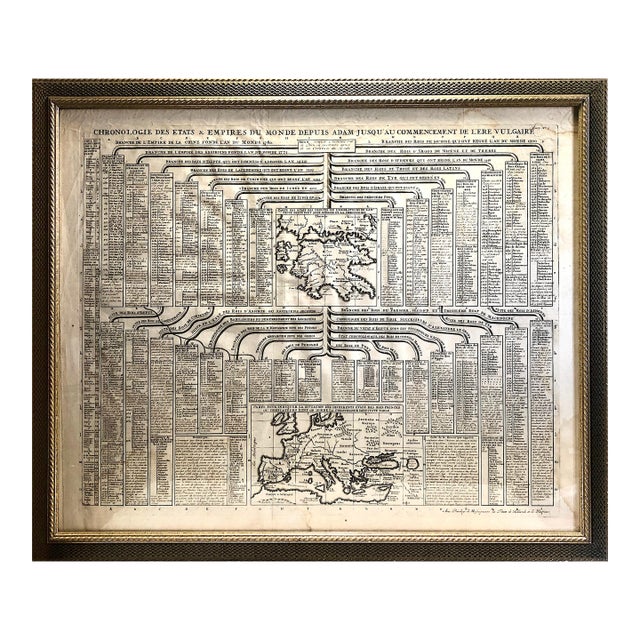
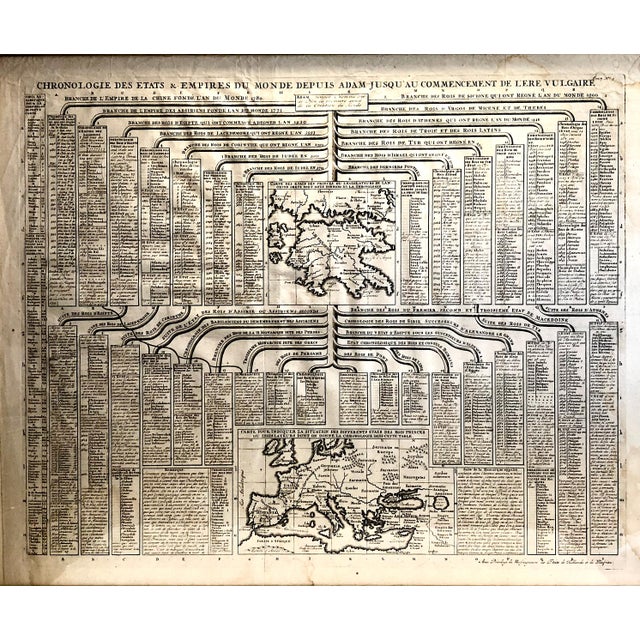
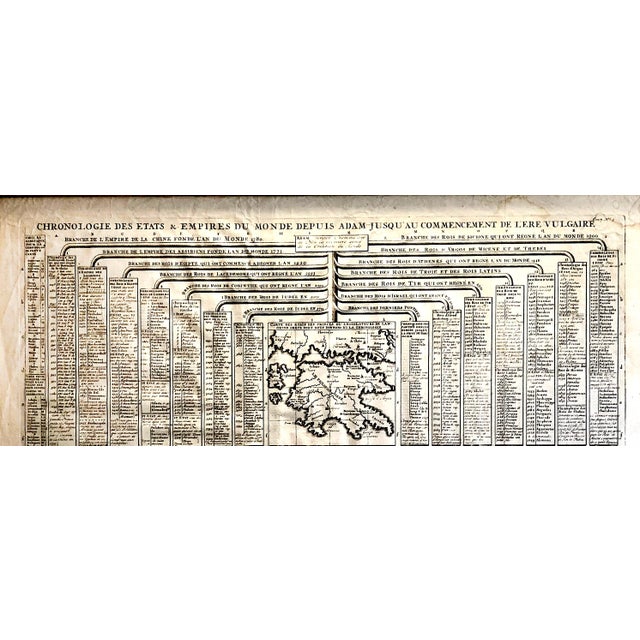
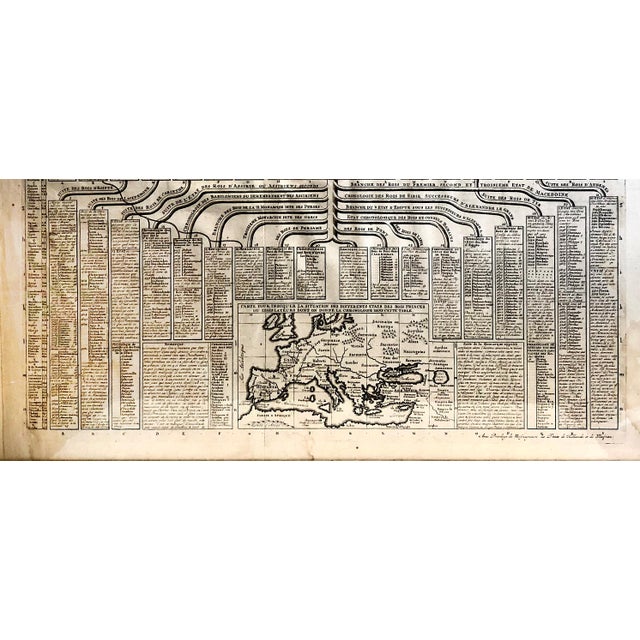
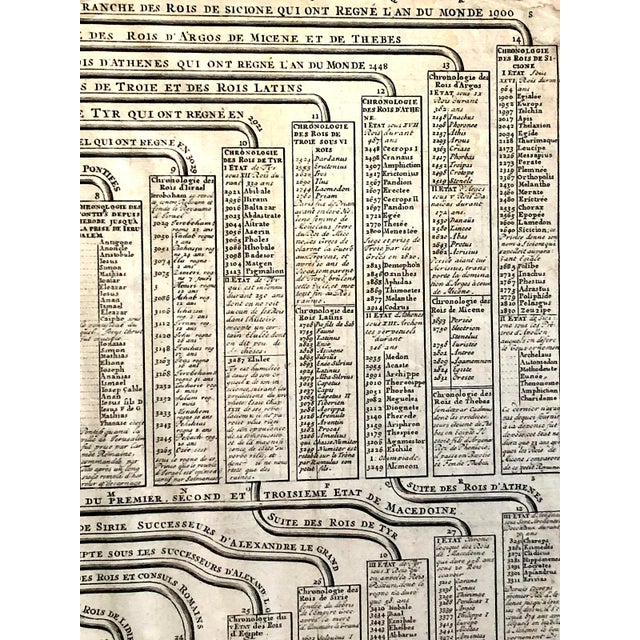
This fascinating chart belongs to a landmark monument of the Enlightenment era, namely Henri Abraham Chatelain's “Chronologie des États et Empires du Monde depuis Adam Jusqu’au Commencement de l’Ère Vulgaire” (Chronology of the States and Empires of the World from Adam to the Commencement of the Common Era).
First published around 1720 in Amsterdam as part of his massive, seven-volume “Atlas Historique,” this monumental single-sheet chart attempts to map the entire lineage of human civilization and global rulers on a synchronized timeline. In some ways it proceeds from the same human urge to know everything from everywhere all at once, which led to the development of AI three centuries later.
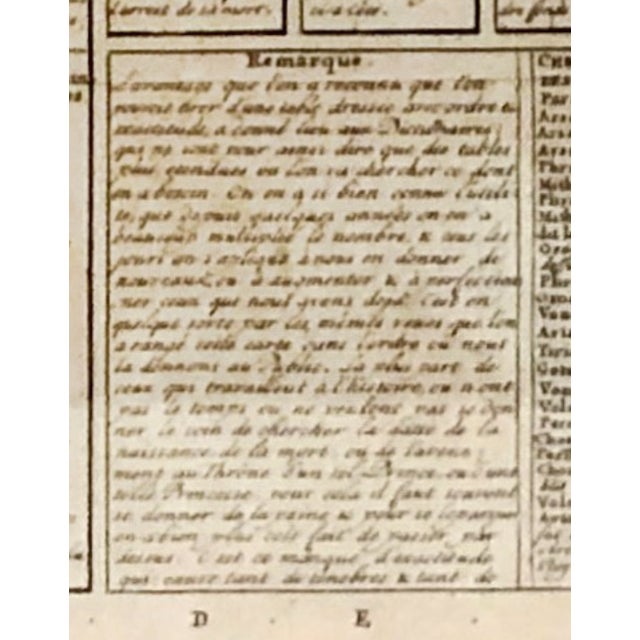
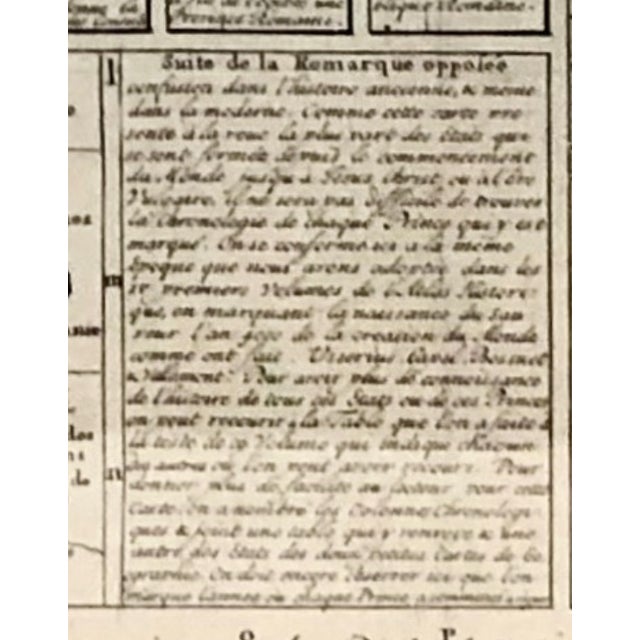
METHOD: The two text blocks pictured, bottom, flanking the chart’s map of the Mediterranean, serve as the map's explicit methodological keys, explaining how Chatelain constructed this complex chronological ledger.
AI French-to-English Translation:
[Left section, photo #12] "Remark. The recognized advantage that can be drawn from a table prepared with order and accuracy gave rise to Dictionaries, which are, so to speak, merely more extensive tables where one goes to search for what one needs. Their usefulness has been so well understood that for several years their number has greatly multiplied, and every day efforts are made to provide us with new ones, or to expand and perfect those we already have.
It is, in a sense, with the same goals in mind that this map has been arranged in the order in which we present it to the Public. Most of those who work on History either do not have the time or do not wish to take the trouble to search for the date of birth, death, or accession to the Throne of such a Prince or such a Princess. To do so often requires a great deal of effort, and to spare themselves from it, they prefer to do without it. This results in unfortunate errors, and it is this lack of accuracy that causes so much darkness and so much...
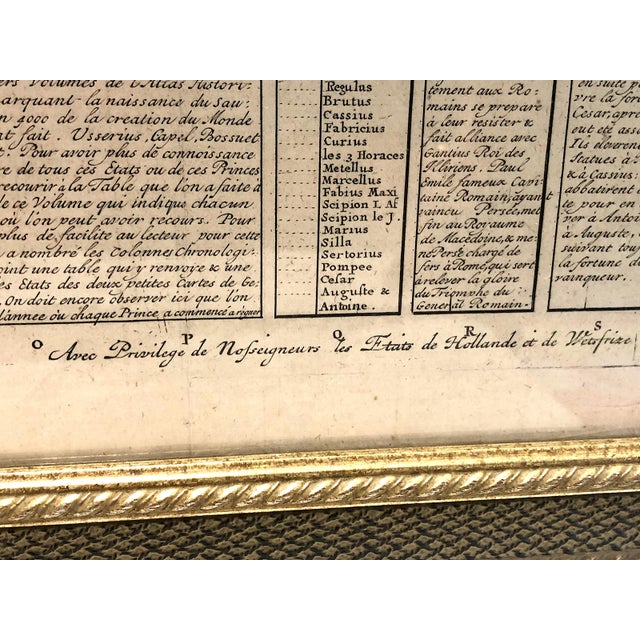
[Right section, photo #13] "Continuation of the Opposite Remark: …confusion in ancient history, and even in modern history. As this map visually represents most of the States that have formed since the beginning of the World until Jesus Christ or the Common Era, it will not be difficult to find the chronology of each Prince marked upon it.
We conform here to the same Epoch that we adopted in the first 4 Volumes of this Atlas Historique, marking the birth of the Savior in the year 4004 from the creation of the World, as was done by Usserius [James Ussher], Capel, Bossuet, and others.
To gain a better knowledge of the author of all these States or of these Princes, one can refer to the Table made at the front of this Volume, which indicates each of the maps that may be consulted. To make this Map easier for the reader, we have numbered the chronological columns and attached a table that references them, as well as another for the States on the two small geographic maps. It should also be observed here that we mark the year in which each Prince began to reign.”
CONTEXT: With these notes, Chatelain aligns his work with the early Enlightenment's obsession with information classification—the same intellectual movement that birthed the modern encyclopedia. He frames his timeline not just as a piece of art, but as a systematic historical data table designed for quick cross-referencing. He laments that historians often omit exact dates of birth, death, or accessions to the throne, which "causes so much obscurity and so many confusions in ancient history."
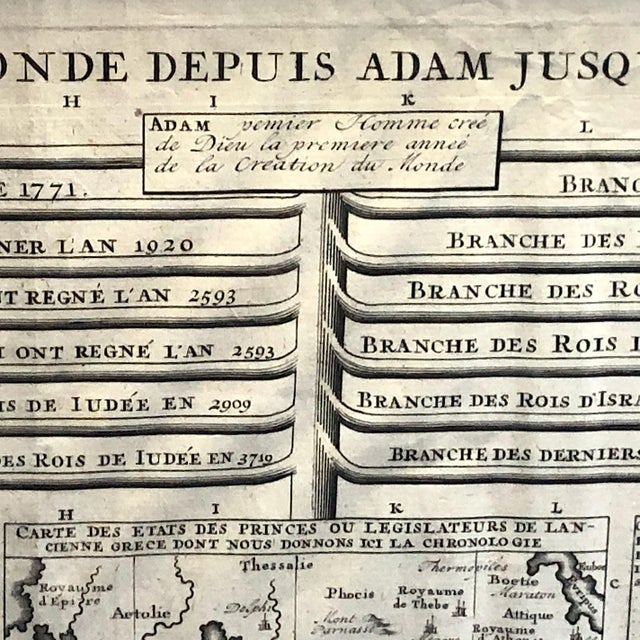
To align the histories of distinct civilizations (such as Rome, Egypt, China, Judea, and Persia) into parallel columns on a single sheet, Chatelain anchors his timeline to Biblical creation—beginning with Adam as Year 0. At the other end of his timeline, Châtelain designates the birth of Jesus Christ exactly at Anno Mundi (Year of the World) 4000. This allows readers to scan across the spreadsheet-like grid and see exactly which rulers across Europe, Asia, and Africa were reigning simultaneously at any century prior to the Common Era. So logical. So symmetrical. So very French.
Signature/Maker’s Mark: Nonexistent. Period copyright/royal license with Holland and West Friesland (photo #11). Unframed dimensions: 21.25 inches high x 26 inches wide.
See less
- Dimensions
- 29ʺW × 1ʺD × 24.5ʺH
- Styles
- French
- Frame Type
- Framed
- Art Subjects
- Text
- Period
- Early 18th Century
- Country of Origin
- Netherlands
- Item Type
- Vintage, Antique or Pre-owned
- Materials
- Paper
- Pen and Ink
- Condition
- Good Condition, Original Condition Unaltered, Some Imperfections
- Color
- Ecru
- Condition Notes
- Condition commensurate with age and use. Please review all photos. Condition commensurate with age and use. Please review all photos. less
Questions about the item?
Returns & Cancellations
Return Policy - All sales are final 48 hours after delivery, unless otherwise specified in the description of the product.
Cancellation Policy - Prior to shipping or local pickup, buyers may cancel an order for up to 48 hours, unless otherwise specified.
Related Collections
- Medium-Density Fibreboard Original Prints
- Soicher Marin Original Prints
- Rattan Original Prints
- Ralph Lauren Original Prints
- Damien Hirst Original Prints
- Sam Francis Original Prints
- Silver Finish Original Prints
- Johannes Kip Original Prints
- Dye Transfer Original Prints
- Donald Sultan Original Prints
- Original Prints in Lexington, KY
- Original Prints in Panama City, FL
- Original Prints in Salt Lake City
- Botanical Prints
- Framed Prints
- Bird Prints
- Woodblock Prints
- Screen Prints
- Japanese Woodblock Prints
- Thomas McKnight Original Prints
- George Barbier Original Prints
- Frank Stella Original Prints
- Gustave Baumann Original Prints
- Teak Original Prints
- Clay Original Prints