

Details
Description
This painting illustrates one of the great episodes of royal encounter in the Old Testament: the visit of the Queen …
Read more
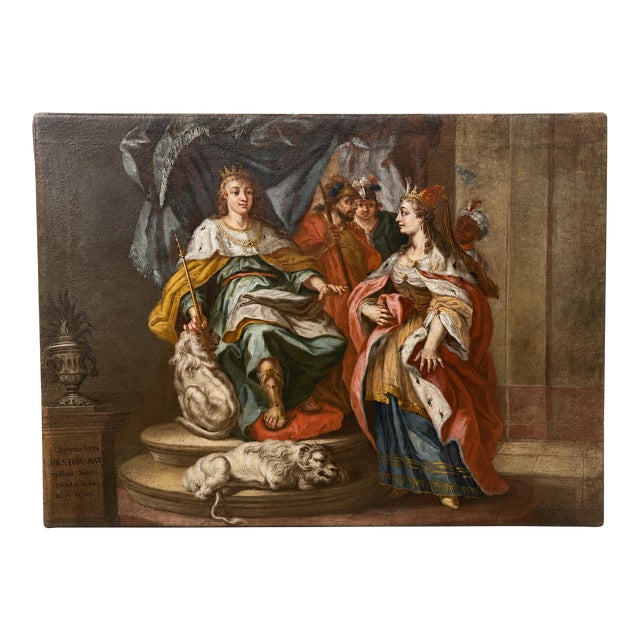
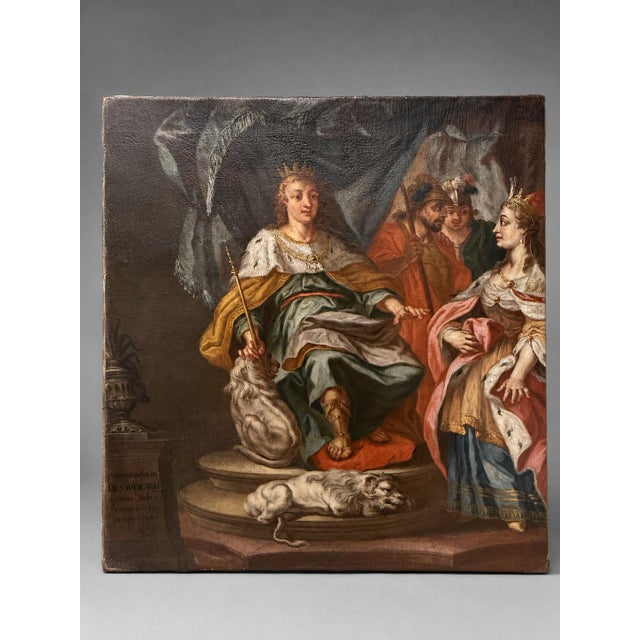
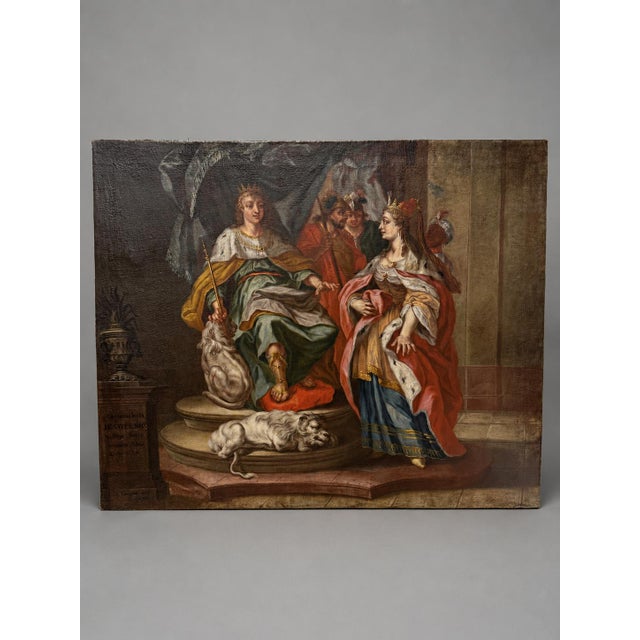
This painting illustrates one of the great episodes of royal encounter in the Old Testament: the visit of the Queen of Sheba to King Solomon. According to 1 Kings 10, the queen had heard of Solomon’s fame and came to Jerusalem with a large retinue, bringing gold, spices, and precious stones, in order to test him with difficult questions. Solomon answers all of them, and the queen, overwhelmed by the splendor of his court and the breadth of his wisdom, acknowledges that the reports she had heard were not exaggerated. The subject therefore is not simply a meeting of two rulers; it is a scene of recognition, wisdom, divine favor, diplomacy, and tribute.
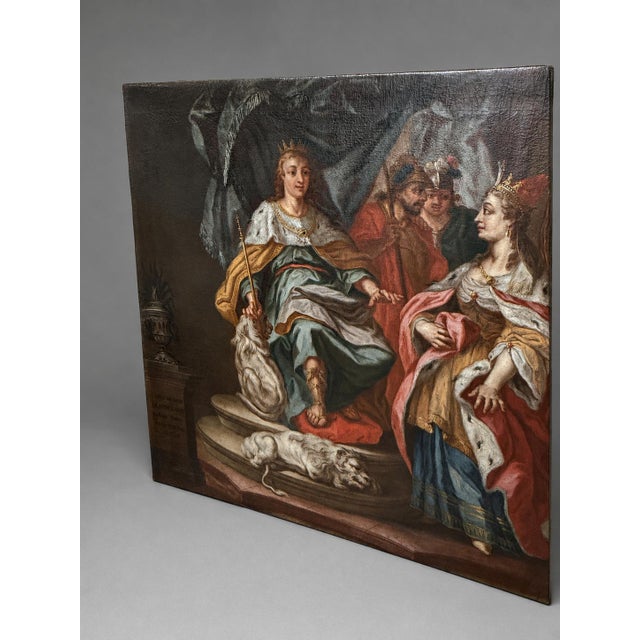
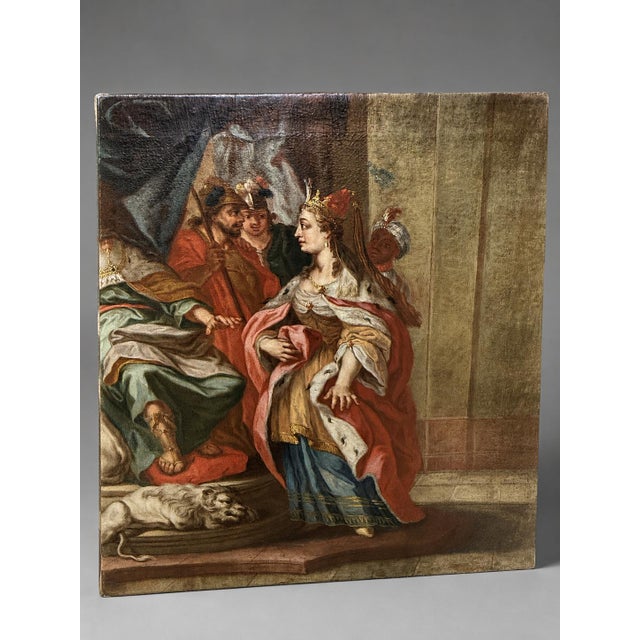
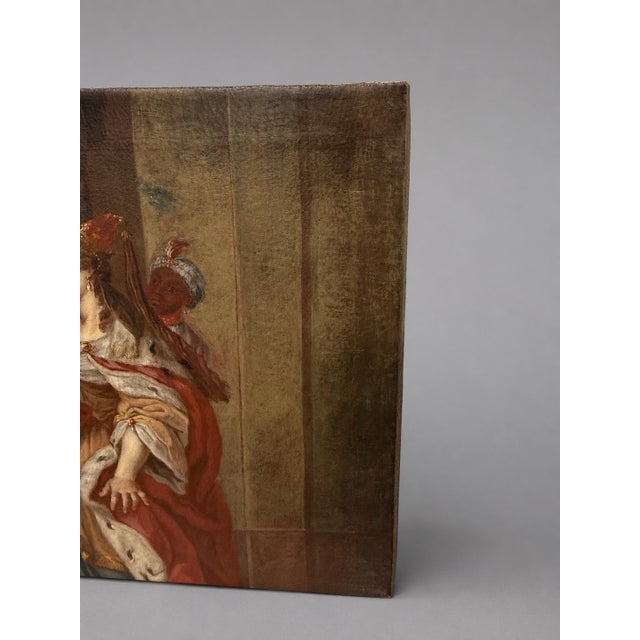
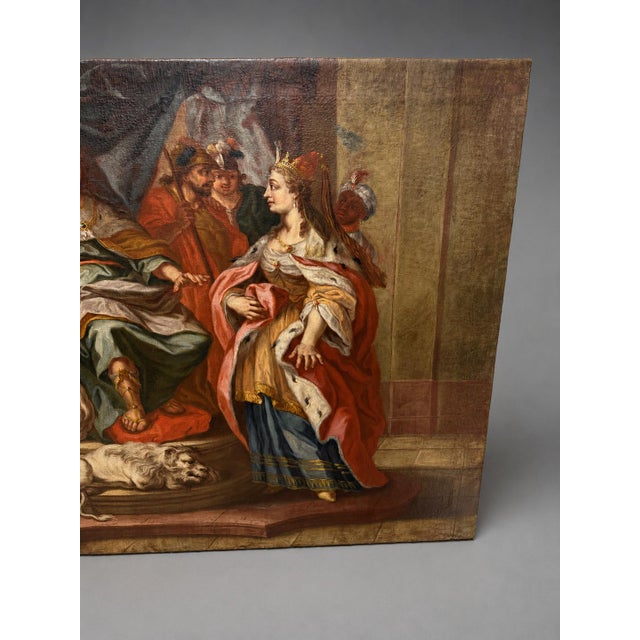
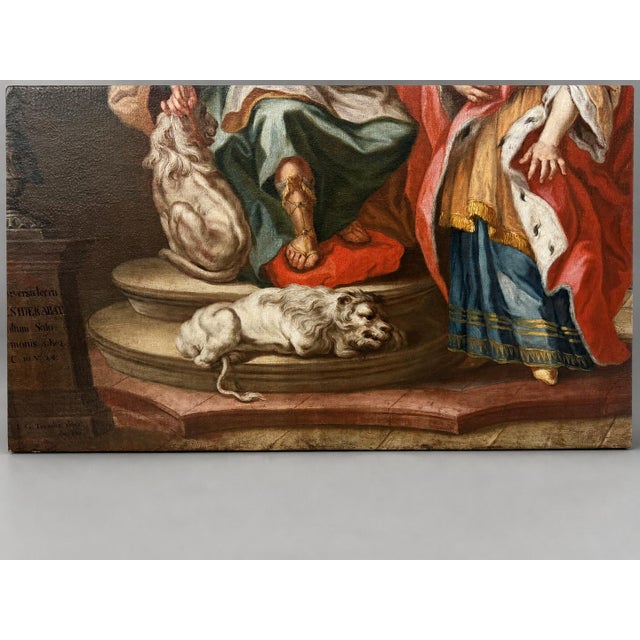
In this painting, Solomon sits enthroned at the left, crowned and formally robed, holding the authority of both king and judge. The Queen of Sheba stands before him at the right, also crowned, her presence treated with dignity rather than submission. This balance is important: in Baroque and Rococo history painting, the scene often becomes a theatrical exchange between masculine wisdom and feminine sovereignty, between Jerusalem and the wider world. The queen is not merely an attendant figure; she is a ruler who has traveled to witness Solomon’s wisdom for herself.
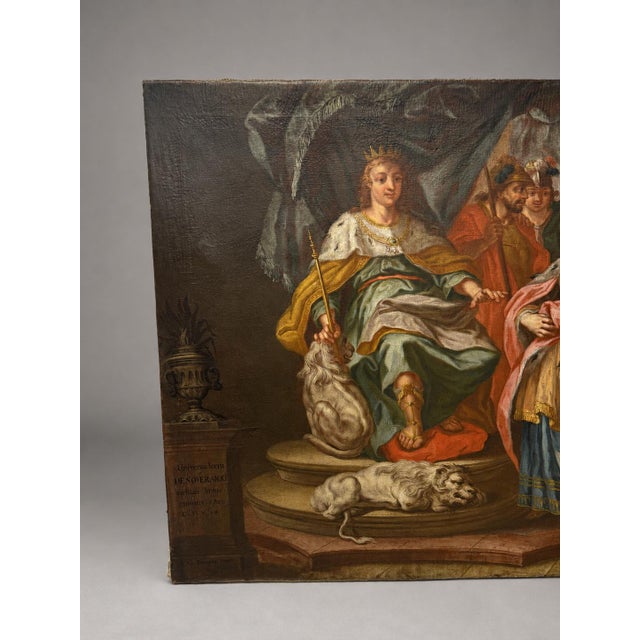
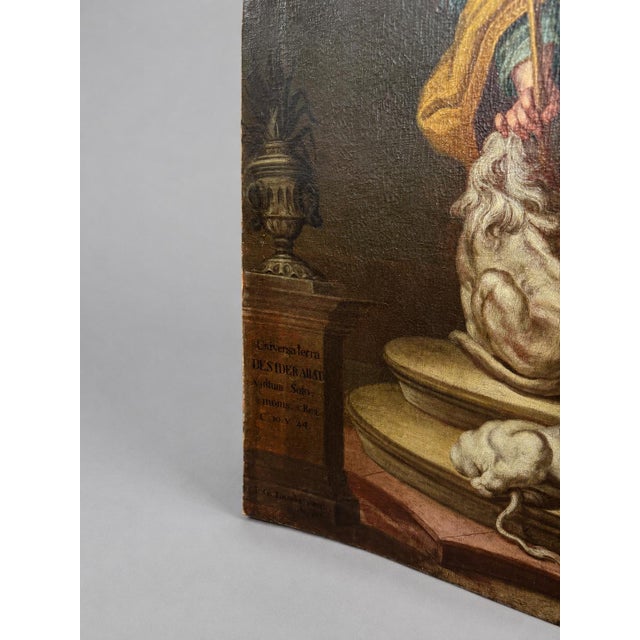
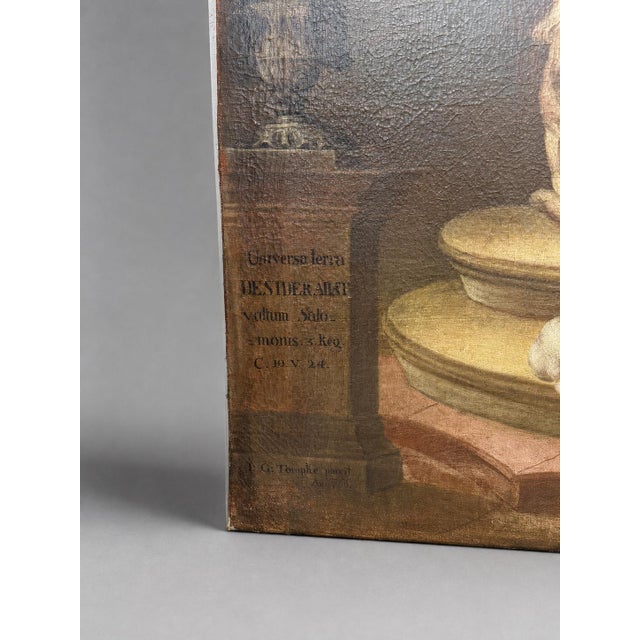
The two lions are especially meaningful. They are not general royal decoration, but a direct reference to Solomon’s throne as described in 1 Kings 10, where lions stand beside the armrests and additional lions appear on the steps. In the painting, the lions operate almost like heraldic emblems of the king’s seat: they mark Solomon as the divinely favored ruler whose wisdom draws “all the earth” to his presence. The lower-left inscription strengthens this reading, quoting the Latin Vulgate phrase “Universa terra desiderabat vultum Salomonis,” or “all the earth sought the face of Solomon.”
The Black or Moorish attendant figure at the right should also be noted carefully. In 18th-century European painting, such figures were often used to signify geographic reach, courtly luxury, foreign embassies, and the imagined splendor of distant kingdoms. The period term “blackamoor” appears frequently in antique cataloging, but in a modern museum-quality description it is best handled as a historical convention rather than an unexamined label. Here, the figure contributes to the painting’s larger idea: Solomon’s wisdom attracts not only one queen, but a global courtly world.
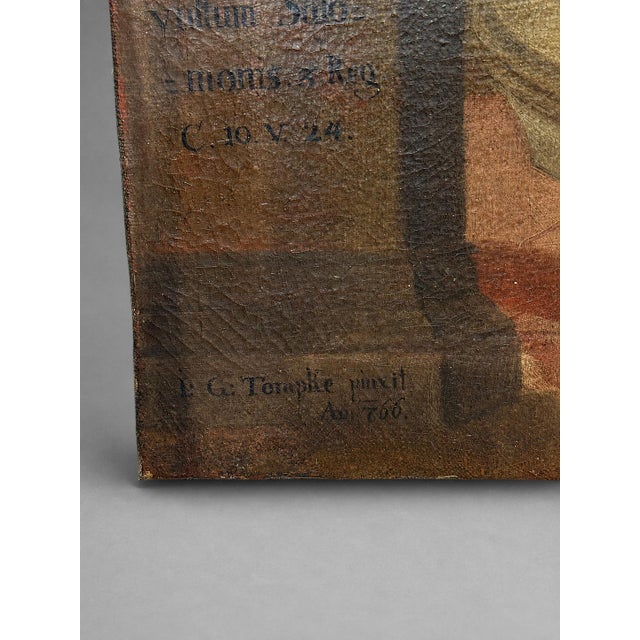
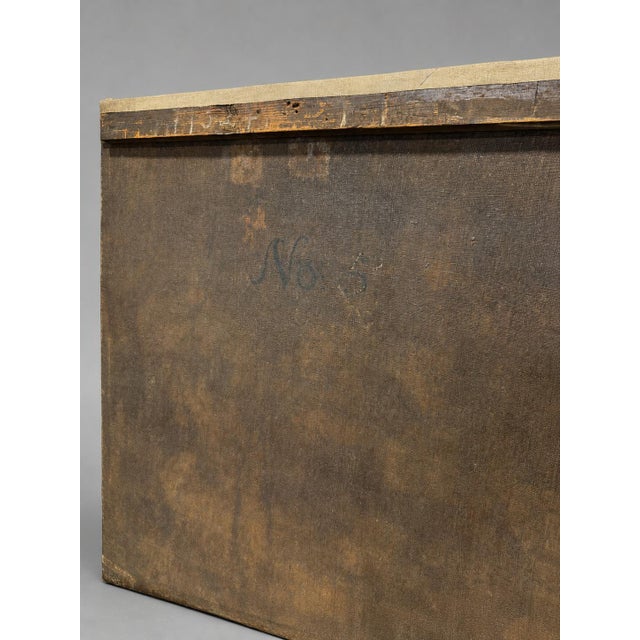
The inscription is one of the most important features of the work. It appears to read, “*. G. Tompke Pinxit AD 1766,”. “Pinxit” is the standard Latin formula meaning “painted it,” while “AD 1766” gives the date. The artist’s first initials remain the point to verify under magnification, because the mark could potentially be read as “L. G.,” “I. G.,” or “J. G.” However, the name Tompke is significant: the documented painter who fits the period and region is Johann Georg Tompke, an Austrian/Upper Austrian artist active in the mid-18th century.
Johann Georg Tompke is not a household-name painter in the way that the great Viennese or Italian Baroque masters are, but he is documented in exactly the sort of ecclesiastical, regional, and historical painting context that fits this work. Known records connect him with Upper Austrian painting, including a large 1753 oil-on-canvas view of Stift St. Florian, a 1754 depiction of Wilbirg at St. Florian, portraits in the Oberösterreichisches Landesmuseum, and the large 1770 altar painting of St. Gallus in the parish church of Gallneukirchen.
The most intriguing research point is that a Linz museum yearbook records the acquisition of a Baroque painting by Johann Georg Tompke depicting an Old Testament scene and dated 1766. That does not prove this is the same painting, and I would not state that as fact without provenance or direct institutional confirmation, but it is highly relevant. It shows that Tompke was associated with Old Testament subject painting at precisely the same date as the inscription visible on your work. Which could also make this an early work of a student or early 19th century museum painting.
Stylistically, the painting belongs to the Central European late Baroque moving toward Rococo classicism. The architecture, raised throne, courtly gestures, warm theatrical staging, and biblical inscription all point to an educated Catholic visual culture in which Scripture, monarchy, and moral exemplum were brought together. The painting would have functioned not only as a biblical narrative, but as an image of ideal rulership: the wise king, the admiring foreign sovereign, the ordered court, the emblematic lions, and the gathered witnesses all form a political and spiritual theater of wisdom.
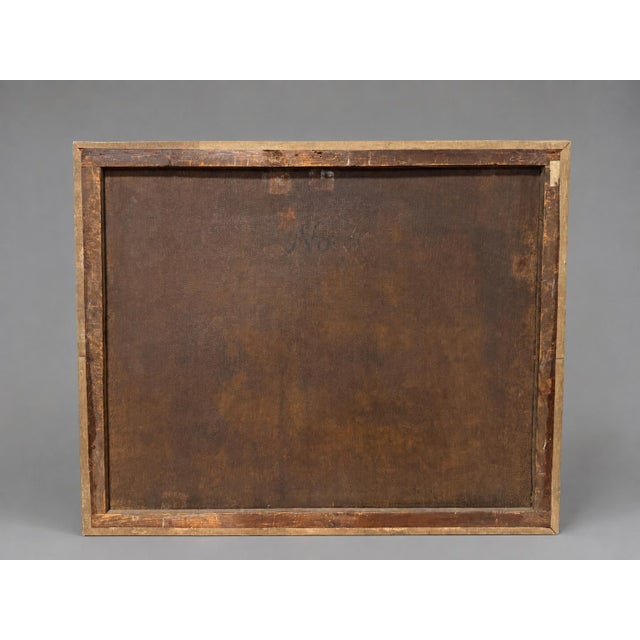
Measurements: 38" w x 31.5" h.
See less
Questions about the item?
Returns & Cancellations
Return Policy - All sales are final 48 hours after delivery, unless otherwise specified in the description of the product.
Cancellation Policy - Prior to shipping or local pickup, buyers may cancel an order for up to 48 hours, unless otherwise specified.
Related Collections
- Photorealism Canvas Paintings
- Ed Ruscha Paintings
- Richard Serra Paintings
- Photorealism Paintings in New York
- Louise Nevelson Paintings
- Karen Offutt Paintings
- Jo Baskerville Paintings
- Nicola Simbari Paintings
- Herman Miller Paintings
- BDDW Paintings
- James McCray Paintings
- Leroy Neiman Paintings
- Jaanika Peerna Paintings
- Vienna Secession Paintings
- Johannes Andersen Paintings
- Pedro Friedeberg Paintings
- Peter Behrens Paintings
- Piet Hein Eek Paintings
- Raphael Paintings
- Jeff Slemmons Paintings
- Photorealism Paintings in Los Angeles
- Milton Avery Paintings
- Karl-Erik Ekselius Paintings
- Hans Andersen Paintings
- Jean-Paul Barray Paintings