


Details
Description
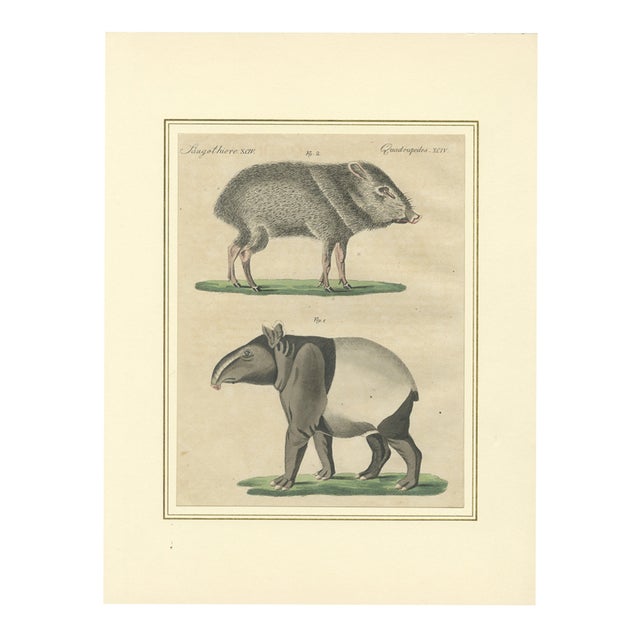
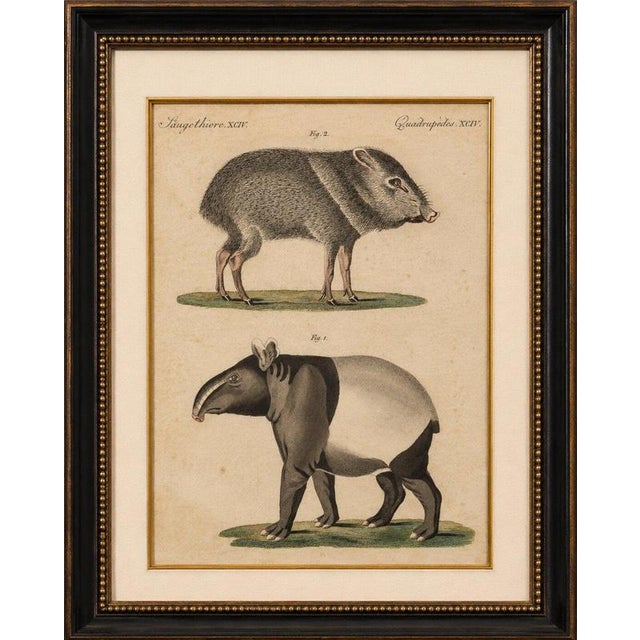
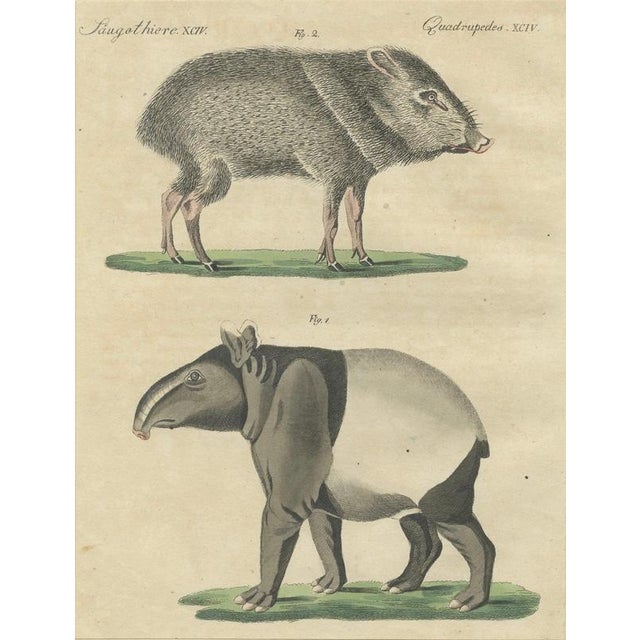
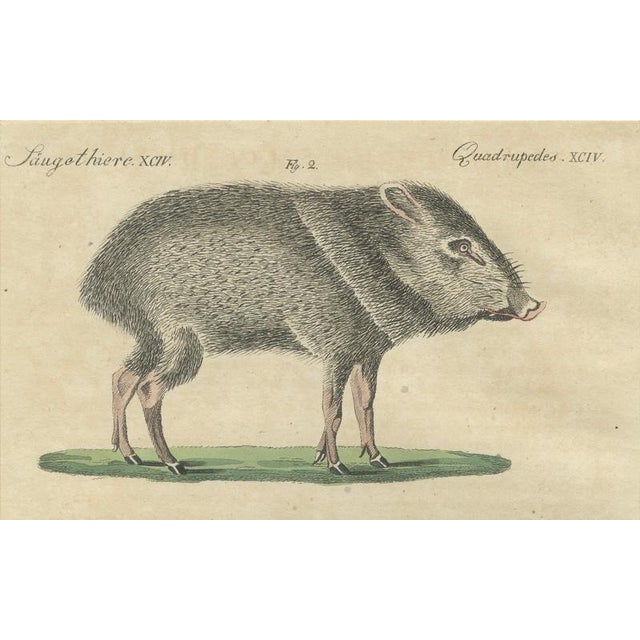
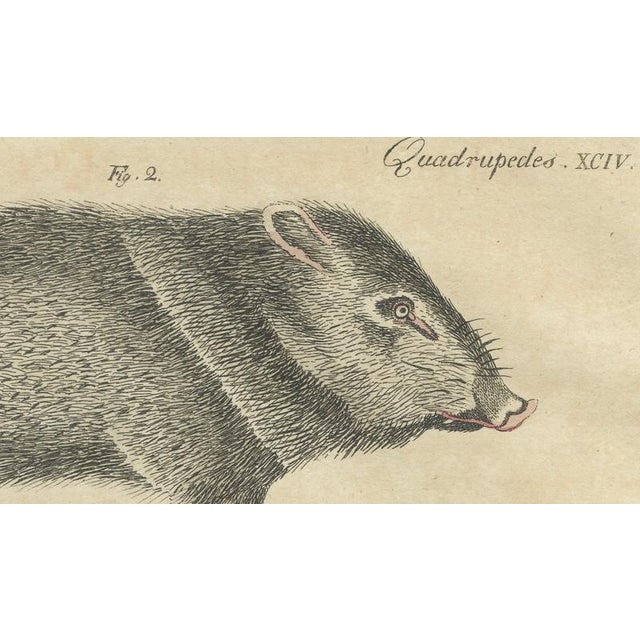
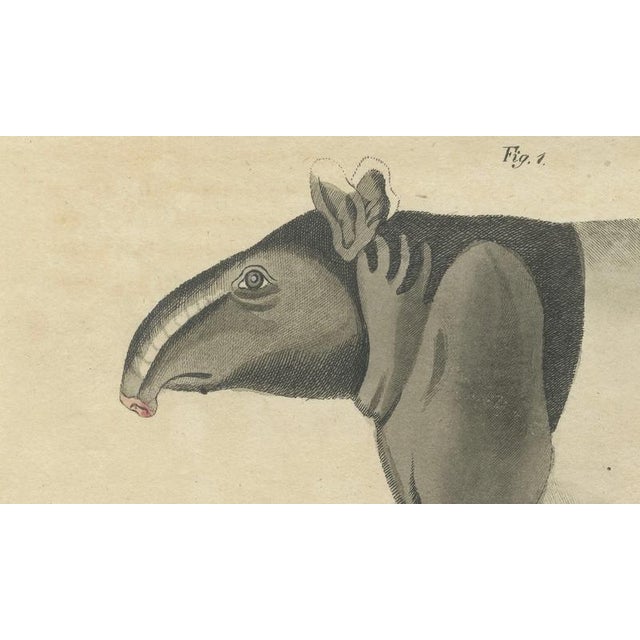
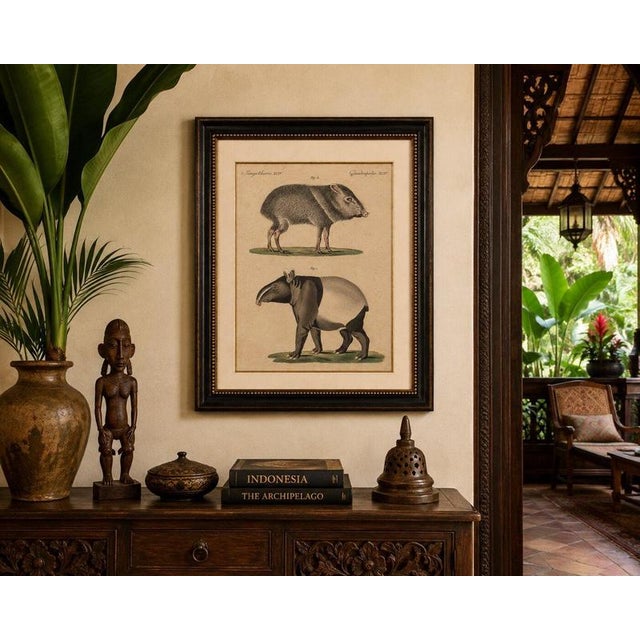
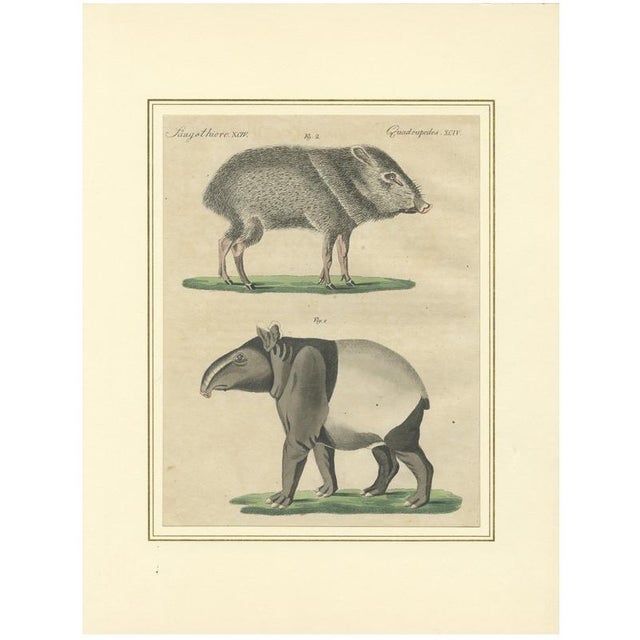
Title: antique malayan tapir & collared peccary engraving – bertuch, c. 1815 original antique hand-colored copper engraving depicting two remarkable … Read more Title: antique malayan tapir & collared peccary engraving – bertuch, c. 1815 original antique hand-colored copper engraving depicting two remarkable mammals from distant parts of the world: the malayan tapir of southeast asia and the collared peccary of the americas. Published in friedrich justin bertuch’s celebrated “bilderbuch für kinder” in weimar in the early 19th century. The plate is headed “säugethiere xciv / quadrupèdes xciv” and presents the two animals in profile, allowing their distinctive forms and markings to be clearly compared. Fig. 1 – malayan tapir / asian tapir scientific name: tapirus indicus also known as: malayan tapir, asian tapir, malay tapir the magnificent lower animal is the malayan tapir, the largest of the living tapir species and the only tapir native to asia. It is immediately recognizable by its extraordinary black-and-white coloration. The head, shoulders and legs are dark, while the middle and rear portion of the body are covered by a broad pale “saddle.” this striking pattern helps distinguish the malayan tapir from the tapir species of central and south america. The malayan tapir is native to southeast asia, historically occurring across parts of the malay peninsula, sumatra and surrounding regions. Despite its somewhat pig-like appearance, the tapir is not closely related to pigs. Tapirs belong to the order perissodactyla – the odd-toed ungulates – and are therefore more closely related to horses and rhinoceroses. One of its most characteristic features is the short, flexible trunk formed by the nose and upper lip. This mobile proboscis is used to grasp leaves, shoots, fruit and other vegetation. For european readers in bertuch’s period, animals such as the malayan tapir represented the extraordinary and still relatively little-known wildlife of southeast asia. Fig. 2 – collared peccary / javelina modern scientific name: dicotyles tajacu also known as: collared peccary, javelina the upper animal represents the collared peccary, a pig-like mammal native to the americas. It is recognizable by its compact body, coarse grey-brown coat and characteristic pale band or “collar” extending around the shoulders and neck. Although peccaries superficially resemble wild pigs, they belong to a separate family, tayassuidae. The collared peccary has an extensive range extending through parts of the southwestern united states and mexico into central and south america. In the southwestern united states and mexico it is widely known by the popular name “javelina,” derived from a spanish term referring to its spear-like canine teeth. Peccaries are highly social animals and frequently live in groups. They feed on a wide range of vegetation, fruit, roots and other available food. Two remarkable mammals the juxtaposition of these two animals is particularly interesting from a modern perspective. Both the tapir and peccary can appear superficially pig-like, yet neither should simply be regarded as a type of domestic pig. They belong to quite different zoological groups and evolved independently. The plate therefore provides a fascinating example of the way early 19th-century natural-history publications introduced european audiences to unusual mammals from asia and the americas. Friedrich justin bertuch (1747–1822) was a german publisher, writer and patron of the arts. His monumental “bilderbuch für kinder” (picture book for children), first published in weimar in 1790, became one of the great illustrated educational encyclopedias of the late 18th and early 19th centuries. Its hundreds of engraved and hand-colored plates introduced readers to animals, plants, geography, science, technology, antiquity and cultures from around the world. This is an especially decorative mammal plate. The bold black-and-white pattern of the malayan tapir contrasts beautifully with the finely engraved grey coat of the collared peccary above. Technique: original hand-colored copper engraving publisher: friedrich justin bertuch / industrie-comptoir publication: bilderbuch für kinder place: weimar, germany date: early 19th century, circa 1815 plate: säugethiere xciv / quadrupèdes xciv subjects: fig. 1 – malayan tapir / asian tapir scientific name: tapirus indicus geographical association: southeast asia, malay peninsula and sumatra fig. 2 – collared peccary / javelina scientific name: dicotyles tajacu also historically classified as: pecari tajacu geographical association: north, central and south america condition: good antique condition with overall age-related toning, scattered foxing and spotting and some visible show-through or offsetting from printed text. Minor marks and imperfections are present consistent with the age of the engraving. The original hand coloring remains attractive, particularly the distinctive contrasting coloration of the malayan tapir. The engraving is loosely inserted in an acid-free matting board. Please study the photographs carefully as they form part of the condition . Please note: this is an original antique hand-colored copper engraving from the early 19th century, not a modern reproduction. The print is sold unframed. Framed images or interior views, if shown, are for presentation and inspiration only. Other companion mammal and natural-history plates from bertuch’s “bilderbuch für kinder” are also available separately. Keywords: friedrich justin bertuch, bilderbuch für kinder, malayan tapir, malay tapir, asian tapir, tapirus indicus, sumatra, indonesia, southeast asia, collared peccary, javelina, dicotyles tajacu, pecari tajacu, peccary, antique tapir print, antique peccary print, exotic mammals, asian wildlife, american wildlife, natural history illustration, antique zoology, hand-colored copper engraving, cabinet of curiosities, german engraving, weimar, early 19th century, original antique print See less
- Dimensions
- 10.24ʺW × 13.39ʺH
- Styles
- Hollywood Regency
- Art Subjects
- Animals
- Period
- Early 19th Century
- Country of Origin
- Germany
- Item Type
- Vintage, Antique or Pre-owned
- Materials
- Paper
- Condition
- Good Condition, Unknown, Some Imperfections
- Color
- Black
- Condition Notes
- Very Good — This vintage item has no defects, but it may show slight traces of use\. Age-related toning, scattered … moreVery Good — This vintage item has no defects, but it may show slight traces of use\. Age-related toning, scattered foxing and spotting and some visible show-through or offsetting from printed text, Several small brown stains and marks less
Returns & Cancellations
Return Policy - All sales are final 48 hours after delivery, unless otherwise specified in the description of the product.
Cancellation Policy - Prior to shipping or local pickup, buyers may cancel an order for up to 48 hours, unless otherwise specified.
Related Collections
- Soicher Marin Original Prints
- Rattan Original Prints
- Medium-Density Fibreboard Original Prints
- Silver Finish Original Prints
- Robert Kipniss Original Prints
- Dye Transfer Original Prints
- Original Prints in Panama City, FL
- Ralph Lauren Original Prints
- Original Prints in Salt Lake City
- Original Prints in Lexington, KY
- Damien Hirst Original Prints
- Sam Francis Original Prints
- Johannes Kip Original Prints
- Botanical Prints
- Framed Prints
- Bird Prints
- Woodblock Prints
- Screen Prints
- Japanese Woodblock Prints
- Thomas McKnight Original Prints
- George Barbier Original Prints
- Frank Stella Original Prints
- Gustave Baumann Original Prints
- Teak Original Prints
- Chaim Gross Original Prints