

Details
Description
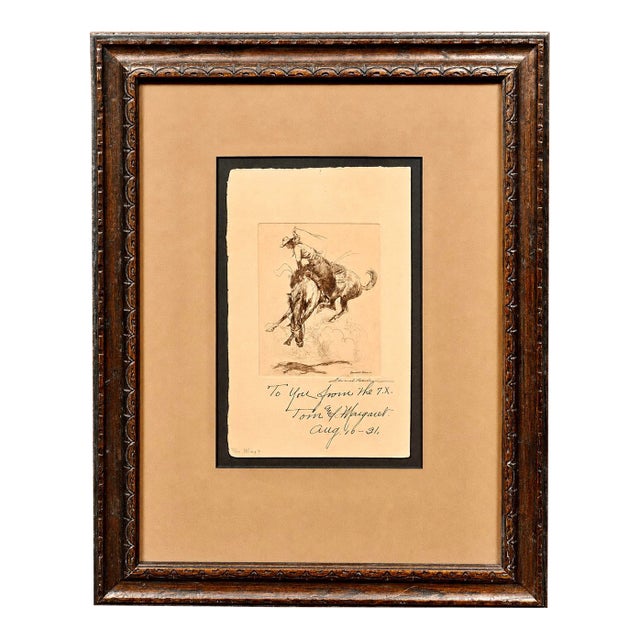
Edward Borein-Who Wins?-Etching & Drypoint, 1931 7X Ranch Presentation Inscription
American South Western - Etching on Paper - Signed
Paper …
Read more
Edward Borein-Who Wins?-Etching & Drypoint, 1931 7X Ranch Presentation Inscription
American South Western - Etching on Paper - Signed
Paper size: 9.5" x 6" - frame 19" x 16" x1"
Description :
This evocative original etching and drypoint, titled Who Wins?, is by celebrated California artist and Western illustrator John Edward Borein (1872–1945), one of the foremost visual chroniclers of the American West.
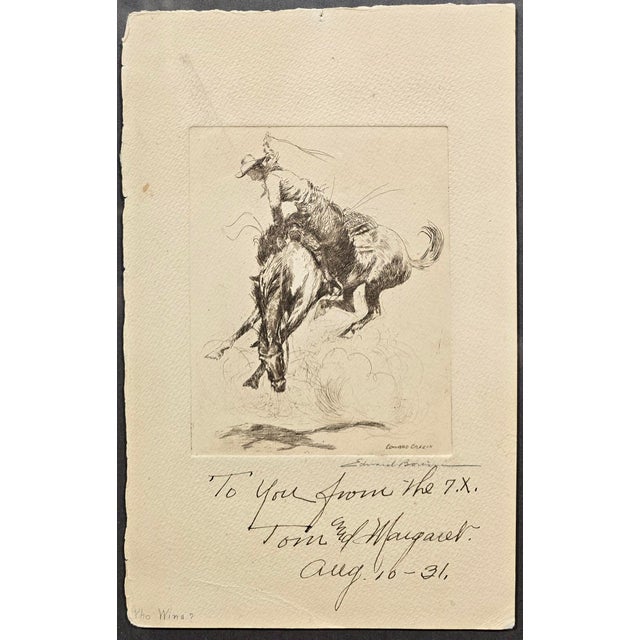
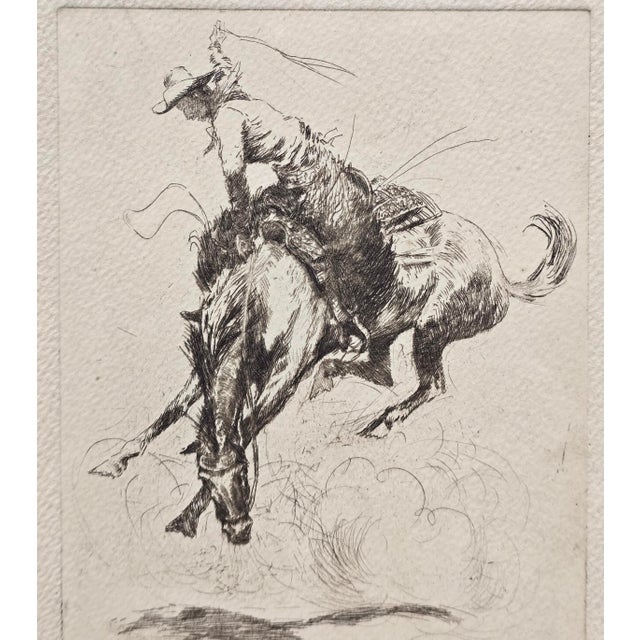
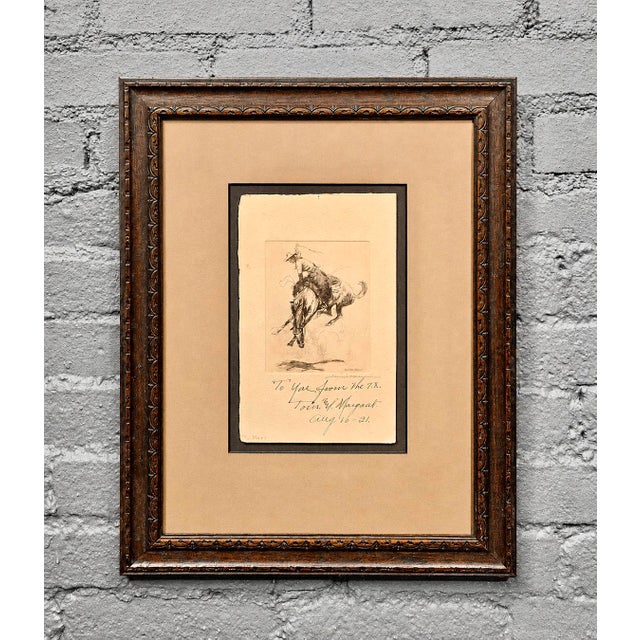
Combining Borein’s firsthand knowledge of horses, cattle, ranch life, and horsemanship with the immediacy of his distinctive draftsmanship, the composition captures a dramatic instant during a bucking contest: cowboy and bronco suspended in a moment of violent, precarious equilibrium.
What makes this particular impression especially compelling is its extensive period inscription and documented association with the 7X Ranch near Adelaida, west of Paso Robles, California. A handwritten presentation inscription dated August 1931, together with later provenance notes preserved on the backing, gives the work a particularly personal connection to California ranching history.
The Composition
Borein depicts horse and rider at the height of the action. The bronco twists forcefully beneath its rider, head lowered and body compressed as its hindquarters rise from the ground. Above it, the cowboy struggles to maintain his seat, his body responding instinctively to the animal's explosive movement.
Rather than constructing an elaborate setting, Borein allows the figures to dominate the otherwise open sheet. Rapid, economical strokes suggest flying dust and movement beneath the horse while the surrounding negative space heightens the sense that the pair has been caught in a single instantaneous burst of action.
The effect is characteristic of Borein at his best: remarkably few lines convey anatomy, weight, speed, tension, and personality. His understanding of the subject was not merely observational. Borein had himself worked among cowboys, ranchers, horses, and cattle throughout the American West and Mexico, giving his Western imagery an authenticity that distinguishes his work from that of many contemporary illustrators.
Signature, Title & Presentation Inscription
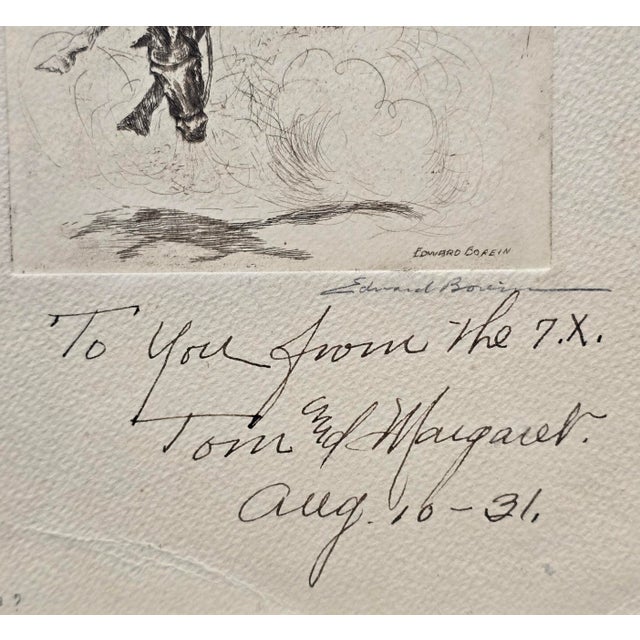
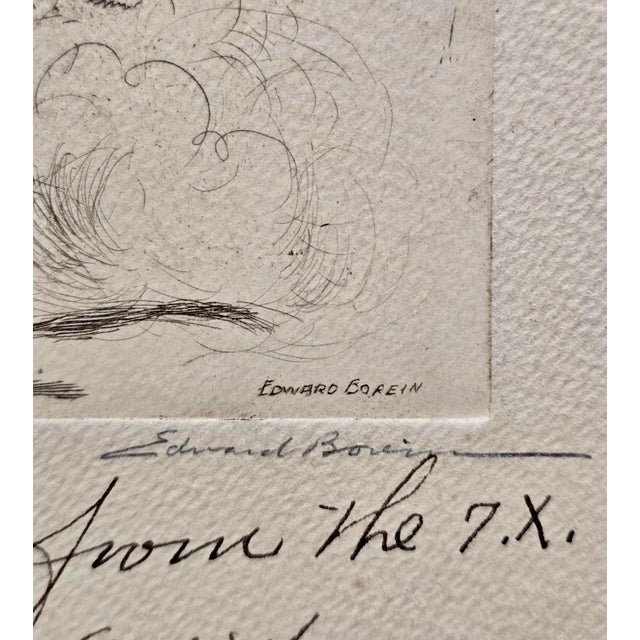
The image bears Borein's name within the plate at lower right and is additionally signed in pencil “Edward Borein” beneath the image.
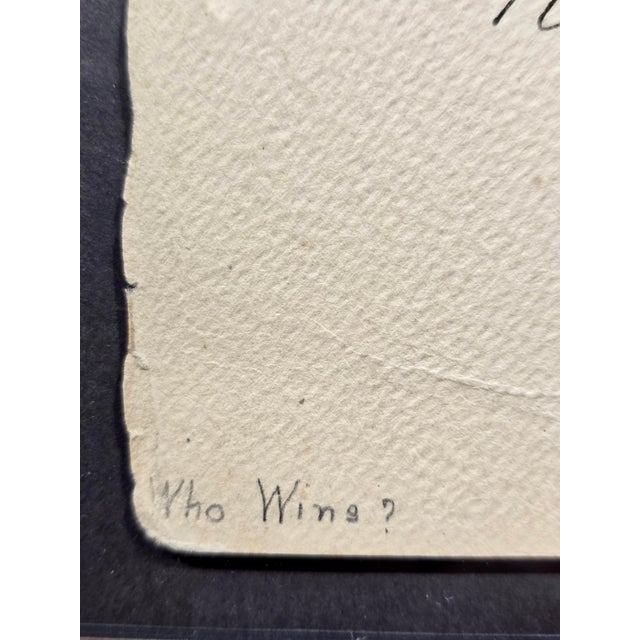
At the lower left, the work is inscribed in pencil:
“Who Wins?”
A prominent period presentation inscription across the lower portion of the sheet reads:
“To You from the 7X.
Tom and Margaret.
Aug. 16 – ’31.”
Far from detracting from the work, this inscription gives this particular impression an unusually personal character and establishes an important connection with the 7X Ranch and its owners.
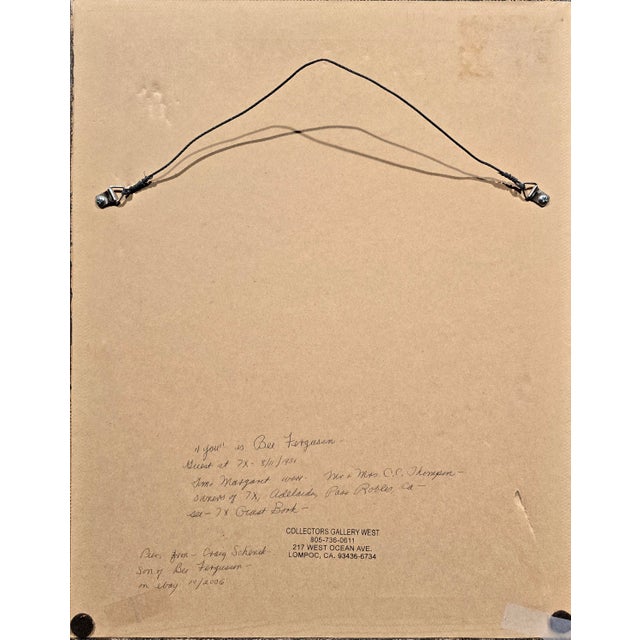
Verso Documentation & Provenance
Handwritten information retained on the backing board provides additional identification of the individuals associated with the presentation. The notes identify “You” as Bee Ferguson, recorded as a guest at the 7X in August 1931, and identify “Tom + Margaret” as Mr. and Mrs. C. C. Thompson, owners of the 7X at Adelaida near Paso Robles, California.
The backing further records:
“Pur. from – Craig Schenck – Son of Bee Fergussen – on ebay 10/2006”
and references the 7X Guest Book as supporting documentation.
The backing also carries the stamp of Collectors Gallery West, Lompoc, California, providing an additional element in the work's modern ownership and gallery history.
Based upon the documentation accompanying the work, the provenance may therefore be summarized as:
C. C. Thompson and Margaret Thompson, 7X Ranch, Adelaida, California;
presented to Bee Ferguson, August 16, 1931;
by descent in the Ferguson family;
Craig Schenck, son of Bee Ferguson;
acquired from the above, October 2006;
Collectors Gallery West, Lompoc, California;
private collection.
This unusually specific chain of ownership substantially enhances the historical interest of the impression, particularly because the original 1931 presentation inscription remains directly on the sheet.
John Edward Borein and the American West
Born in San Leandro, California, in 1872, John Edward Borein developed his knowledge of Western life not from romanticized accounts but through direct experience. As a young man he worked as a cowboy and traveled extensively through California, Arizona, New Mexico, Mexico, and Central America, constantly drawing the horses, cattle, vaqueros, Indigenous peoples, missions, ranches, and landscapes he encountered.
This firsthand familiarity became fundamental to his art. Borein understood how a horse moved, how a cowboy sat in the saddle, how tack rested against an animal, and how the human body reacted to the unpredictable violence of a bucking horse. His drawings therefore possess an immediacy and anatomical credibility that became hallmarks of his work.
After establishing himself as an illustrator in California, Borein spent a period in New York, where he further developed his printmaking technique and became associated with many leading artists and personalities of the Western genre. Among his friends and contemporaries were Charles M. Russell, Will Rogers, Maynard Dixon, and Carl Oscar Borg.
Borein eventually returned to California and settled in Santa Barbara, where he maintained his studio and continued producing drawings, watercolors, etchings, and drypoints devoted to the rapidly disappearing world of the nineteenth-century West.
Today his work is represented in important collections devoted to Western American art and California history, and his etchings remain particularly admired for their combination of technical economy, vigorous line, and firsthand understanding of their subjects.
Historical Character of This Impression
Beyond the strength of Borein's image itself, this example has the additional appeal of being an inscribed presentation impression with a specific date, recipient, ranch association, and documented family descent.
The handwritten inscription transforms the print from an example of Borein's graphic work into an object with its own individual history. Created as an image of the Western experience and subsequently presented within the social world of a working California ranch, Who Wins? preserves both Borein's artistic vision and a small but tangible piece of California ranching history.
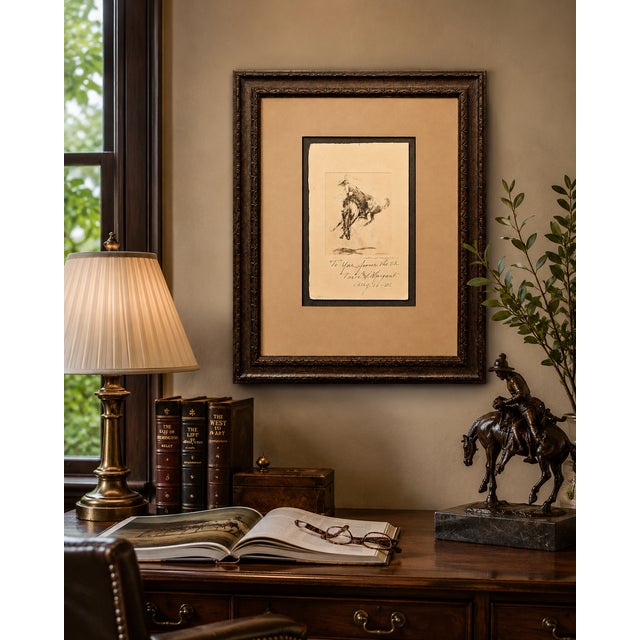
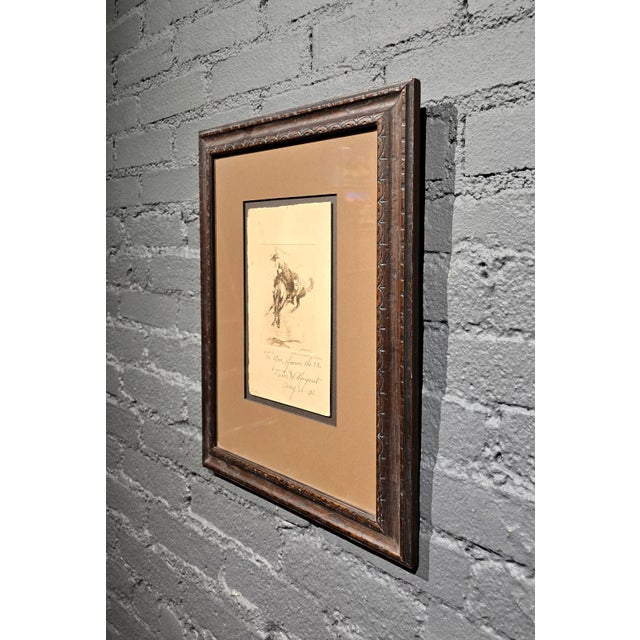
The work is presented under glass with a black inner border and broad warm-toned mat in a carved, dark-stained wood frame whose rustic character complements the Western subject.
See less
- Dimensions
- 16ʺW × 1ʺD × 19ʺH
- Styles
- Americana
- Frame Type
- Framed
- Artist
- Edward Borein
- Period
- 1930s
- Country of Origin
- United States
- Item Type
- Vintage, Antique or Pre-owned
- Materials
- Paper
- Condition
- Good Condition, Original Condition Unaltered, Some Imperfections
- Color
- Onyx
- Condition Notes
- Excellent - Minor wear consistent with age and history Excellent - Minor wear consistent with age and history less
Questions about the item?
Returns & Cancellations
Return Policy - All sales are final 48 hours after delivery, unless otherwise specified in the description of the product.
Cancellation Policy - Prior to shipping or local pickup, buyers may cancel an order for up to 48 hours, unless otherwise specified.
Related Collections
- Medium-Density Fibreboard Original Prints
- Soicher Marin Original Prints
- Rattan Original Prints
- Silver Finish Original Prints
- Robert Kipniss Original Prints
- Dye Transfer Original Prints
- Sam Francis Original Prints
- Johannes Kip Original Prints
- Original Prints in Salt Lake City
- Original Prints in Lexington, KY
- Original Prints in Panama City, FL
- Ralph Lauren Original Prints
- Damien Hirst Original Prints
- Botanical Prints
- Framed Prints
- Bird Prints
- Woodblock Prints
- Screen Prints
- Japanese Woodblock Prints
- Thomas McKnight Original Prints
- George Barbier Original Prints
- Frank Stella Original Prints
- Gustave Baumann Original Prints
- Teak Original Prints
- Chaim Gross Original Prints