

Details
Description
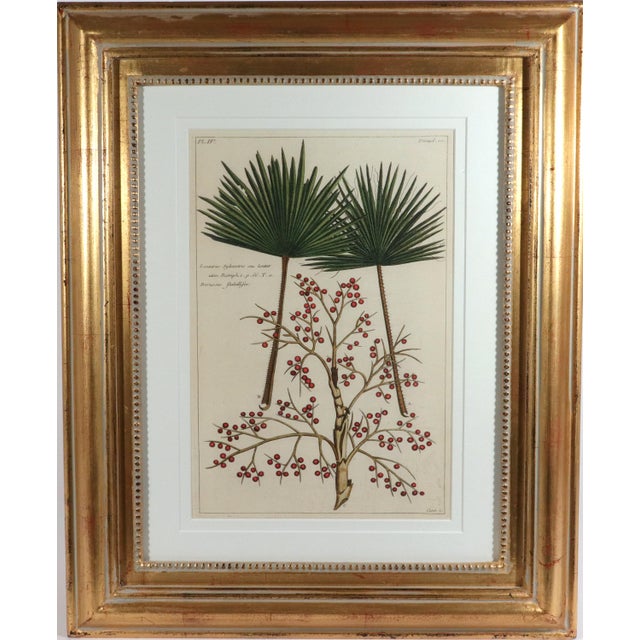
Palmyra Palm Hand-Colored Botanical Engraving, Pierre-Joseph Buc'hoz after Rumphius, Paris, 18th Century
1774–1780
Pierre-Joseph Buc'hoz, Histoire universelle du règne végétal, …
Read more
Palmyra Palm Hand-Colored Botanical Engraving, Pierre-Joseph Buc'hoz after Rumphius, Paris, 18th Century
1774–1780
Pierre-Joseph Buc'hoz, Histoire universelle du règne végétal, after Georg Eberhard Rumphius
Decad. 10, Pl. IV
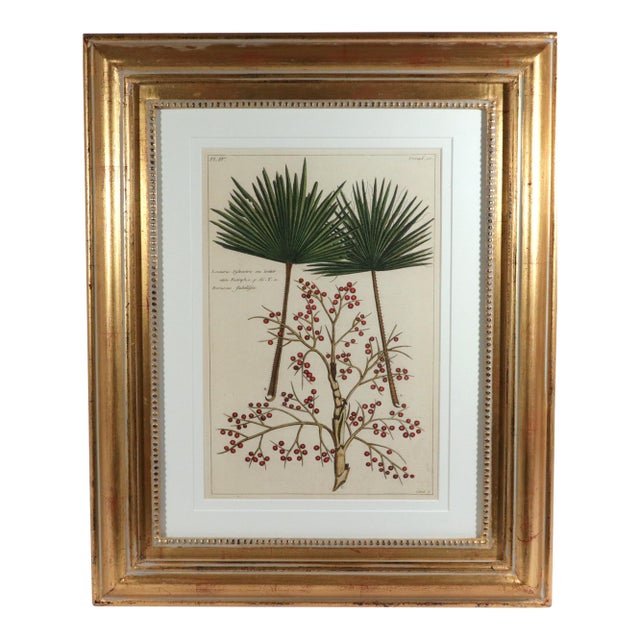
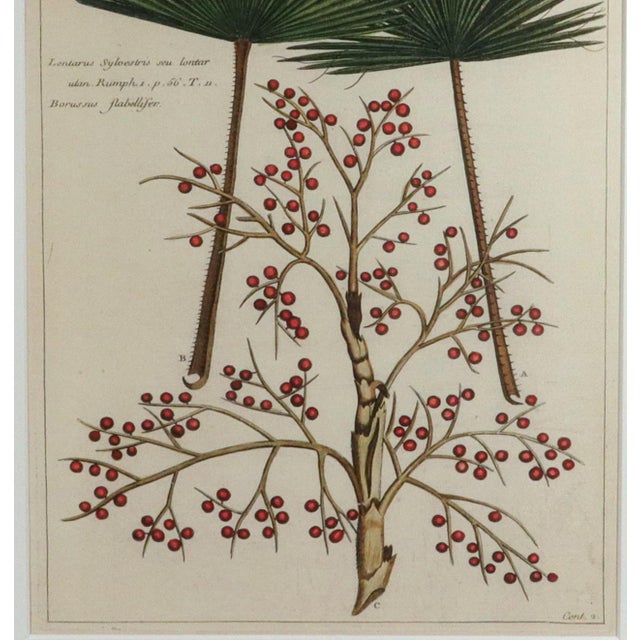
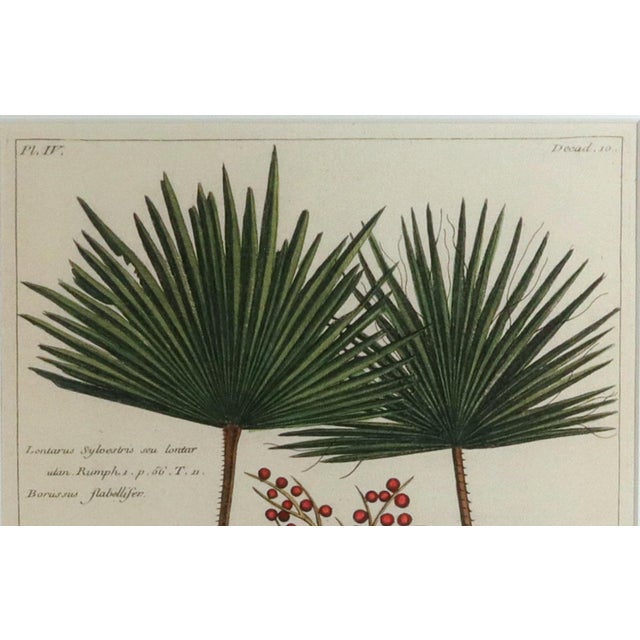
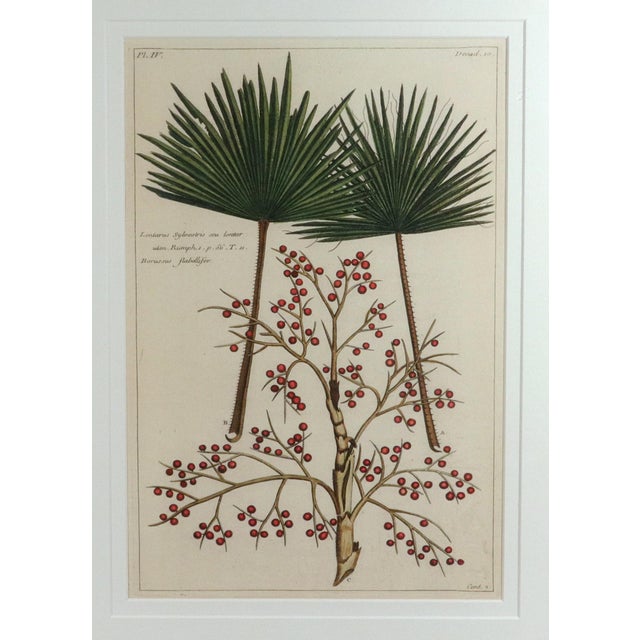
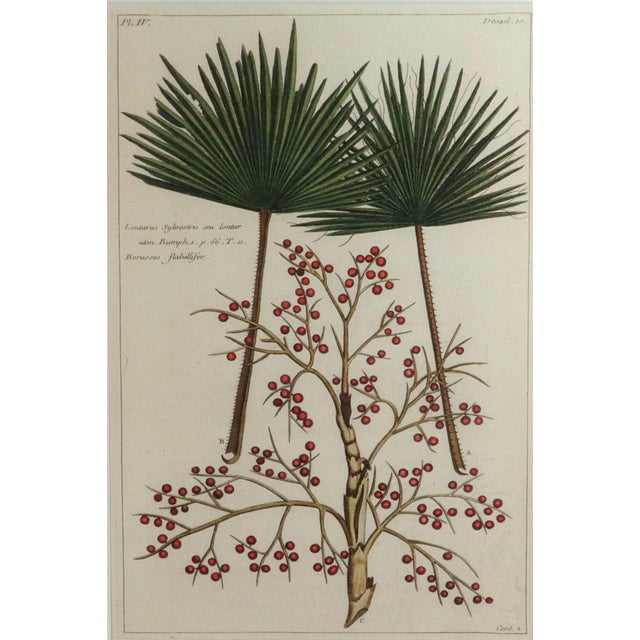
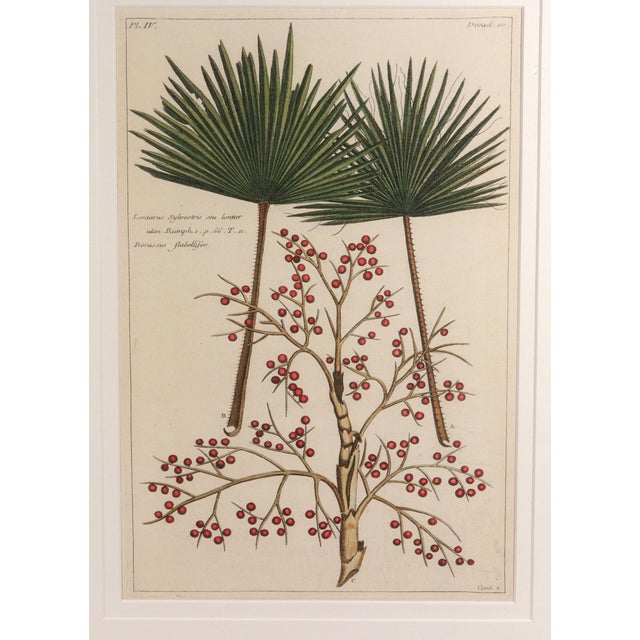
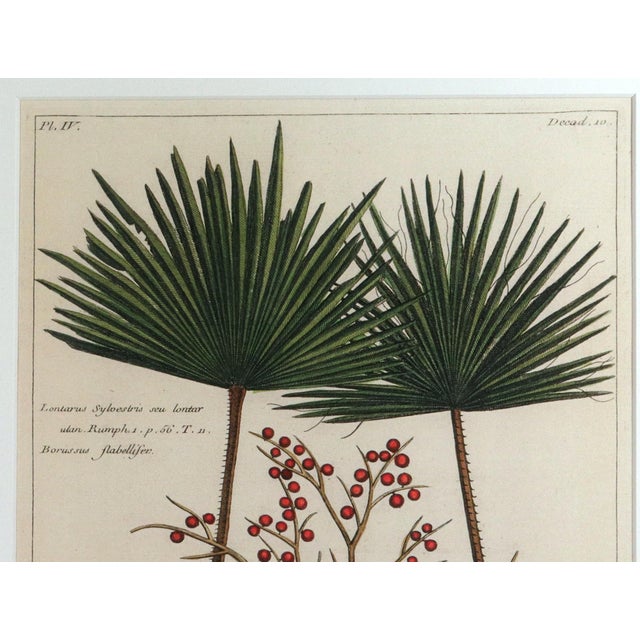
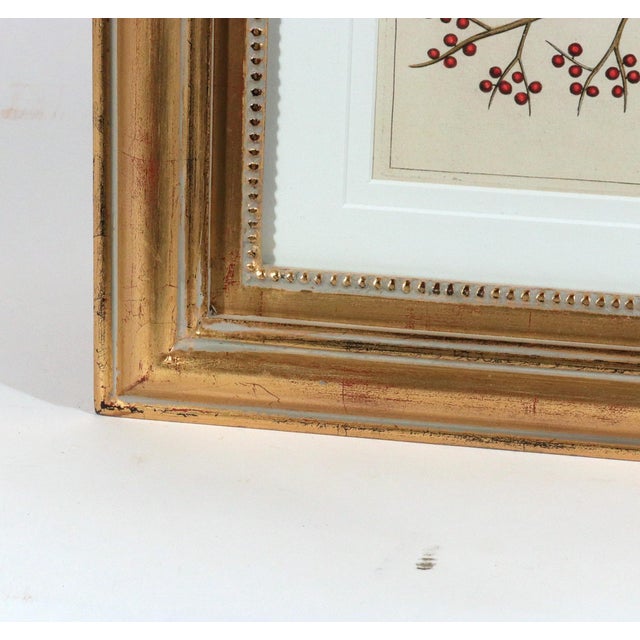
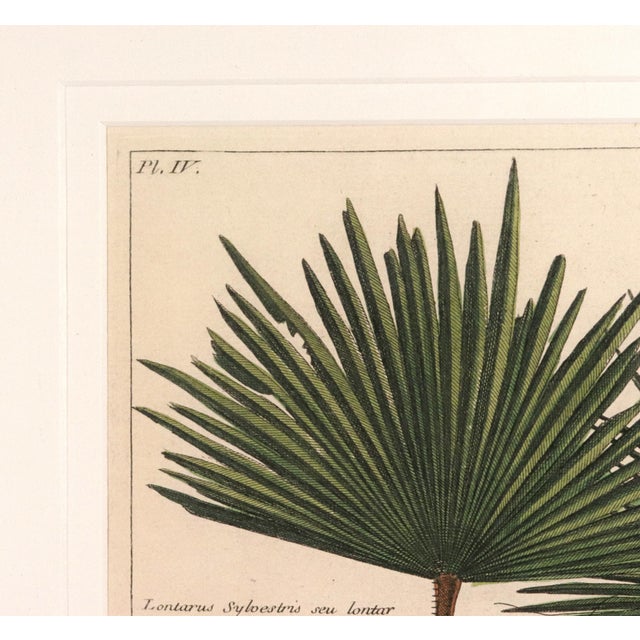
This hand-colored copper engraving depicts the palm the plate names Borassus flabellifer, the Palmyra palm, and comes from Pierre-Joseph Buc'hoz's Histoire universelle du règne végétal, published in Paris between 1774 and 1780. The image is redrawn from Georg Eberhard Rumphius's Herbarium Amboinense, which the inscription cites directly. Two great fan-shaped leaves, colored in deep and pale greens, rise on long stalks edged with fine teeth, their sheathing bases lettered A and B. Between and below them spreads a branched fruiting spray, lettered C at the foot of its sheathed stem and hung with clusters of small round fruits colored a vivid red. The strong verticals, radiating fronds and scattered red fruit give the plate a graphic vitality well beyond its scientific purpose.
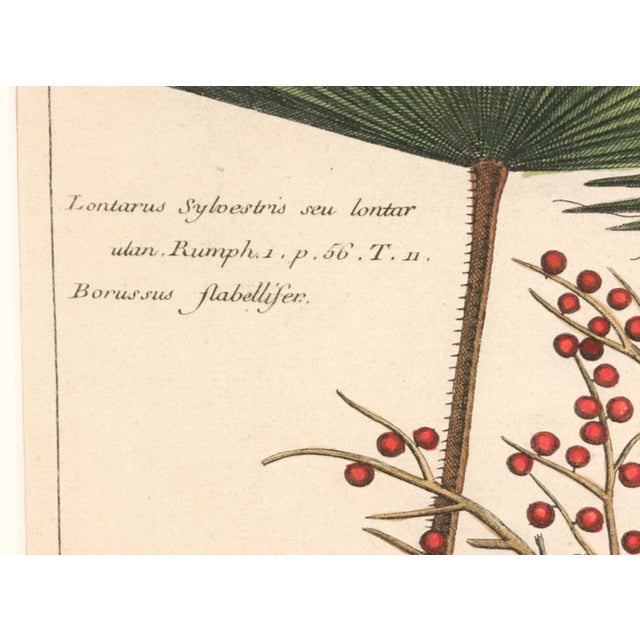
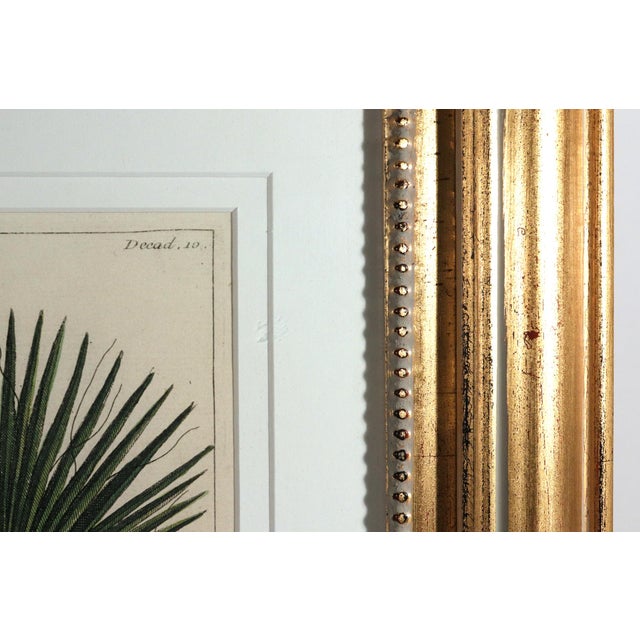
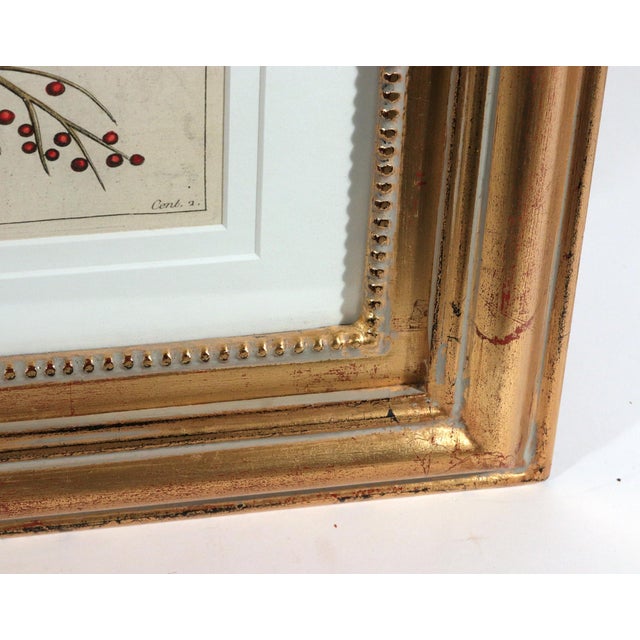
The plate is engraved Pl. IV and Decad. 10 at the upper corners and Cent. 2 at the lower right. The caption at the left reads Lontarus Sylvestris seu lontar ulan. Rumph. 1. p. 56. T. 11. Borussus flabellifer. It gives Rumphius's pre-Linnaean name for the wild lontar palm, his citation (volume 1, page 56, plate 11), and the Linnaean binomial, engraved with the misspelling Borussus.
The Palmyra palm is a species of enormous economic and cultural importance across South and Southeast Asia, yielding palm sugar, toddy, timber, thatch and fiber. Its Indonesian name, lontar, preserved in the caption, is also the word for the palm-leaf manuscripts written on its leaves in Java and Bali.
The print is presented in a white double mat within a molded giltwood frame, the gilding worn to show the red bole beneath, with gray-painted fillets and a beaded inner slip.
The deep greens and scattered reds, set against a warm ground, suit a library, study or garden room. The print hangs well singly over a console or desk, or as part of a group of tropical botanical engravings.
Dimensions (framed)
Height: 21½ inches (54.6 cm)
Width: 17½ inches (44.5 cm)
Depth: 1 inch (2.5 cm)
Provenance
Framed by Trowbridge, London, July 22, 2022 (label on reverse)
Earle D. Vandekar of Knightsbridge
References
Georg Eberhard Rumphius, Herbarium Amboinense, ed. Johannes Burman, vol. 1 (Amsterdam, 1741), p. 56, tab. 11 (the source image)
Gordon Dunthorne, Flower and Fruit Prints of the 18th and Early 19th Centuries (Washington, 1938), no. 59
Claus Nissen, Die botanische Buchillustration (Stuttgart, 1951–1966), no. 287
Georg August Pritzel, Thesaurus Literaturae Botanicae, no. 1325
Wilfrid Blunt and William T. Stearn, The Art of Botanical Illustration (Woodbridge, 1994), pp. 175, 178–179
Historical Context
Pierre-Joseph Buc'hoz (1731–1807), also spelled Buchoz, was born in Metz and trained in law and medicine, taking his medical degree at Nancy in 1763. He served as physician to Stanislas Leszczyński, King of Poland and Duke of Lorraine, and later to Monsieur, brother of Louis XVI, and the comte d'Artois, and became one of the most prolific natural history publishers of the eighteenth century. His Histoire universelle du règne végétal, issued in parts with some 1,200 engraved plates and approved by the Académie des sciences, drew its images from many sources, among them the royal collection of paintings on vellum now in the Muséum national d'Histoire naturelle and the great illustrated floras of the previous generation. Scientific botanists faulted his habit of reusing plates, but his decorative sense has long placed his books among the most appealing plant books of the period.
The source of this image, the Herbarium Amboinense, was the life's work of Georg Eberhard Rumphius (1627–1702), who spent nearly fifty years on Ambon in the Moluccas in the service of the Dutch East India Company. Despite losing his sight in 1670 and much of his work to fire in 1687, he completed his account of the island's flora, published posthumously in Amsterdam between 1741 and 1750 under the editorship of Johannes Burman. Buc'hoz's adaptation adds the Linnaean name, bringing Rumphius's palm into the binomial system introduced in Linnaeus's Species Plantarum (1753).
(Ref: NY11182-iprx)
See less
- Dimensions
- 17.5ʺW × 1ʺD × 21.5ʺH
- Styles
- Illustration
- Traditional
- Art Subjects
- Botanic
- Frame Type
- Framed
- Period
- Late 18th Century
- Country of Origin
- Netherlands
- Item Type
- Vintage, Antique or Pre-owned
- Materials
- Paper
- Condition
- Good Condition, Original Condition Unaltered, Some Imperfections
- Color
- Green
- Condition Notes
- Good condition Good condition less
Questions about the item?
Returns & Cancellations
Return Policy - All sales are final 48 hours after delivery, unless otherwise specified in the description of the product.
Cancellation Policy - Prior to shipping or local pickup, buyers may cancel an order for up to 48 hours, unless otherwise specified.
Related Collections
- Soicher Marin Original Prints
- Medium-Density Fibreboard Original Prints
- Rattan Original Prints
- Original Prints in Panama City, FL
- Ralph Lauren Original Prints
- Original Prints in Salt Lake City
- Damien Hirst Original Prints
- Original Prints in Lexington, KY
- Johannes Kip Original Prints
- Silver Finish Original Prints
- Sam Francis Original Prints
- Dye Transfer Original Prints
- Botanical Prints
- Framed Prints
- Bird Prints
- Woodblock Prints
- Screen Prints
- Japanese Woodblock Prints
- Thomas McKnight Original Prints
- George Barbier Original Prints
- Frank Stella Original Prints
- Gustave Baumann Original Prints
- Teak Original Prints
- Clay Original Prints
- Louis XIII Original Prints