

Details
Description
Hand-Colored Copper Engraving of the Pineapple
Georg Eberhard Rumphius, Herbarium Amboinense, edited by Johannes Burman
Amsterdam, 1741–1750
Decad. 5, Pl. …
Read more
Hand-Colored Copper Engraving of the Pineapple
Georg Eberhard Rumphius, Herbarium Amboinense, edited by Johannes Burman
Amsterdam, 1741–1750
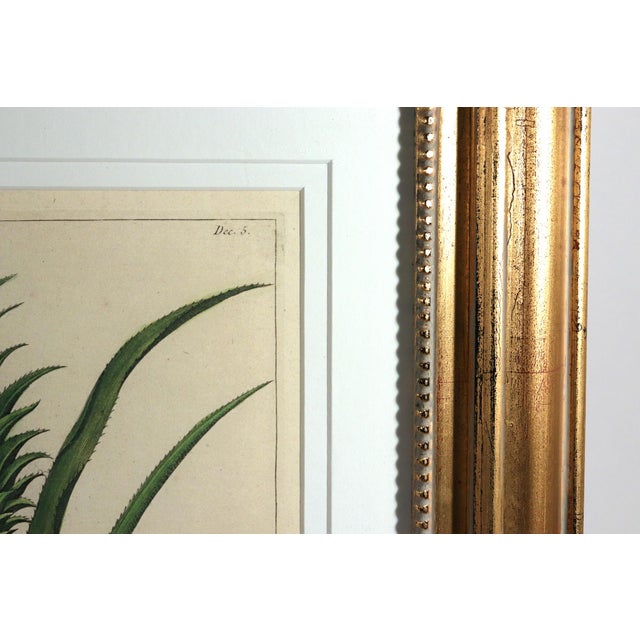
Decad. 5, Pl. IX
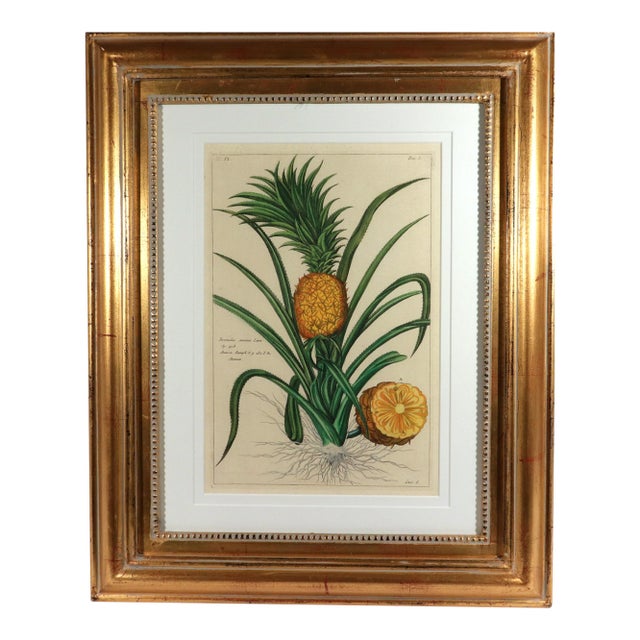
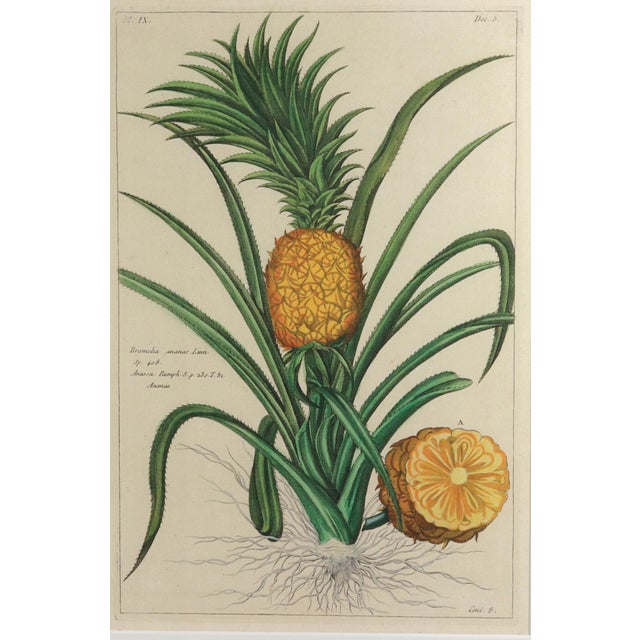
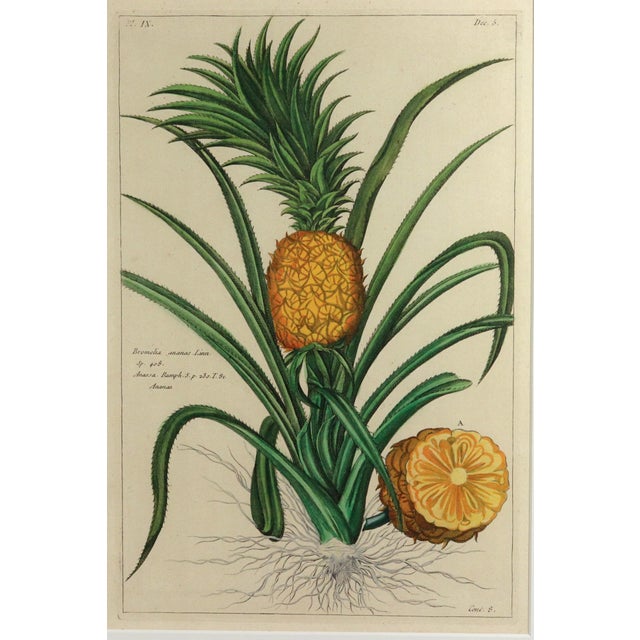
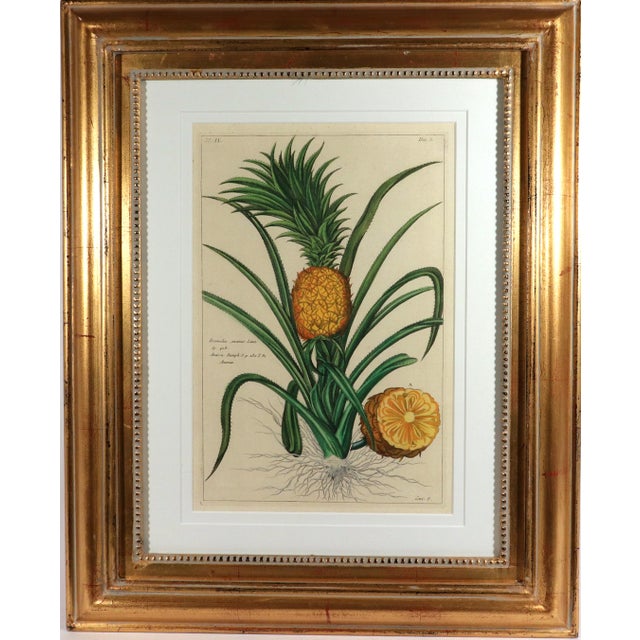
A fine hand-colored copper engraving depicting the pineapple (Bromelia ananas), from the celebrated Herbarium Amboinense of Georg Eberhard Rumphius.
The pineapple, native to South America but long cultivated across tropical Asia by the time Rumphius was writing, carried enormous symbolic and decorative prestige in the seventeenth and eighteenth centuries — a signifier of exotic luxury and hospitality that made botanical depictions of the fruit among the most sought-after of all tropical plant illustrations. Hand-colored copies of the Herbarium Amboinense are considerably rarer than the uncolored state.
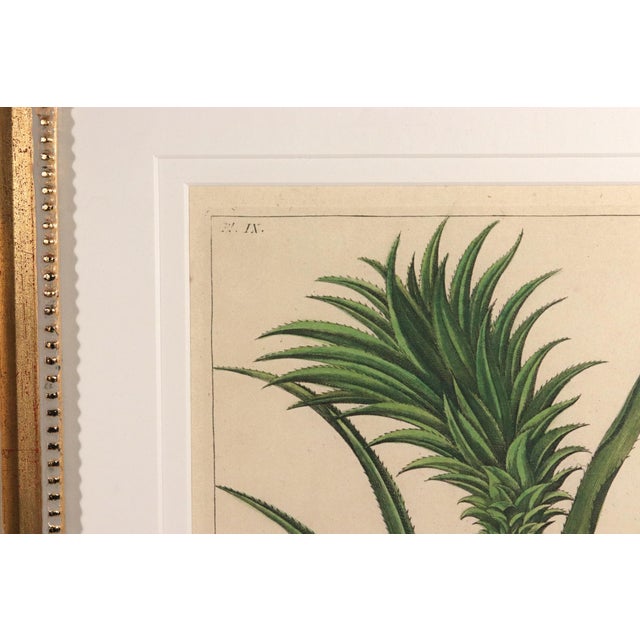
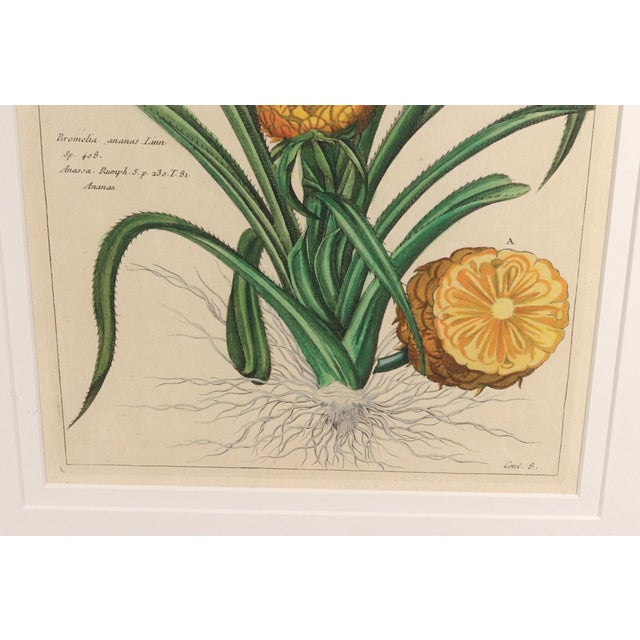
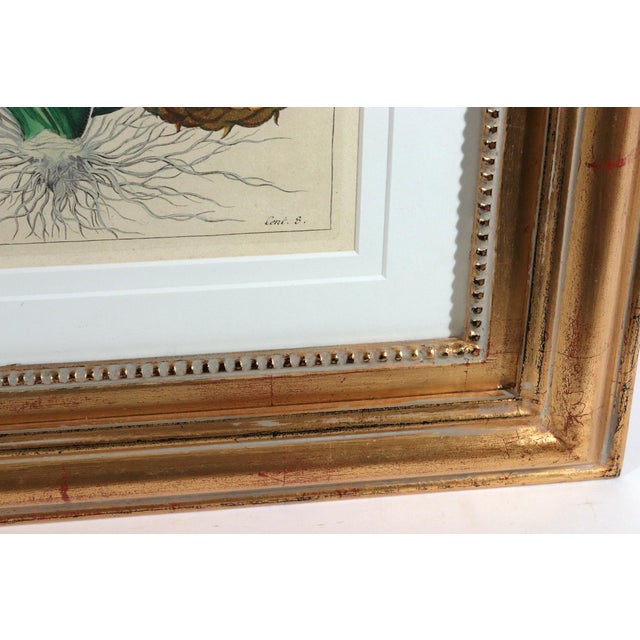
The plant is shown complete from root to crown: the rosette of long, serrated, sword-like leaves — colored in strong greens with pale central striping — rises from a mass of exposed fibrous roots, while the ripe fruit, rendered in vivid golden yellow, emerges from the centre of the plant surmounted by its spiky foliar crown. To the lower right, a subsidiary figure (A) shows the fruit in cross-section, its interior depicted in rich amber and yellow. The plate is inscribed Bromelia ananas Linn. Sp. 408, with the Rumphius citation Anassa Rumph. 5, p. 230, T. 81, and the common name Ananas.
Dimensions
21½ inches (54.6 cm) high by 17½ inches (44.5 cm) wide by 1 inch (2.5 cm) deep, framed.
Provenance
Framed by Trowbridge in London, July 22, 2022 (label on reverse).
Earle D. Vandekar of Knightsbridge
Historical Context
Georg Eberhard Rumphius (1627–1702) spent fifty years on the island of Amboina in the Moluccas as a botanist for the Dutch East India Company, cataloguing the flora of the Indonesian archipelago with extraordinary thoroughness despite going blind in 1670 and suffering the destruction of his manuscript in a catastrophic fire in 1687.
His Herbarium Amboinense — published posthumously in Amsterdam between 1741 and 1750 under the editorship of Johannes Burman, director of the Amsterdam Botanic Garden — remains the foundational reference for the botany of the Moluccas and a landmark of eighteenth-century natural history illustration. The work appeared in six bilingual Dutch and Latin volumes, issued in parts known as decades (groups of ten plates), each inscribed with Rumphius's own references alongside the Linnaean binomial nomenclature introduced in Species Plantarum (1753).
(Ref: NY11181-nprx)
See less
- Dimensions
- 17.5ʺW × 1ʺD × 21.5ʺH
- Styles
- Traditional
- Frame Type
- Framed
- Art Subjects
- Botanic
- Period
- Mid 18th Century
- Country of Origin
- Netherlands
- Item Type
- Vintage, Antique or Pre-owned
- Materials
- Engraving
- Condition
- Good Condition, Original Condition Unaltered, Some Imperfections
- Color
- Green
- Condition Notes
- Good condition Good condition less
Questions about the item?
Returns & Cancellations
Return Policy - All sales are final 48 hours after delivery, unless otherwise specified in the description of the product.
Cancellation Policy - Prior to shipping or local pickup, buyers may cancel an order for up to 48 hours, unless otherwise specified.
Related Collections
- Medium-Density Fibreboard Original Prints
- Rattan Original Prints
- Soicher Marin Original Prints
- Johannes Kip Original Prints
- Sam Francis Original Prints
- Damien Hirst Original Prints
- Silver Finish Original Prints
- Dye Transfer Original Prints
- Original Prints in Lexington, KY
- John Kiraly Original Prints
- Donald Sultan Original Prints
- Original Prints in Panama City, FL
- Original Prints in Salt Lake City
- Ralph Lauren Original Prints
- Framed Prints
- Botanical Prints
- Bird Prints
- Woodblock Prints
- Screen Prints
- Japanese Woodblock Prints
- Thomas McKnight Original Prints
- George Barbier Original Prints
- Frank Stella Original Prints
- Gustave Baumann Original Prints
- Teak Original Prints