

Details
Description
An extraordinary find for the connoisseur of early Americana, this offering features a spectacular, matched pendant pair of original 19th-century …
Read more
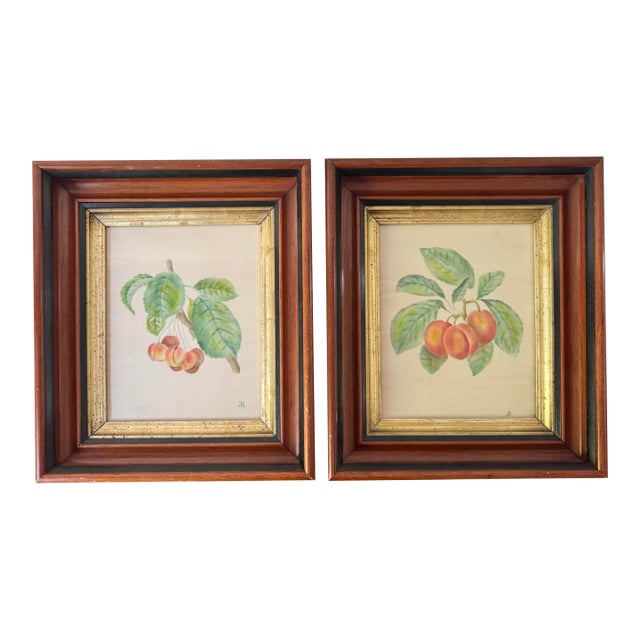
An extraordinary find for the connoisseur of early Americana, this offering features a spectacular, matched pendant pair of original 19th-century American theorem paintings on velvet. Sourced together and preserved in their original matching period frames, these companion pieces capture the naive elegance and material luxury of early Victorian domestic curation.
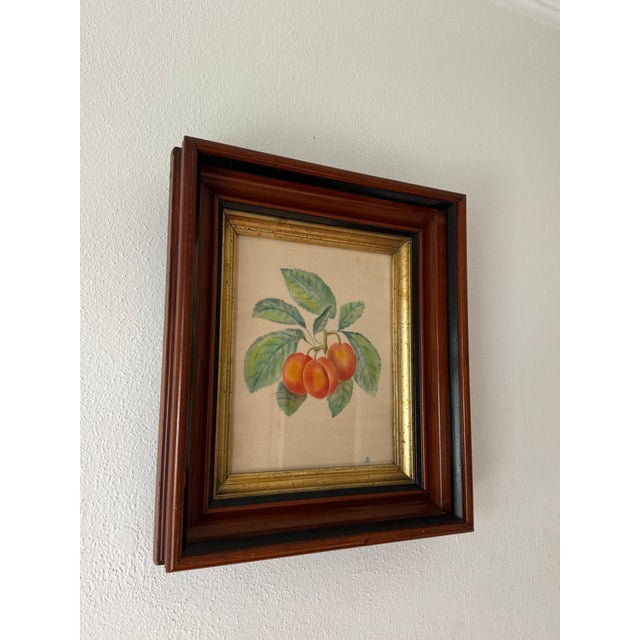
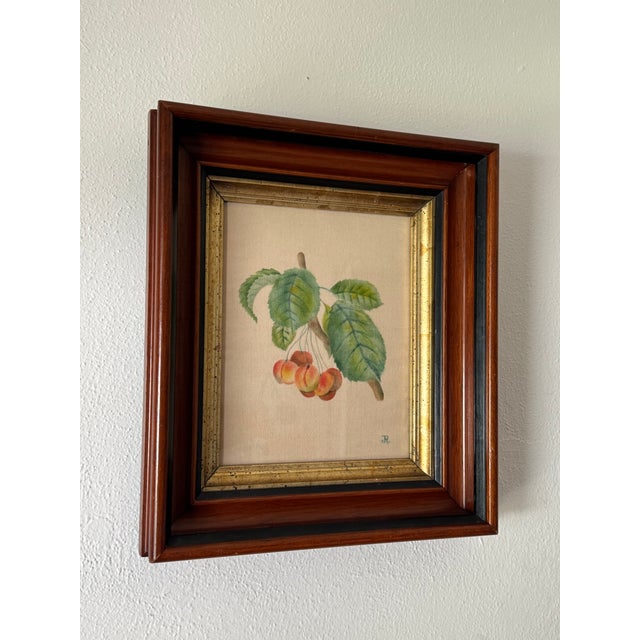
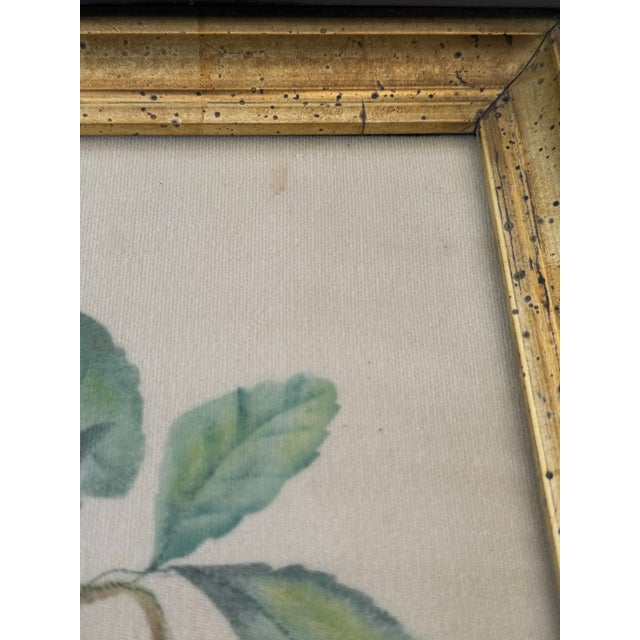
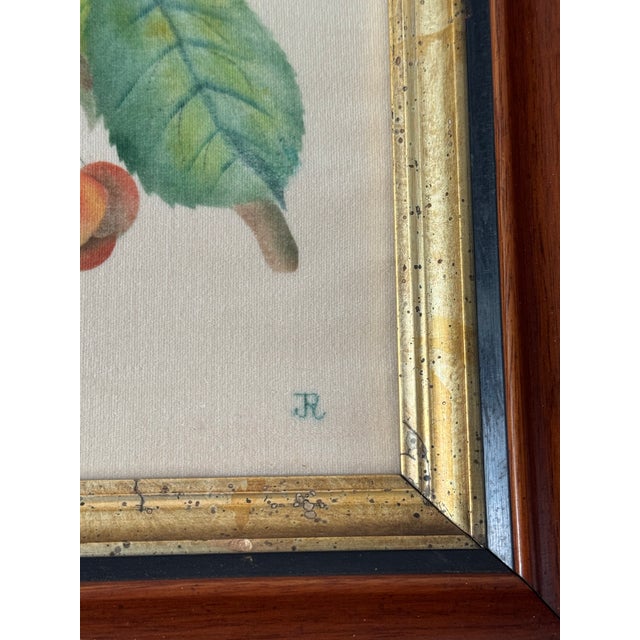
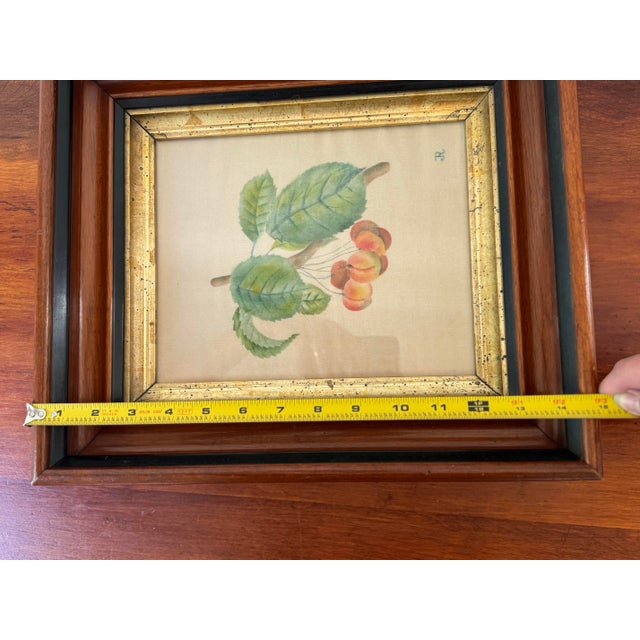
Each piece is hand-painted on a cream-colored velveteen ground that has aged to a warm, rich ivory patina. The first composition features a beautifully balanced study of three ripe stone fruits—evoking the lush, heavy warmth of late-summer plums or apricots—nestled amongst stenciled, hand-finished green leaves. Its matching companion piece depicts a complementary arrangement of ripe peaches, echoing the same organic forms and vibrant, autumnal color palette. The artist has signed the lower margin of the plum study with the initials "JR," a highly coveted detail as the vast majority of period theorems remained unsigned.
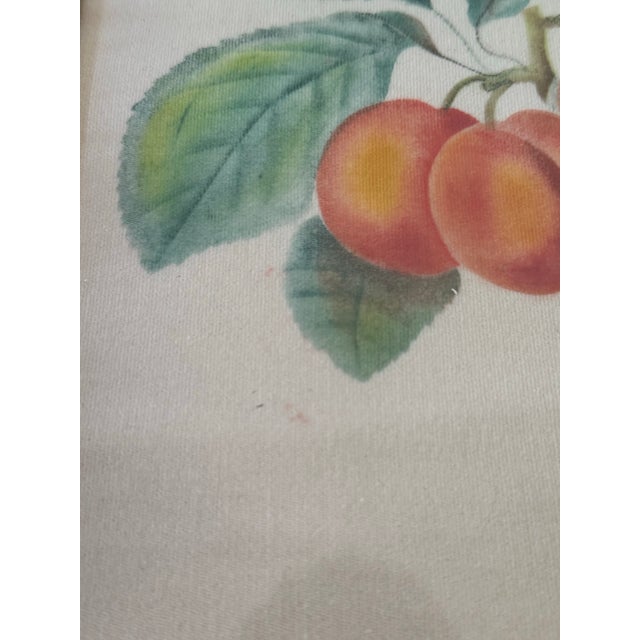
The physical magic of these pieces lies in the unique interaction between the pigment and the textile support. Rather than reflecting light as canvas or paper does, the soft velvet pile absorbs ambient light, allowing the warm amber, peach, and deep red tones of the fruit to project forward with a three-dimensional, glowing intensity.
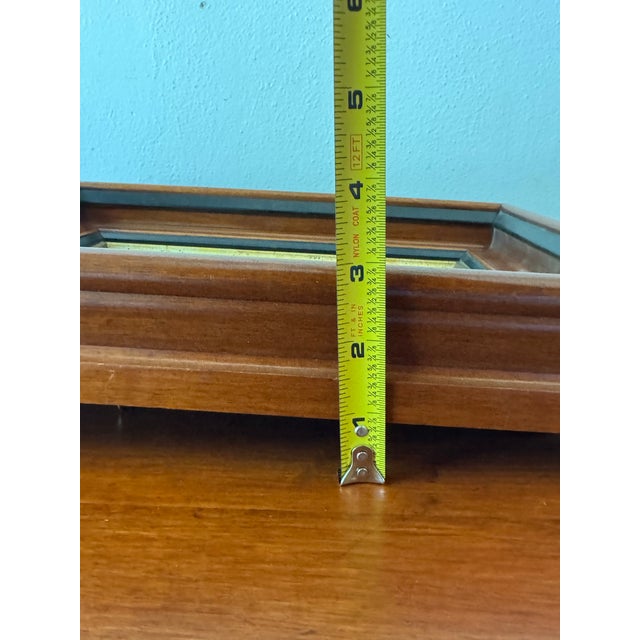
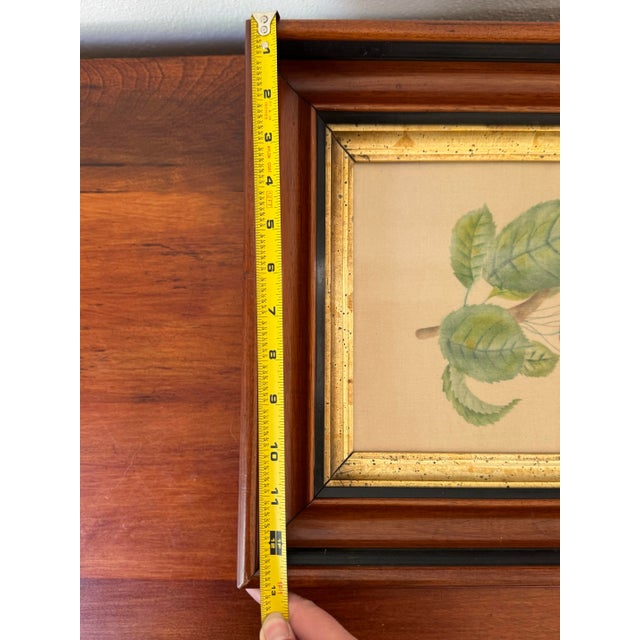
Both paintings are housed in their magnificent, original mid-19th-century American stepped wood frames. Crafted with rich mahogany veneer, each frame is detailed with an ebonized cove liner and a hand-gilded gold inner slip. The frames display an authentic, gorgeous patina with minor wood wear and gentle scuffs consistent with their near 180-year history.
Acquiring a unified pendant pair of 19th-century theorems is a rare triumph. Perfect for traditional, grandmillennial, or historic farmhouse interiors, this pair brings an unmatched layer of texture, symmetry, and authentic historical soul to any editorial space.
History of American Theorem Art
Theorem painting, historically referred to as Poonah or stencil painting, represents one of the most significant decorative arts practiced in early-to-mid 19th-century America. The art form's popularity was heavily driven by the rise of elite female academies and finishing schools throughout New England, Pennsylvania, and the Mid-Atlantic states. In these institutions, young women of prominent families were educated in the "polite arts"—including embroidery, watercolor, and stenciling—which were viewed as essential markers of social refinement, taste, and preparation for running a sophisticated household.
The technical process of theorem painting was first popularized in Western art instruction manuals around 1830, notably by Matthew Finn, who described it as a systematic method of constructing a composition by applying pigments through a series of stencils. To create these stencils, instructors or advanced students traced designs onto drawing paper that had been treated with linseed oil to render it transparent, then coated on both sides with protective varnish. Once dried, this stiff, non-absorbent "horn paper" was carefully cut using a sharp penknife.
The choice of velvet as a support medium was a deliberate statement of luxury. In the 19th century, velvet remained a highly prized and expensive textile, associated with high fashion, wealthy domestic interiors, and religious iconography. Painting on velvet, however, presented extreme technical challenges that separated amateur hobbyists from skilled artisans.
Because velvet features a raised, three-dimensional pile, applying standard wet paint was impossible. Excess moisture would cause the fibers of the pile to clump, ruin the fabric's soft sheen, and lead to heavy paint cracking as the textile expanded and contracted with atmospheric changes. To overcome this, theorem artists utilized an incredibly dry-brush technique. The brush was dipped in pigment and then rigorously rubbed onto scrap paper or fabric until it carried only a trace of nearly dry color. The artist then swept the brush lightly across the stencil, depositing color only onto the microscopic tips of the velvet fibers.
This meticulous layering technique, combined with the dry pigment application, created a luminous, translucent glaze effect. The unpainted, creamy velvet surrounding the central fruit composition acts as a negative space that absorbs ambient light, creating a deep, soft contrast that makes the warm colors of the plums, apricots, and peaches appear to glow from within.
See less
- Dimensions
- 13ʺW × 3ʺD × 15ʺH
- Art Subjects
- Botanic
- Still Life
- Frame Type
- Framed
- Period
- Mid 19th Century
- Country of Origin
- United States
- Item Type
- Vintage, Antique or Pre-owned
- Materials
- Velvet
- Condition
- Good Condition, Original Condition Unaltered, Some Imperfections
- Color
- Cream
- Condition Notes
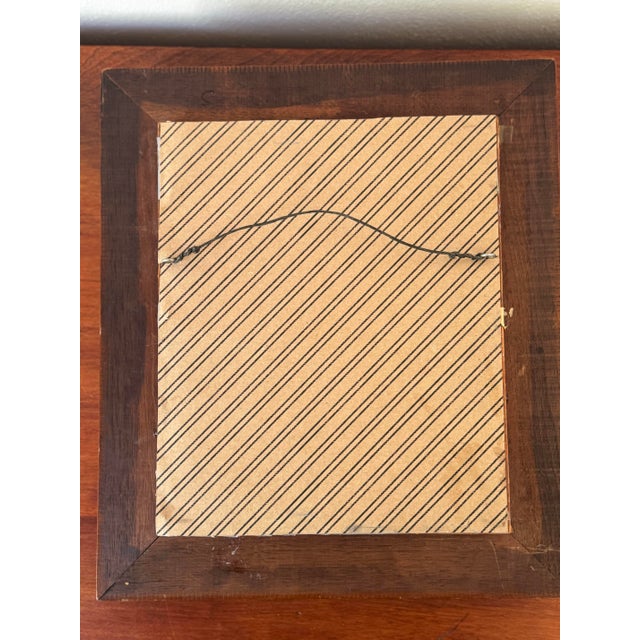
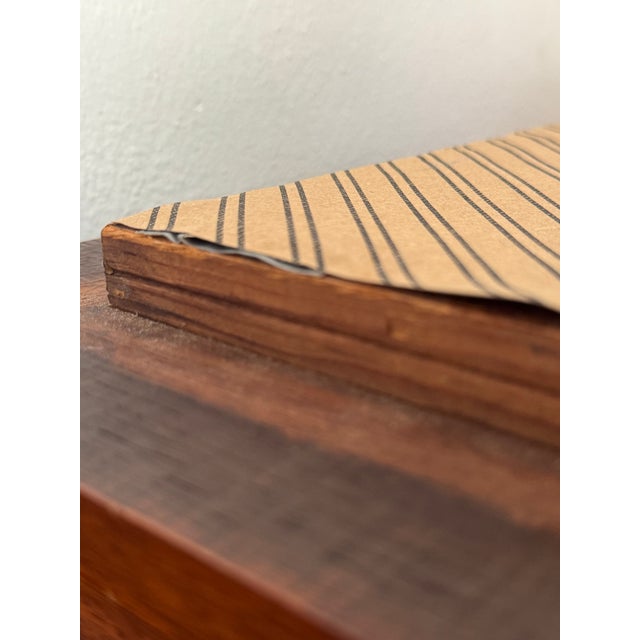
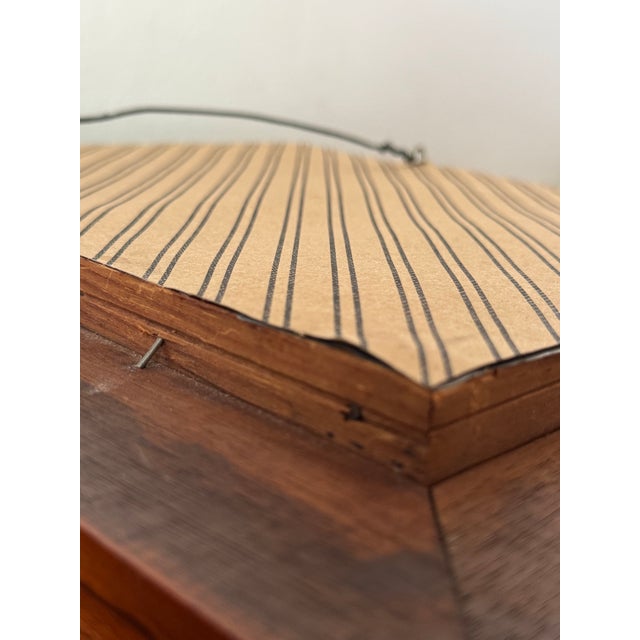
- Very good antique condition. Velvet displays natural overall toning and light, age-appropriate spotting. Frames show stable wear, minor wood scuffs, … moreVery good antique condition. Velvet displays natural overall toning and light, age-appropriate spotting. Frames show stable wear, minor wood scuffs, and gentle discoloration to the gilt surface consistent with age. The original paper backing of one painting has begun to slightly lift. less
Questions about the item?
Returns & Cancellations
Return Policy - All sales are final 48 hours after delivery, unless otherwise specified in the description of the product.
Cancellation Policy - Prior to shipping or local pickup, buyers may cancel an order for up to 48 hours, unless otherwise specified.
Related Collections
- Photorealism Canvas Paintings
- Ed Ruscha Paintings
- Photorealism Paintings in New York
- Richard Serra Paintings
- Jo Baskerville Paintings
- Louise Nevelson Paintings
- Karen Offutt Paintings
- Nicola Simbari Paintings
- Herman Miller Paintings
- BDDW Paintings
- Jaanika Peerna Paintings
- Leroy Neiman Paintings
- Jeff Slemmons Paintings
- Vienna Secession Paintings
- Johannes Andersen Paintings
- Pedro Friedeberg Paintings
- Peter Behrens Paintings
- Piet Hein Eek Paintings
- Raphael Paintings
- Carl-Axel Acking Paintings
- Karl-Erik Ekselius Paintings
- Hans Andersen Paintings
- Jean-Paul Barray Paintings
- Cassina Paintings
- Soicher Marin Paintings