

Details
Description
A rare and most charming authentic antique Italian Chinoiserie decorated poudreuse (dressing table) with beautifully aged original patina and interesting …
Read more
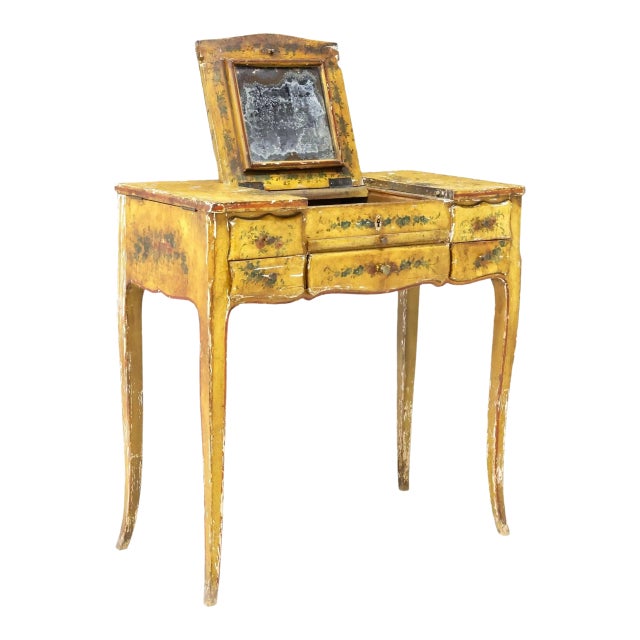
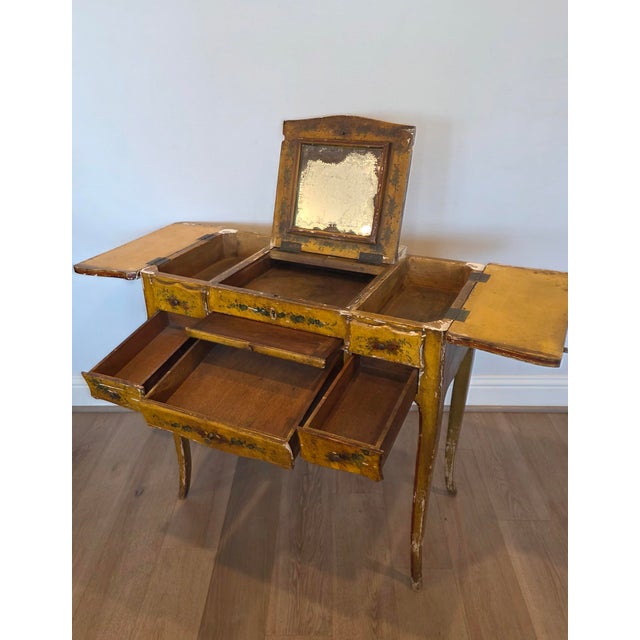
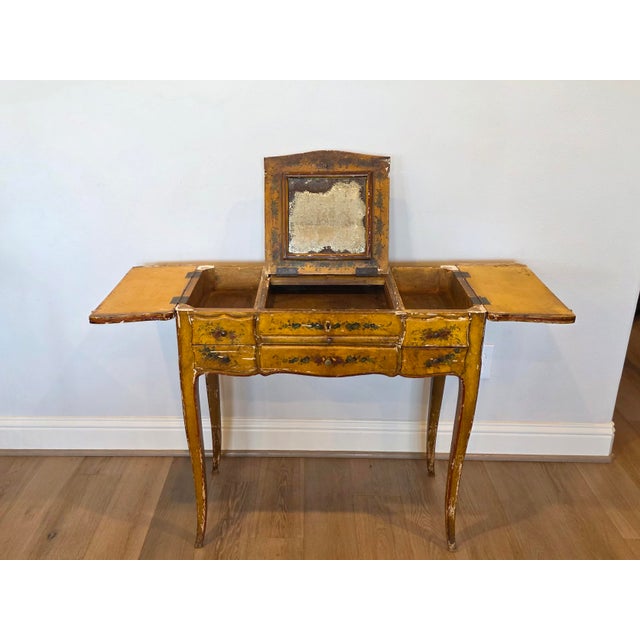
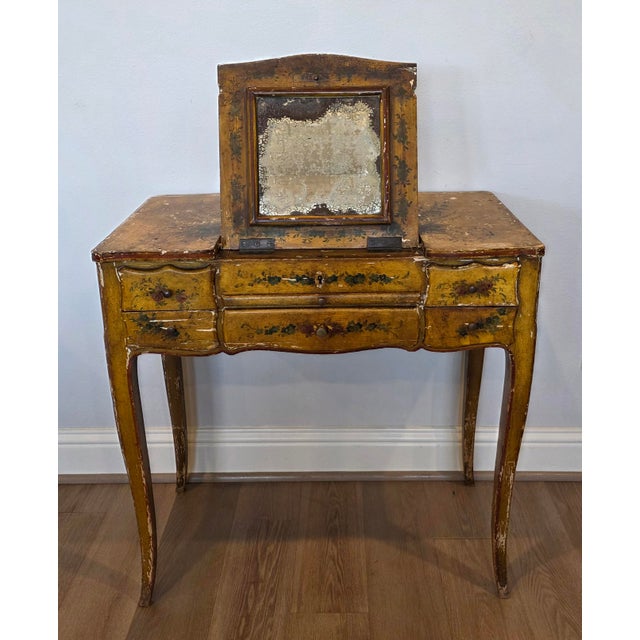
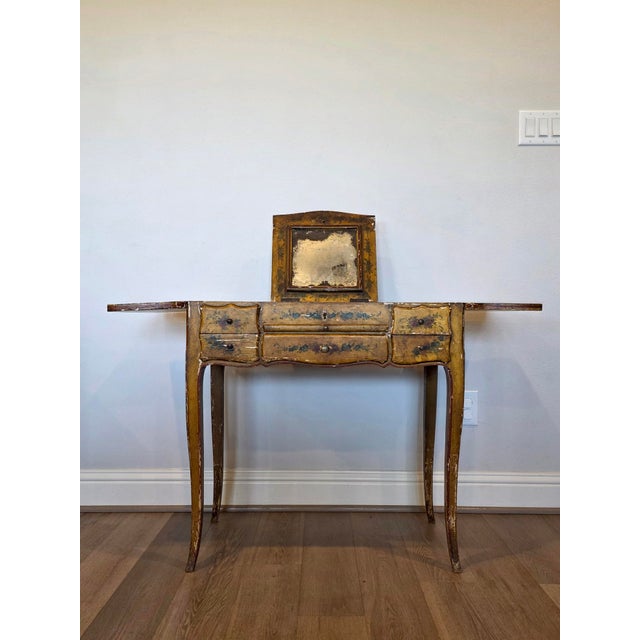
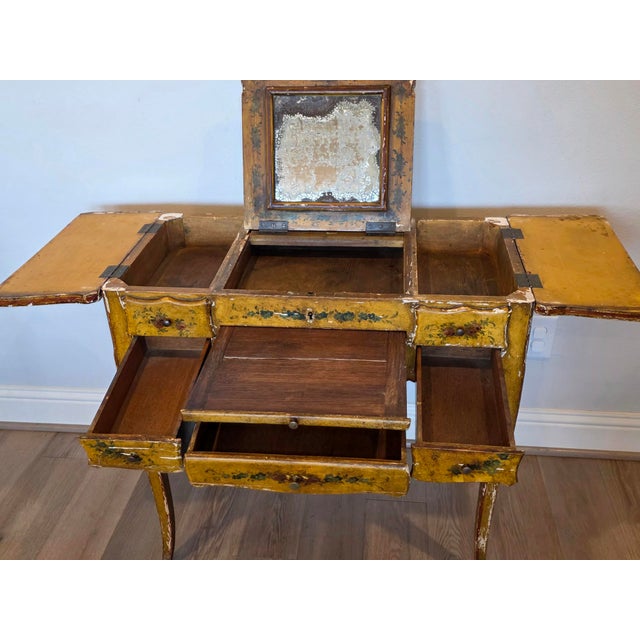
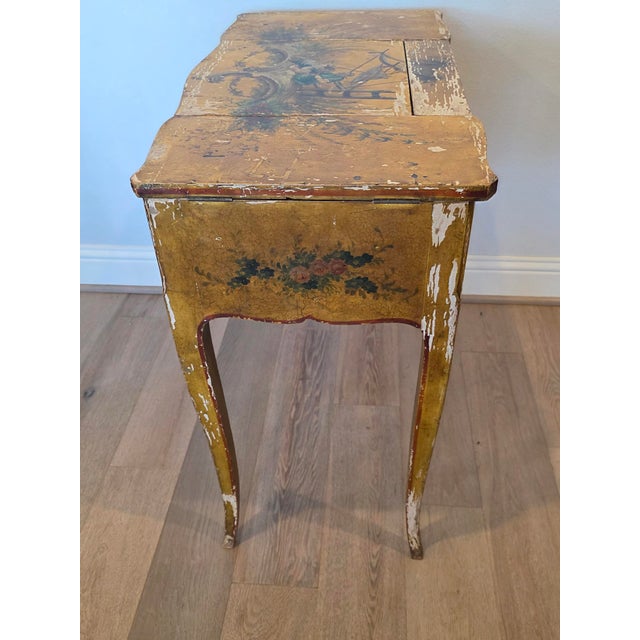
A rare and most charming authentic antique Italian Chinoiserie decorated poudreuse (dressing table) with beautifully aged original patina and interesting provenance.
Venice, Italy, 18th century
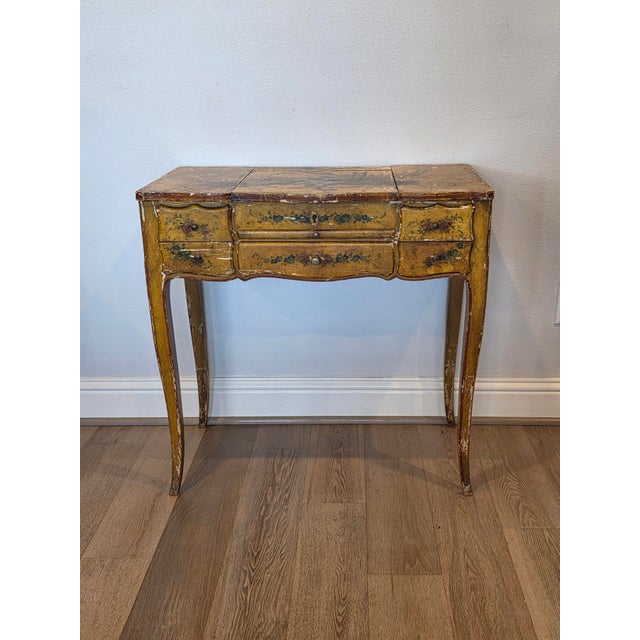
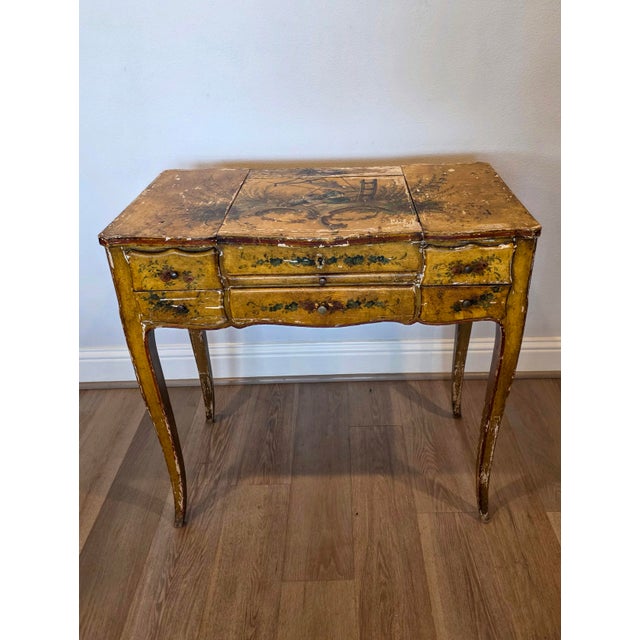
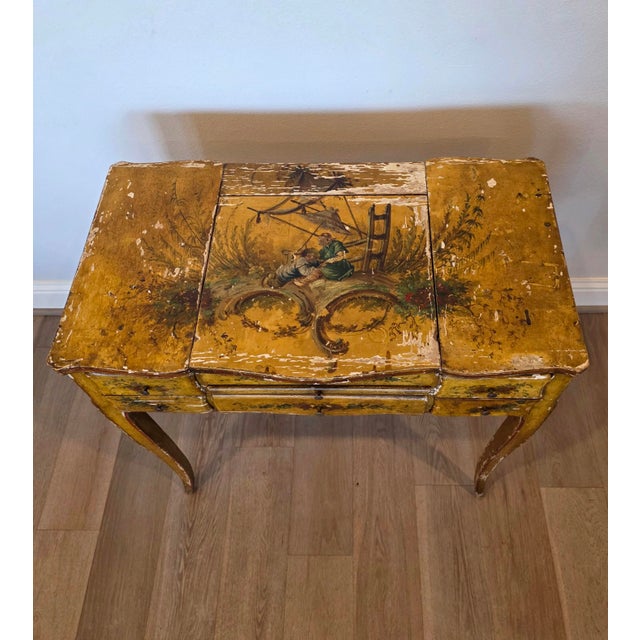
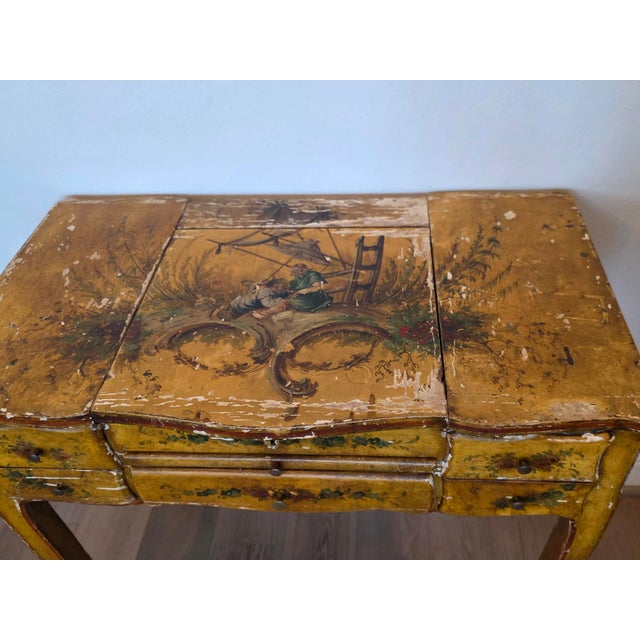
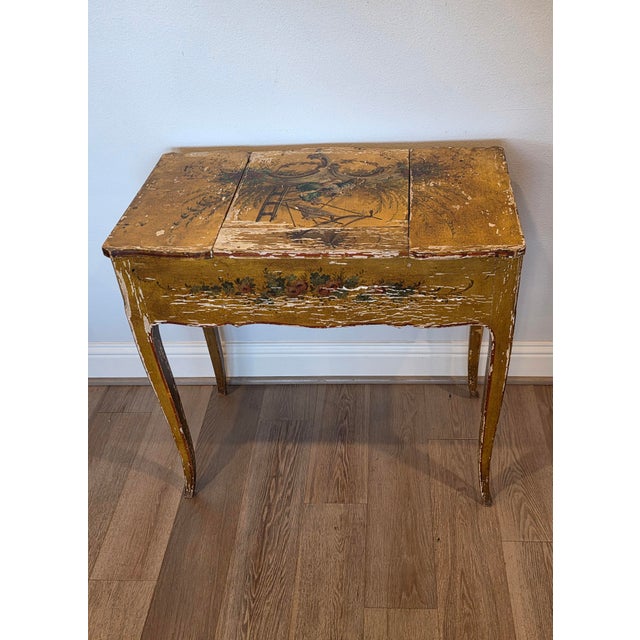
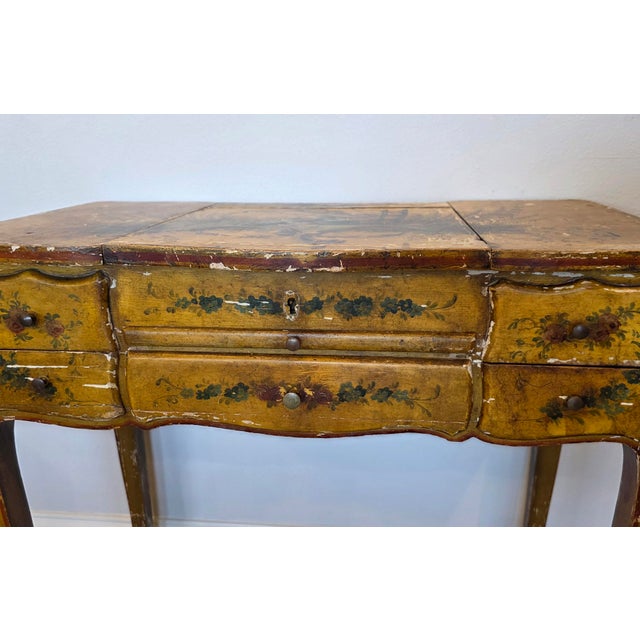
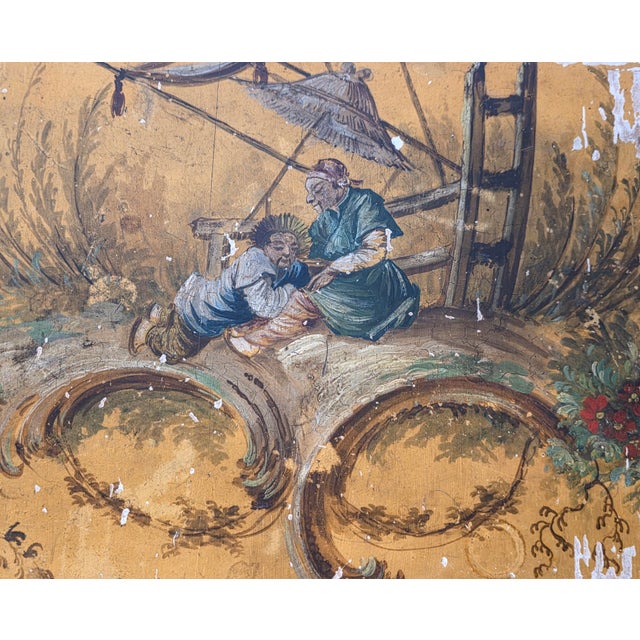
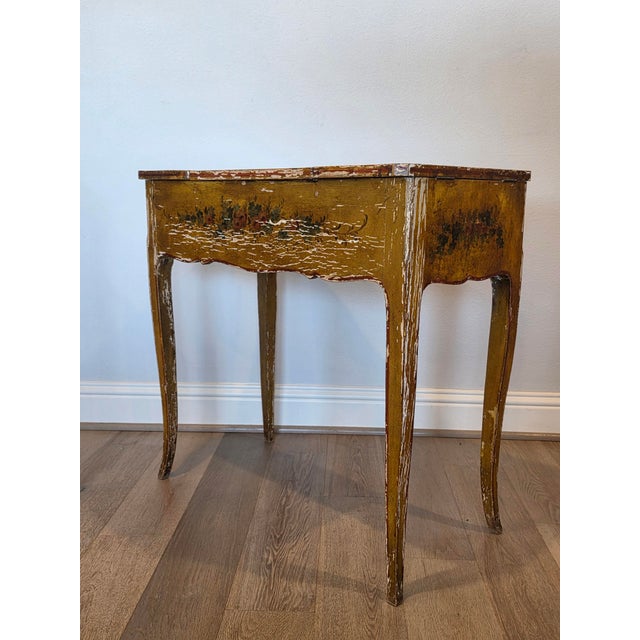
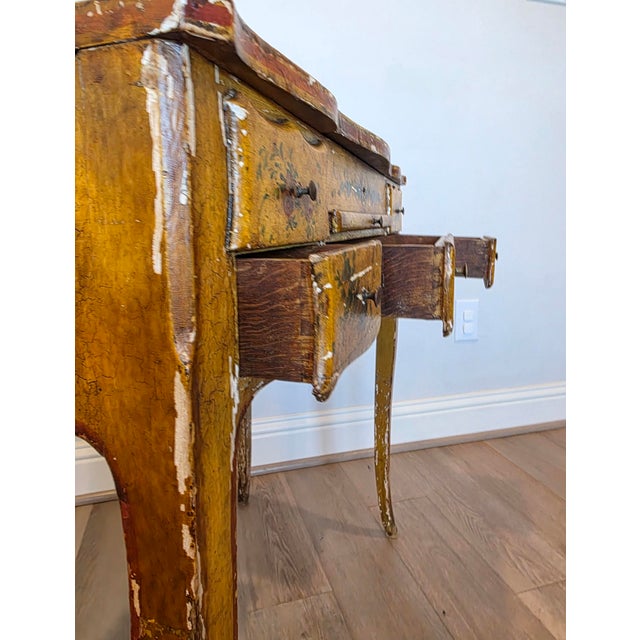
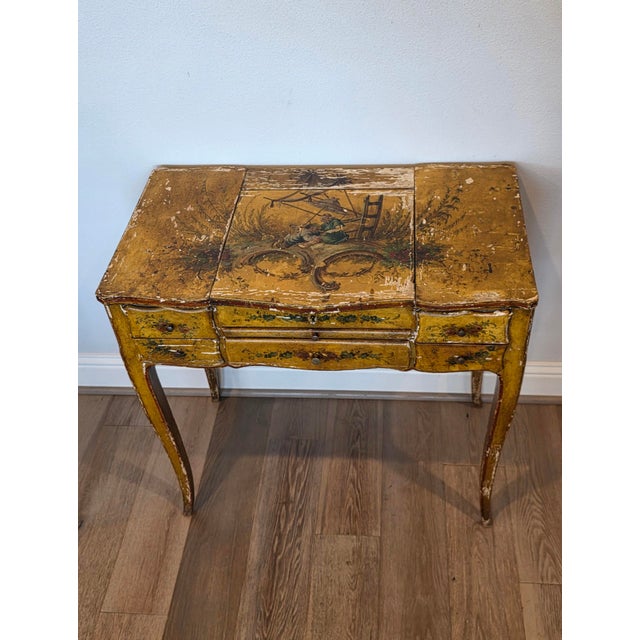
A wonderful way to add elegant sophistication, intimate dramatic presence, chic romantic warmth, and rich historical depth to any space! Exceptionally executed in distinct regional Louis XV period (1715-1774) Venetian Rococo taste, handcrafted of solid pine with oak secondary wood, finished on all sides in a worn warm yellow ochre paint finish outlined with red banding, accented by hand-painted floral sprays and detailed figural oriental pastoral scene.
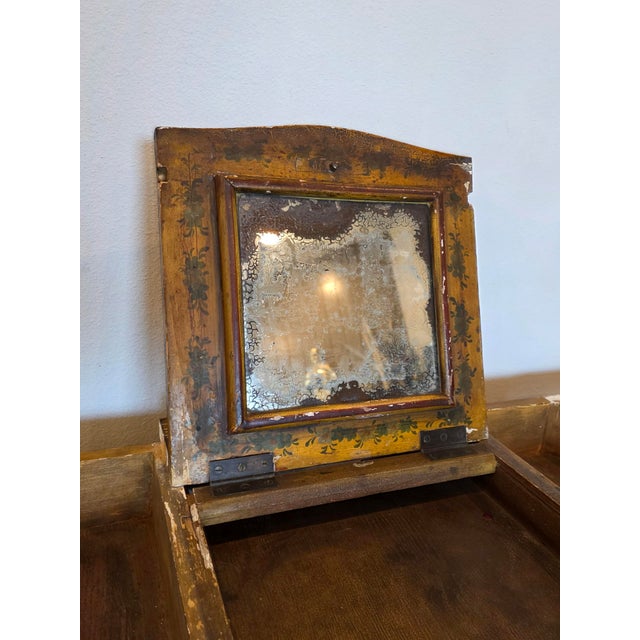
Petite light airy small-scale, having a rectangular shaped front top with central sliding lift-top panel revealing the prized original "looking glass" flat mercury glass mirror plate with visually striking foxing patina, over shallow open storage, flanked by outward flip-top panels opening to interior compartments, above a pair of faux drawer-fronts, the case fitted with a frontal wooden writing slide, over three dovetailed drawers, gently scalloped apron, rising gracefully on tall slender cabriole legs. circa 1760
- PROVENANCE / ACQUISITION -
From the collection of Kathryn V. Alexander, an antiques dealer and designer with over 20 years of experience operating shops in New Orleans, Louisiana, and Middleburg, Virginia. Kathryn retired in 2020 and now lives in Georgetown, Texas
Acquired from the above owner through the highly reputable auction house, Austin Auction Gallery, est.1983, Austin, Texas. 1-16-26, January 2026 New Year New Treasures Auction catalog, lot #3427
- DIMENSIONS -
Closed: 29.25" High, 29.75" Wide, 16" Deep;
Open: 41" High, 46" Wide, 16" Deep;
Leg clearance from bottom of apron to floor: 21.75" Tall
- BRIEF HISTORY -
The Poudreuse originated in the 17th century and reached its heyday during the 18th century. It underwent further development and was often designed with great sophistication and luxury. A mirror was mounted in the center of the top panel, which could be folded open and raised. These tables were frequently equipped with numerous drawers and compartments.
Sometimes the powder table was combined with a writing desk or reading table, serving as a French Bonheur-Du-Jour. As an important piece of furniture, it was often found in a boudoir.
During the 19th century, larger tables featuring a three-panel mirror attached to the tabletop came into use. This type of table has survived into the modern era.
Originally known as a toilette or toilet table, the word “toilette” referred to a cloth (toile) that was spread over a woman’s dressing table; then it came to mean the items needed for “dressing,” particularly the table (dressing table, nightstand) next to the mirror on which these items were placed; and finally, the female “dressing” routine itself, down to its smallest details. Hence the phrase “toilette machen”: to get fully dressed and groomed, such as in the morning. Variations include the simple early lowboy, large-scale lady's duchess, and the popular Regency era refined gentleman's Beau Brummell.
Timeless and elegant Chinoiserie, a term derived from the French word "chinois" meaning Chinese, it refers to a European artistic style that emerged in the 17th century, characterized by the imitation and interpretation of Chinese and East Asian art and design. This style reached its peak during the 18th century and remains influential in various forms today. The origins and evolution of Chinoiserie offer a fascinating glimpse into the cultural exchange between East and West and the European fascination with the exotic.
The roots of Chinoiserie can be traced back to the Age of Exploration in the 16th century, when European explorers and traders began to establish direct contact with China and other parts of East Asia. The establishment of the Portuguese trading post in Macau in 1557 and the Dutch East India Company's expansion in the early 17th century facilitated the flow of Asian goods into Europe. Among these goods were silks, porcelains, lacquerware, and intricate furniture, which captivated the European imagination with their exotic beauty and craftsmanship.
As the demand for these luxurious items grew, European artisans began to create their own versions, often blending Asian motifs with European styles. This hybrid aesthetic, initially seen in decorative arts such as ceramics, textiles, and furniture, gradually developed into a distinct artistic movement known as Chinoiserie.
- VERSATILE -
As warm and attractive as it is functional, having the ideal size and proportions for a variety of different uses in today's contemporary interiors, including as a side table, hall console, sofa table, wall accent, ladies writing desk, changing room mirrored vanity, work stand, or placed in the foyer as a stunning entry statement piece!
- CONDITION -
A superb original unrestored museum quality example, in great antique condition with highly desirable organically distressed patina over the whole.
Strong, sturdy, stable, structurally sound, attractive heavily patinated appearance, wear commensurate with authentic age and use, worn warm dark rustic finish with significant chippy paint losses and subsequent exposed gesso throughout, scattered nicks, chips, abrasions and accretions. Retaining the original mercury glass mirror with the naturally aged foxing, oxidation, and sparkling craquelure its treasured for.
See less
- Dimensions
- 29.75ʺW × 16ʺD × 29.5ʺH
- Table Shape
- Rectangle
- Period
- 18th Century
- Country of Origin
- Italy
- Item Type
- Vintage, Antique or Pre-owned
- Materials
- Gesso
- Mirrored Glass
- Oak
- Pine
- Condition
- Good Condition, Original Condition Unaltered, Some Imperfections
- Color
- Yellow
- Condition Notes
- A superb original unrestored museum quality example, in great antique condition with highly desirable organically distressed patina over the whole. … moreA superb original unrestored museum quality example, in great antique condition with highly desirable organically distressed patina over the whole. Strong, sturdy, stable, structurally sound, attractive heavily patinated appearance, wear commensurate with authentic age and use, worn warm dark rustic finish with significant chippy paint losses and subsequent exposed gesso throughout, scattered nicks, chips, abrasions and accretions. Retaining the original mercury glass mirror with the naturally aged foxing, oxidation, and sparkling craquelure its treasured for. less
Questions about the item?
Returns & Cancellations
Return Policy - All sales are final 48 hours after delivery, unless otherwise specified in the description of the product.
Cancellation Policy - Prior to shipping or local pickup, buyers may cancel an order for up to 48 hours, unless otherwise specified.
Related Collections
- Mid-Century Modern Walnut Console Tables
- Tommy Bahama Console Tables
- Lily's Living Console Tables
- Tony Duquette Console Tables
- Chrome Finish Console Tables
- Maison Baguès Console Tables
- Cerulean Console Tables
- Adrian Pearsall Console Tables
- Black Console Tables in Los Angeles
- Oil Paint Console Tables
- Media Console Tables
- Mid-Century Modern Console Tables
- Spanish Console Tables
- Bamboo Console Tables
- French Console Tables
- Narrow Console Tables
- Ethan Allen Console Tables
- Teak Console Tables
- Ming Console Tables
- Marble Console Tables
- Henredon Console Tables
- Drexel Heritage Console Tables
- Brass Glass Console Tables
- Chinoiserie Console Tables
- Maitland - Smith Console Tables