


Details
Description
Early 20th Century Italian Signed Drawing
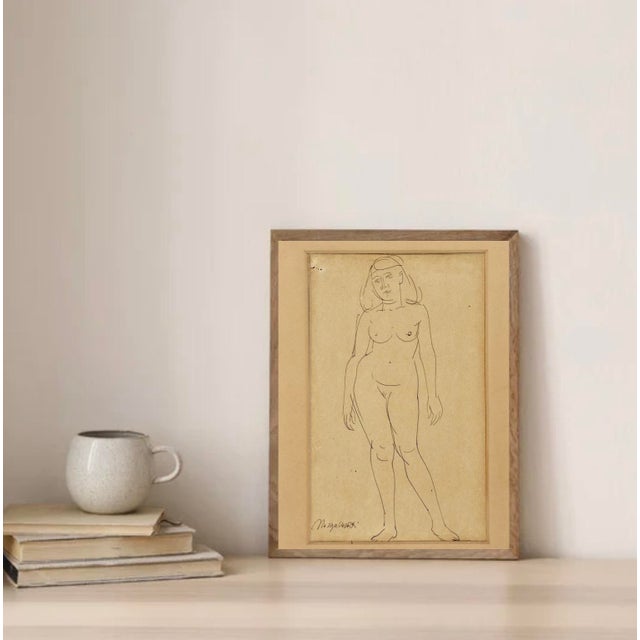
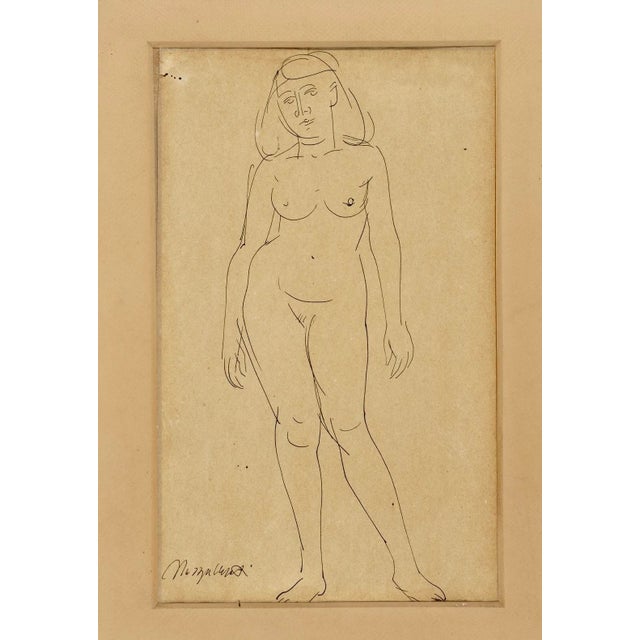
This wonderful drawing depicts a standing nude female figure, portrayed from the front in …
Read more
Early 20th Century Italian Signed Drawing
This wonderful drawing depicts a standing nude female figure, portrayed from the front in a natural pose.
The body is rendered with fluid, well-proportioned curves, typical of a modernist style that represents the human form in an essential manner, without superfluous detail.
The work dates from the 1930s–1940s, a pivotal period in Mazzacurati’s career, when, influenced by the Parisian avant-garde (Rodin, Matisse, Picasso), he became a leading figure of the Roman School.
During this phase, the artist explored themes of the female nude with an artistic style that harmonised realism with elements of distortion typical of the Expressionist movement; works such as ‘Female Nude’ from 1943 or ‘Red Nude’ from 1936 are representative of this period.
His style evolved from his early Cubism towards a more socially engaged realism, reflecting the historical context of the post-war avant-garde.
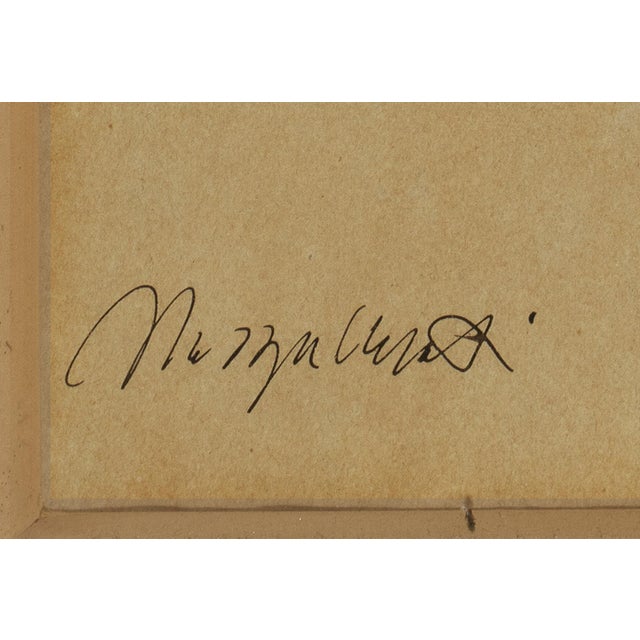
The signature ‘Mazzacurati’ in the lower left corner, written in fluid, slanted cursive with an elegant and personal hand, is consistent with the artist’s autograph signatures, often placed in similar positions in his drawings and paintings.
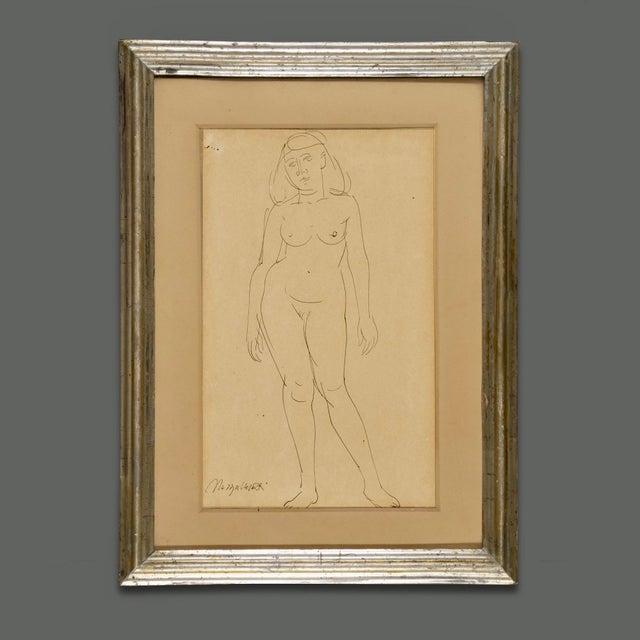
This artwork, never before on the market, comes from an important Italian private collection and is beautified by an impressive antique frame in silvered wood\.
The drawing is also protected by glass
Renato Marino Mazzacurati (22 July 1907 – 18 September 1969) was an important Italian painter and sculptor belonging to the modern movement of the Scuola romana (Roman School), of eclectic styles and able within his career span to represent the artistic currents of Cubism, Expressionism, and Realism.
He believed that art could sustain social functions.
Moved to Rome in 1926, he befriended Scipione, Mario Mafai and Raphaël, creating with them an artistic movement called by Italian scholar Roberto Longhi the Scuola di via Cavour or Scuola Romana.
In 1931 Mazzacurati went to Paris, where he became particularly interested in the works of Rodin, Matisse and Picasso, as both his pictorial production (between 1931 and 1935) and his sculptures show.
Their expressionism emphasizes the physical structure, as in Ritratto del conte N. (Portrait of Count) or deforms it into grotesque figures – e.g., see Imperatori e Imperatrici (Emperors & Empresses, 1942–1943).
Subsequently, Mazzacurati tended towards a cruder realism, joining in 1947 the "Fronte Nuovo delle Arti".
His other works include Martyrs’ Monument in Beirut (1960), Monumento al Partigiano (Monumento to the Partisan) in Parma (1964) and the Monumento alle quattro giornate (Monument to the Four days of Naples) in Naples.
His work was also part of the sculpture event in the art competition at the 1948 Summer Olympics.
Dimensions are frame included This piece has an attribution mark,
I am sure that it is completely authentic and take full responsibility for any authenticity
issues arising from misattribution
See less
- Dimensions
- 14.57ʺW × 1.18ʺD × 20.08ʺH
- Styles
- Mid-Century Modern
- Modern
- Art Subjects
- Nude
- Period
- 1930s
- Country of Origin
- Italy
- Item Type
- Vintage, Antique or Pre-owned
- Materials
- Paper
- Condition
- Good Condition, Unknown, Some Imperfections
- Color
- Black
- Condition Notes
- Heavy Signs of Use,Patina Consistent with Age and Use Heavy Signs of Use,Patina Consistent with Age and Use less
Returns & Cancellations
Return Policy - All sales are final 48 hours after delivery, unless otherwise specified in the description of the product.
Cancellation Policy - Prior to shipping or local pickup, buyers may cancel an order for up to 48 hours, unless otherwise specified.
Related Collections
- Jeff Slemmons Drawings
- Maison Jansen Drawings
- Tempera Drawings
- John James Audubon Drawings
- Guillaume Azoulay Drawings
- Joseph Stella Drawings
- Erté Drawings
- Salvador Dalí Drawings
- Leroy Neiman Drawings
- Piet Hein Eek Drawings
- Carl-Axel Acking Drawings
- Charcoal Drawings
- Fashion Drawings
- 1950s Fashion Drawings
- Pencil Drawings
- Ink Drawings
- Gustavian (Swedish) Drawings