








Details
Description
Antique Rhenish Frechen Salt Glazed Stoneware Bellarmine Jug, Circa 17th–18th Century
A substantial and deeply characterful example of early Rhenish …
Read more
Antique Rhenish Frechen Salt Glazed Stoneware Bellarmine Jug, Circa 17th–18th Century
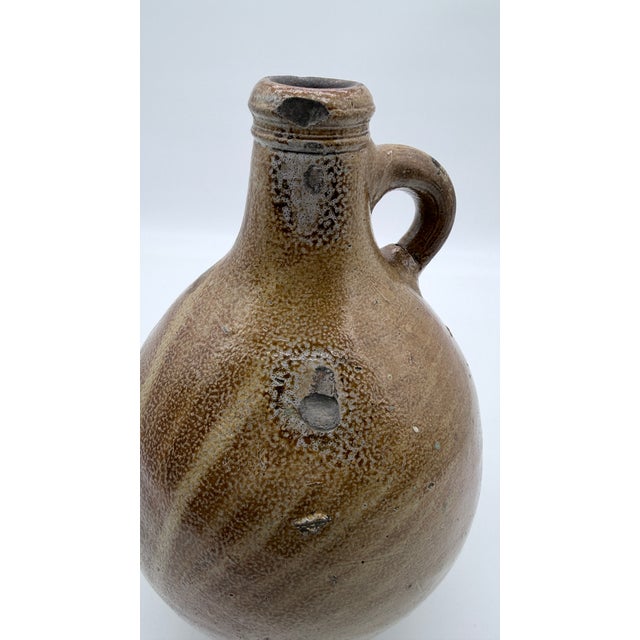
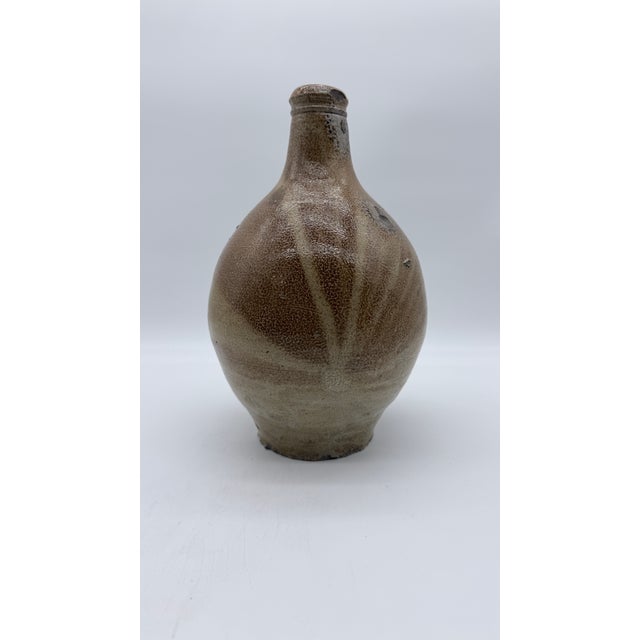
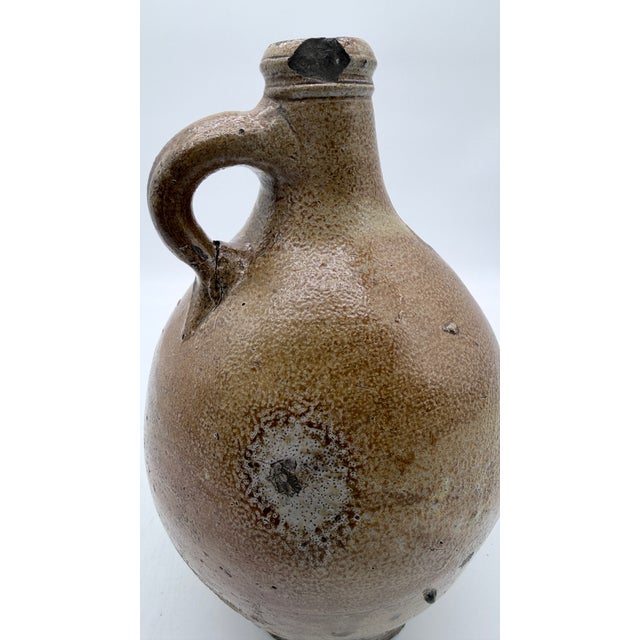
A substantial and deeply characterful example of early Rhenish salt glazed stoneware, this impressive Bellarmine jug displays all the physical and visual hallmarks of genuine early period Frechen production — one of the most historically significant and actively collected categories of European utilitarian ceramics. Heavy, dense, and magnificently primitive in its construction, this jug speaks with quiet authority of the centuries of European ceramic tradition from which it emerges.
The globular body is covered in the characteristic iron brown mottled salt glaze over grey stoneware that defines Frechen production at its most authentic — the "orange peel" texture of the glaze surface, the dramatic variation in tone from warm brown to cool grey across the body, and the sheer physical weight and density of the fired stoneware all pointing unambiguously to early high fired Rhenish production. The jagged, unglazed base displays the characteristic concentric wheel marks and rough sand fired surface entirely consistent with genuine period kiln production, where jugs were fired directly on beds of sand in wood fired kilns at temperatures that produced the extraordinarily hard, dense stoneware body this jug possesses.
The strap handle, multi-ringed neck, and globular ovoid body are all classic Bellarmine form elements — the Bellarmine or Bartmann jug being one of the most enduring and recognizable forms in the entire European stoneware tradition, produced in the Rhineland region from the 16th century onward and exported throughout Europe and the colonial world in enormous quantities. These jugs served as the universal storage and transport vessel of the early modern period — carrying wine, spirits, water, and provisions across the known world and into the new settlements of colonial America.
Of particular historical note, this jug was acquired at auction alongside a documented example of identical type bearing a label reading "Excavated during the building of the World Trade Center in New York City — 17th Century" — a provenance that places that companion piece firmly within the remarkable corpus of Dutch colonial artifacts excavated from the original New Amsterdam settlement during the construction of the World Trade Center in the 1960s and 1970s. While this jug's individual provenance cannot be independently confirmed, its acquisition alongside that documented piece from the same consignor, combined with its own period consistent physical characteristics, makes a compelling case for a shared origin and history.
German Rhenish stoneware Bellarmine jugs were among the most commonly imported ceramic objects in 17th century New Amsterdam — brought over by Dutch settlers as practical household vessels and subsequently discarded, buried, and preserved in the archaeological layers of Lower Manhattan for three centuries until their dramatic rediscovery during one of the most significant urban construction projects in American history.
Chips on the base and two chips on the neck are honestly noted and entirely consistent with the piece's age and working life. All wear and firing characteristics are authentic period features that add to rather than detract from the jug's considerable historical character and appeal.
Dimensions: 11"H × 7"W
Type: Salt glazed stoneware Bellarmine jug, iron brown Frechen glaze
Origin: Rhineland, Germany (Frechen), Circa 17th–18th Century
Provenance: Acquired alongside a documented World Trade Center excavation piece of identical type from the same consignor
Condition: Chips to base and neck; firing characteristics and wear consistent with age and period production
See less
- Dimensions
- 7ʺW × 7ʺD × 11ʺH
- Period
- 18th Century
- Country of Origin
- Germany
- Item Type
- Vintage, Antique or Pre-owned
- Materials
- Stoneware
- Condition
- Good Condition, Original Condition Unaltered, Some Imperfections
- Color
- Sand
- Condition Notes
- Condition: Chips to base and neck; firing characteristics and wear consistent with age and period production Condition: Chips to base and neck; firing characteristics and wear consistent with age and period production less
Questions about the item?
Returns & Cancellations
Return Policy - All sales are final 48 hours after delivery, unless otherwise specified in the description of the product.
Cancellation Policy - Prior to shipping or local pickup, buyers may cancel an order for up to 48 hours, unless otherwise specified.
Related Collections
- Roger Capron Bottles and Jars and Jugs
- Ralph Lauren Bottles and Jars and Jugs
- Gold-Plate Bottles and Jars and Jugs
- Medieval Bottles and Jars and Jugs
- Borosilicate Glass Bottles and Jars and Jugs
- Cherry Wood Bottles and Jars and Jugs
- Bottles and Jars and Jugs in Lexington, KY
- Khaki Bottles and Jars and Jugs
- Port 68 Bottles and Jars and Jugs
- Acrylic Bottles and Jars and Jugs
- Crocks
- Wicker Bottles and Jars and Jugs
- Apothecary Jars
- Cookie Jars
- Japanese Bottles and Jars and Jugs
- 1800s Perfume Bottles
- Candy Jars
- Antique Water Jugs
- Apothecary Bottles
- Murano Glass Bottles and Jars and Jugs
- 1950s Perfume Bottles
- Portieux Vallerysthal Bottles and Jars and Jugs
- Mottahedeh Bottles and Jars and Jugs
- Lead Bottles and Jars and Jugs
- Carl Auböck Bottles and Jars and Jugs