

Details
Description
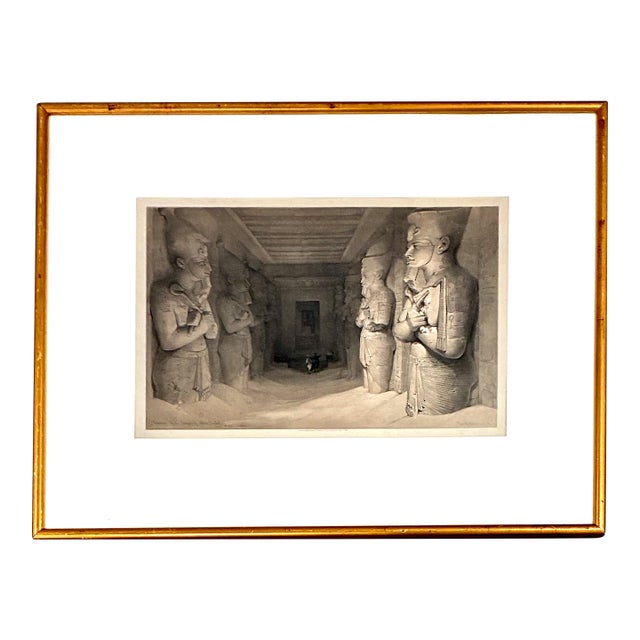
This tinted lithograph, titled "Interior of the Temple of Abu Simbel," was created by Scottish artist David Roberts, R.A. (1796–1864) …
Read more
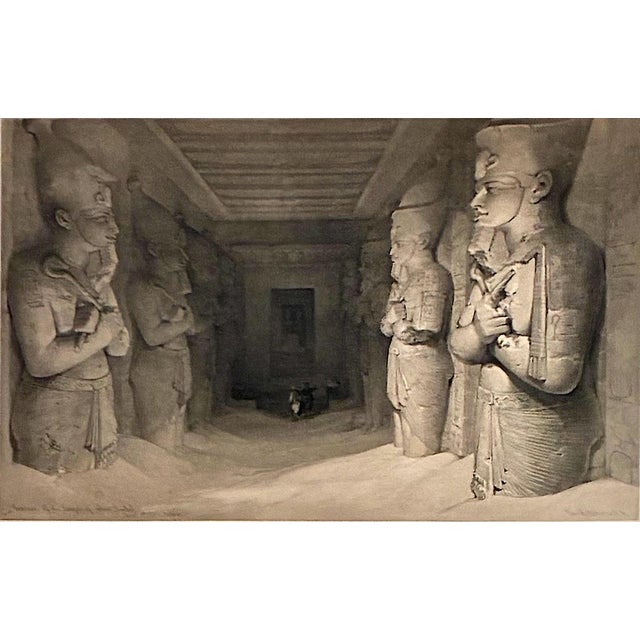
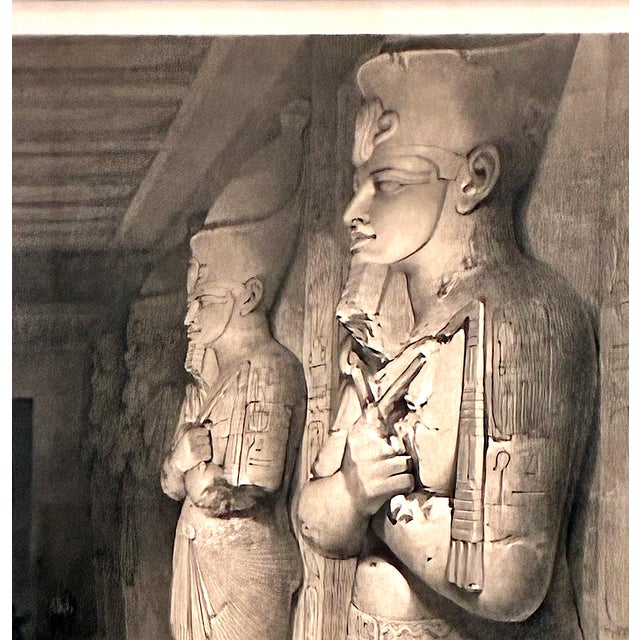
This tinted lithograph, titled "Interior of the Temple of Abu Simbel," was created by Scottish artist David Roberts, R.A. (1796–1864) at a time when the temple was largely obscured by sand. It is based on sketches from his undoubtedly challenging travels in Nubia in 1836.
It depicts the hypostyle hall of the Great Temple of Ramesses II (c.1279-1213 B.C.E.), one of two temples the pharaoh built in ancient Nubia. It was a statement of domination; he wished to demonstrate his power and his divine nature. In ancient times the area was at the southern frontier of pharaonic Egypt, facing Nubia. As a vanity project, it also illustrates that ideas of male handsomeness are unchanged in 3000 years.
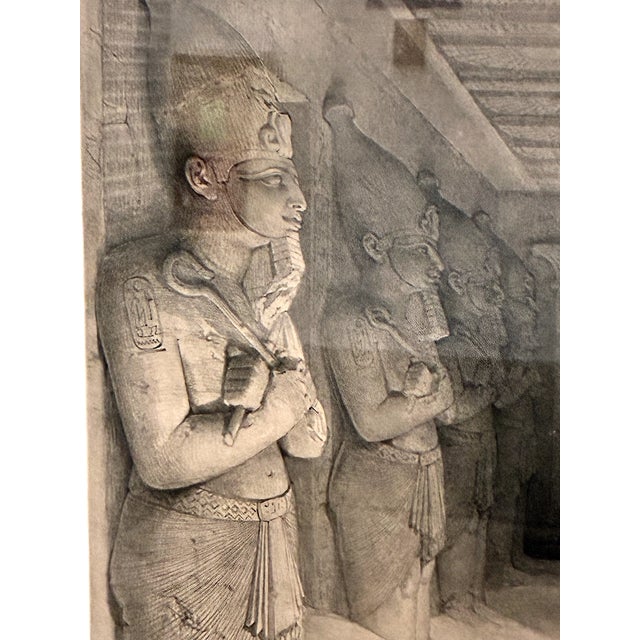
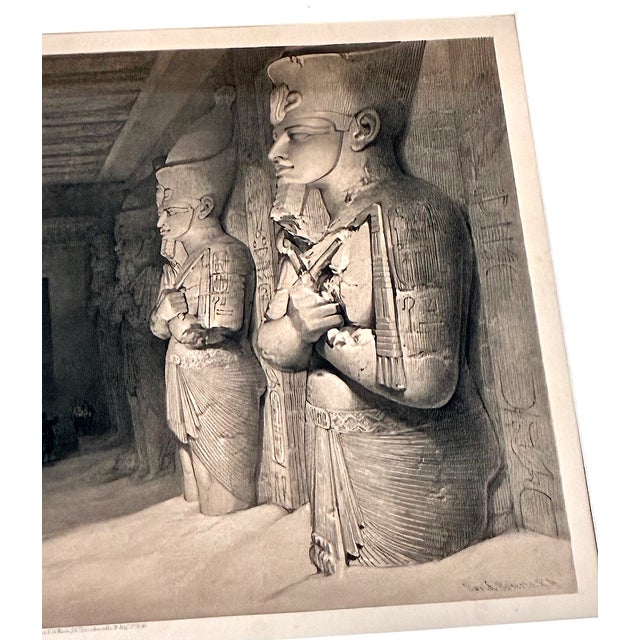
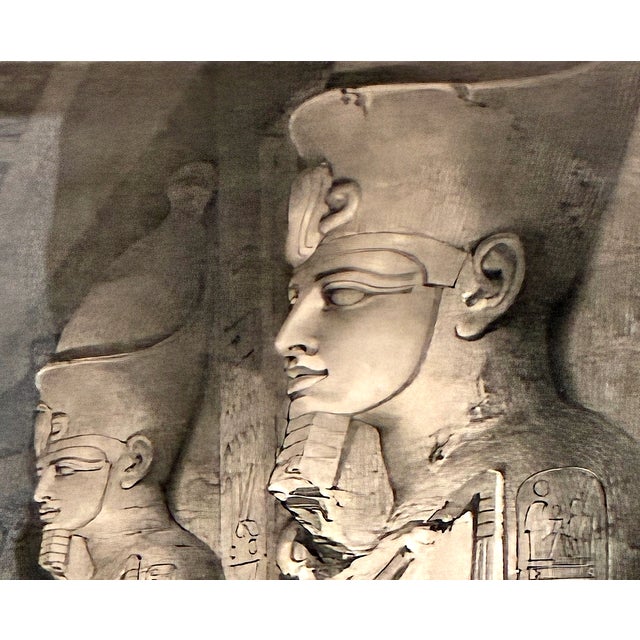
This view captures the grand interior architecture of the temple, including the Osirid Pillars; eight nearly 33-foot-tall statues of Ramesses II as Osiris line the hall. The statues on the left wear the White Crown of Upper Egypt, while those on the right wear the Double Crown.
Each statue holds a crook and flail, the traditional emblems of pharaonic power. The walls and ceiling are covered with hieroglyphics and reliefs of the Battle of Kadesh.
The pathway leads to the inner sanctum, which contains four seated statues of deities. Notable is artist David Robert’s exactitude in the details, but we can also appreciate his sense of scale with the inclusion of two tiny figures in the center.
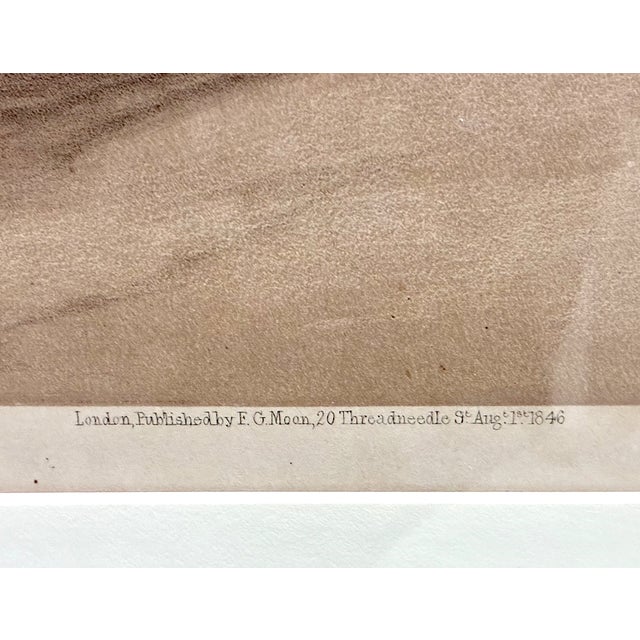
This lithograph was part of the multi-volume series “The Holy Land, Syria, Idumea, Arabia, Egypt, & Nubia (1842–1849)” produced by publisher F.G. Moon. Francis Graham Moon was the leading fine-art publisher in mid-19th-century London. He was known for high-quality production, using the best lithographers like Louis Haghe, who worked on this one. Fun fact: Moon later became the Lord Mayor of London.
Roberts' illustrations significantly shaped how 19th-century Europeans viewed the region. His work satisfied a huge public curiosity in the West for "exotic" Middle Eastern sites. As such, they were among the most expensive and popular publishing ventures of their time, prized for their topographical accuracy.
Aside from possessing considerable courage for undertaking such a project, Roberts was no slacker as an artist. The initials R.A. after his name stand for Royal Academician. This is a title given to members of the Royal Academy of Arts in London. It is the highest professional honor for a British artist. Members were elected by their peers based on exceptional skill, and at Roberts’ time only 40 artists held the full "R.A." title.
This specific lithograph comes from the Egypt and Nubia volumes, which were published between 1846 and 1849. While Roberts sketched the temple in 1836, the prints were released in "parts" over time to subscribers. Hence the publisher’s date on this print a decade later.
Famous subscribers to this massive series included Queen Victoria and Charles Dickens, who undoubtedly received the "Subscriber's Edition," fully hand-colored and mounted on card stock. This specific “Standard First Edition” lithograph was printed directly onto thick paper with two or three "tint stones" to provide a soft, atmospheric depth without the need for full hand-painting. Because it is from the Egypt and Nubia volumes, it often features slightly more varied "duotone" or "tritone" ink than the earlier Holy Land series, which was mostly limited to cream or fawn tints.
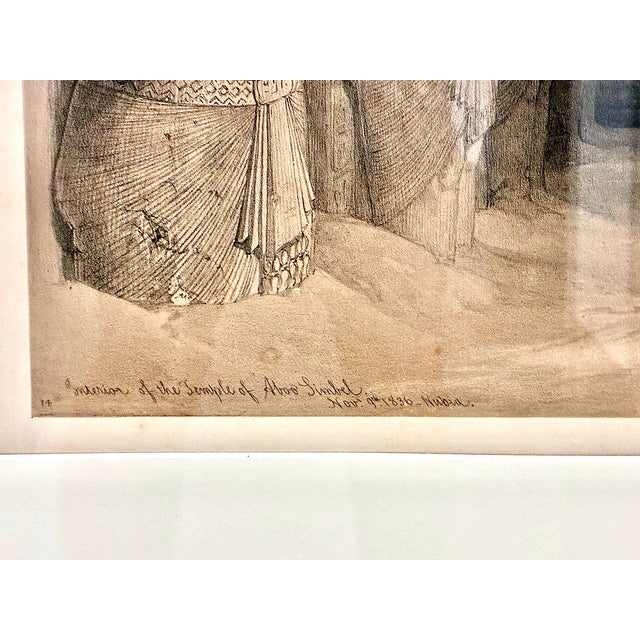
The number 14 in the far-left bottom corner of this lithograph identifies it as Plate 14 in Egypt and Nubia’s first volume. In 19th-century publishing, these numbers were essential for organizing the massive sets of prints. For example, this is “14” out of 247 lithographs spread across six volumes. Numbering was essential to help subscribers who received the prints in monthly installments to eventually bind them in the correct order. The "20 Threadneedle St." publisher’s address confirms it is an early impression. Moon moved his business shortly after this series was completed. Today, you can view this piece in major collections like the Royal Academy of Arts or the Cleveland Museum of Art.
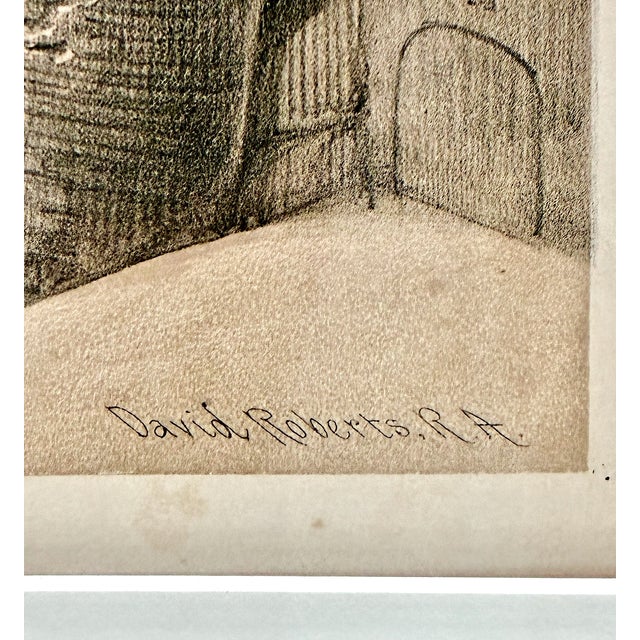
Signature/Maker’s mark: Artist signature, lower right (photo #7); Publisher (photo 9)
Unframed dimensions: 19”w x 13”h.
See less
- Dimensions
- 31.5ʺW × 0.75ʺD × 25.5ʺH
- Styles
- English
- Art Subjects
- Architecture
- Figure
- Frame Type
- Framed
- Period
- Mid 19th Century
- Country of Origin
- United Kingdom
- Item Type
- Vintage, Antique or Pre-owned
- Materials
- Lithograph
- Paper
- Condition
- Good Condition, Original Condition Unaltered, Some Imperfections
- Color
- Sand
- Condition Notes
- Condition commensurate with age and use. Glass reflections, particularly on photos 3 & 7-9) are not indicative of the condition … moreCondition commensurate with age and use. Glass reflections, particularly on photos 3 & 7-9) are not indicative of the condition of the lithograph. Please review all photos. less
Questions about the item?
Returns & Cancellations
Return Policy - All sales are final 48 hours after delivery, unless otherwise specified in the description of the product.
Cancellation Policy - Prior to shipping or local pickup, buyers may cancel an order for up to 48 hours, unless otherwise specified.
Related Collections
- Frank Stella Original Prints
- George Barbier Original Prints
- Byzantine Original Prints
- Toledo Original Prints
- Robert Kipniss Original Prints
- Dye Transfer Original Prints
- Silver Finish Original Prints
- Abraham Rattner Original Prints
- Gustave Baumann Original Prints
- Louis XIII Original Prints
- Botanical Prints
- Framed Prints
- Bird Prints
- Woodblock Prints
- Screen Prints
- Japanese Woodblock Prints
- Thomas McKnight Original Prints
- Teak Original Prints
- Red Grooms Original Prints
- Paul Wunderlich Original Prints
- Chaim Gross Original Prints