




Details
Description
Folk Art Woolwork Depicting a Cat
“The Tabby on the Rug”
Circa 1860s
This mid-19th-century sailor’s woolwork, possibly American, presents …
Read more
Folk Art Woolwork Depicting a Cat
“The Tabby on the Rug”
Circa 1860s
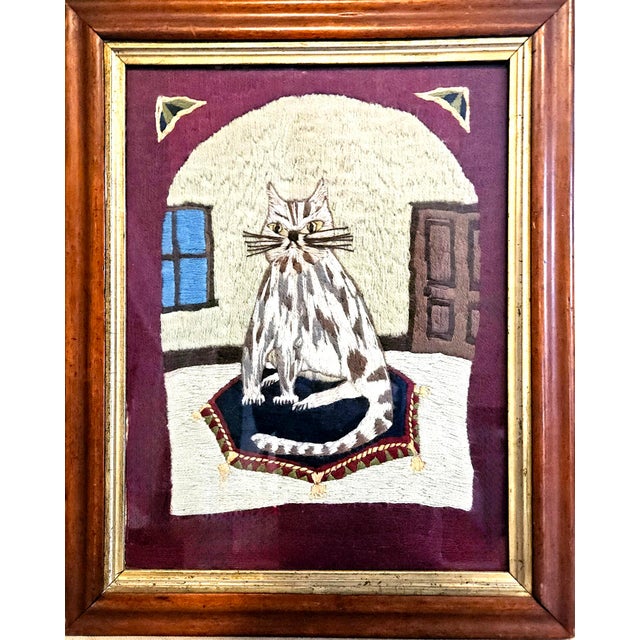
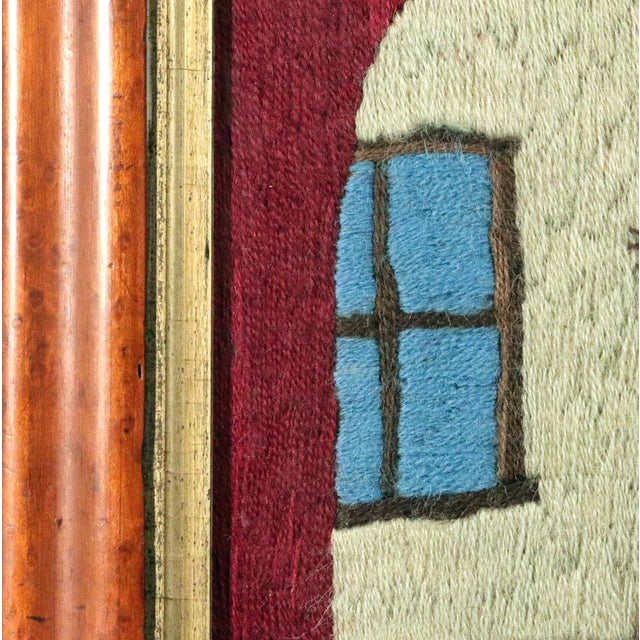
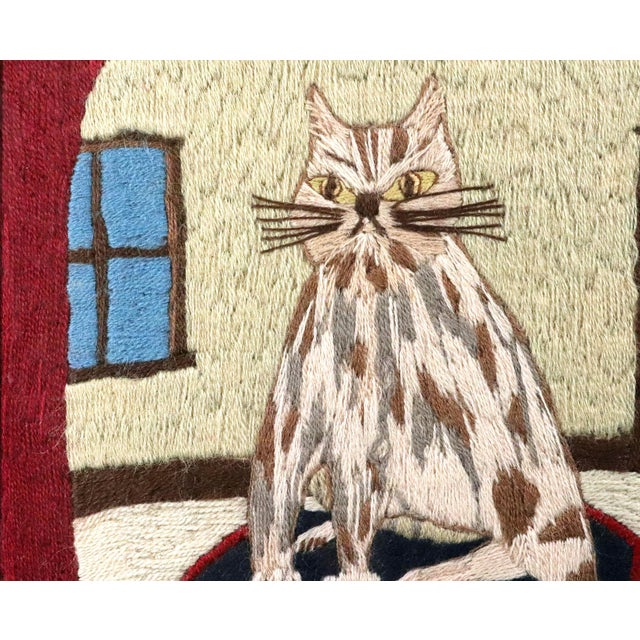
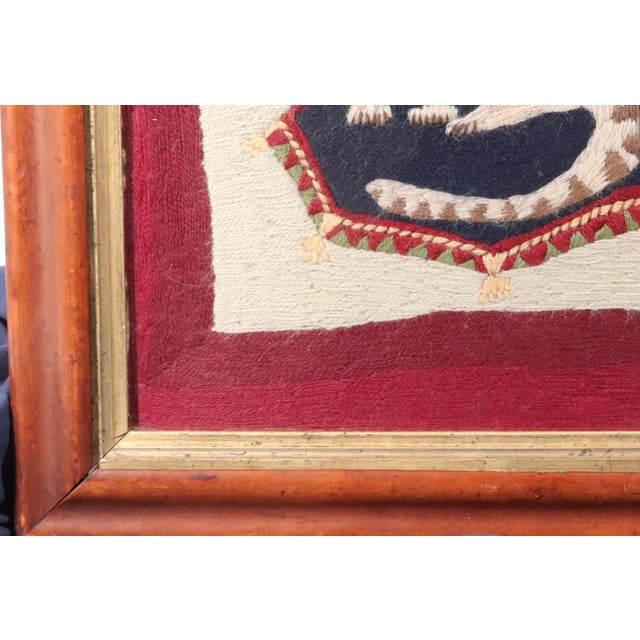
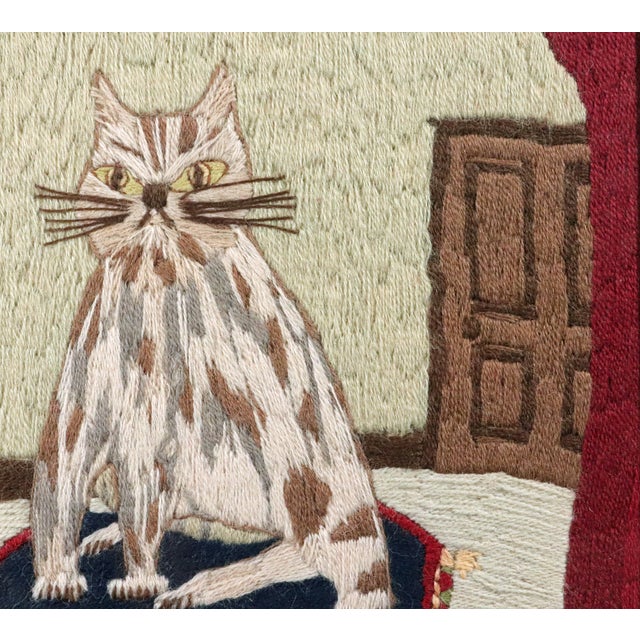
This mid-19th-century sailor’s woolwork, possibly American, presents a centrally placed tabby cat, rendered in a frontal, highly stylized manner, seated upon a fringed hexagonal rug worked in blue and red wool. The cat’s enlarged eyes and emphatically delineated whiskers give it a commanding presence within the composition. The animal is set within a simplified interior space, defined by a paned window with blue sky beyonf to the left and a paneled wooden door to the right, creating a balanced and architecturally framed domestic setting.
The pictorial field is organized beneath an arched form and set against a deep purple wool ground, embellished with embroidered corner motifs that function as both decorative and compositional anchors. The work is presented in a period wooden frame, likely walnut or mahogany, fitted with a gilt inner slip, consistent with mid-19th-century presentation practices for folk needlework.
Measurements:
Height: 20 1/2 inches (52.1 cm)
Width: 16 1/2 inches (41.9 cm)
Depth: 3/4 inch (1.9 cm)
Historical and Cultural Context
Sailor’s Woolwork Tradition
Sailor’s woolworks—commonly referred to as “woolies”—were produced primarily between the second quarter and the mid-19th century by mariners.While ship portraits dominate the surviving corpus, a smaller and less frequently encountered group depicts symbolic, domestic, or animal subjects. These works are widely understood as personal expressions, keepsakes, or talismanic images rather than documentary records. The present example aligns with this more intimate and symbolic strand of the tradition.
The Ship’s Cat in Maritime Culture
Cats occupied an important role aboard sailing vessels, valued for their utility in controlling vermin and their perceived ability to bring good fortune. The cat’s broad stance and emphasized paws correspond visually with characteristics historically associated with polydactyl cats, commonly referred to as “ship’s cats.” Polydactylism occurs with notable frequency in port cities and coastal regions, particularly in New England, a distribution attributed to maritime trade networks. In maritime belief systems, such cats were often regarded as auspicious and protective figures.
Within sailor-made folk art, symbolic meaning is typically conveyed through posture, scale, and placement rather than anatomical specificity. The cat’s central position, elevated seat, and frontal orientation suggest a protective or guardian role, consistent with broader maritime superstitions concerning animals as stabilizing and benevolent presences. The enclosed interior—defined by threshold elements such as the window and door—further reinforces themes of domestic order and security, standing in contrast to the instability of life at sea.
The “Tabby” Motif
The term “tabby” derives from Attābī, a patterned silk produced in Baghdad and disseminated through early global trade routes. Its adoption in the English language underscores the long-standing association between striped textiles, commerce, and maritime exchange. The cat’s formal pose also bears comparison to 19th-century Staffordshire ceramic figures, which frequently occupied mantelpieces in British and American households connected to seafaring ommunities.
(Ref: NY11029-nirr)Folk Art Woolwork Depicting a Cat
“The Tabby on the Rug”
Circa 1860s
This mid-19th-century sailor’s woolwork, possibly American, presents a centrally placed tabby cat, rendered in a frontal, highly stylized manner, seated upon a fringed hexagonal rug worked in blue and red wool. The cat’s enlarged eyes and emphatically delineated whiskers give it a commanding presence within the composition. The animal is set within a simplified interior space, defined by a paned window with blue sky beyonf to the left and a paneled wooden door to the right, creating a balanced and architecturally framed domestic setting.
The pictorial field is organized beneath an arched form and set against a deep purple wool ground, embellished with embroidered corner motifs that function as both decorative and compositional anchors. The work is presented in a period wooden frame, likely walnut or mahogany, fitted with a gilt inner slip, consistent with mid-19th-century presentation practices for folk needlework.
Measurements:
Height: 20 1/2 inches (52.1 cm)
Width: 16 1/2 inches (41.9 cm)
Depth: 3/4 inch (1.9 cm)
Historical and Cultural Context
Sailor’s Woolwork Tradition
Sailor’s woolworks—commonly referred to as “woolies”—were produced primarily between the second quarter and the mid-19th century by mariners.While ship portraits dominate the surviving corpus, a smaller and less frequently encountered group depicts symbolic, domestic, or animal subjects. These works are widely understood as personal expressions, keepsakes, or talismanic images rather than documentary records. The present example aligns with this more intimate and symbolic strand of the tradition.
The Ship’s Cat in Maritime Culture
Cats occupied an important role aboard sailing vessels, valued for their utility in controlling vermin and their perceived ability to bring good fortune. The cat’s broad stance and emphasized paws correspond visually with characteristics historically associated with polydactyl cats, commonly referred to as “ship’s cats.” Polydactylism occurs with notable frequency in port cities and coastal regions, particularly in New England, a distribution attributed to maritime trade networks. In maritime belief systems, such cats were often regarded as auspicious and protective figures.
Within sailor-made folk art, symbolic meaning is typically conveyed through posture, scale, and placement rather than anatomical specificity. The cat’s central position, elevated seat, and frontal orientation suggest a protective or guardian role, consistent with broader maritime superstitions concerning animals as stabilizing and benevolent presences. The enclosed interior—defined by threshold elements such as the window and door—further reinforces themes of domestic order and security, standing in contrast to the instability of life at sea.
The “Tabby” Motif
The term “tabby” derives from Attābī, a patterned silk produced in Baghdad and disseminated through early global trade routes. Its adoption in the English language underscores the long-standing association between striped textiles, commerce, and maritime exchange. The cat’s formal pose also bears comparison to 19th-century Staffordshire ceramic figures, which frequently occupied mantelpieces in British and American households connected to seafaring ommunities.
(Ref: NY11029-nirr)
See less
- Dimensions
- 15.5ʺW × 1ʺD × 20.5ʺH
- Styles
- Folk Art
- Period
- Mid 19th Century
- Country of Origin
- United States
- Item Type
- Vintage, Antique or Pre-owned
- Materials
- Wool
- Condition
- Good Condition, Original Condition Unaltered, Some Imperfections
- Color
- Red
- Condition Notes
- Great condition and now with Museum glass for light protection and clarity Great condition and now with Museum glass for light protection and clarity less
Questions about the item?
Returns & Cancellations
Return Policy - All sales are final 48 hours after delivery, unless otherwise specified in the description of the product.
Cancellation Policy - Prior to shipping or local pickup, buyers may cancel an order for up to 48 hours, unless otherwise specified.
Related Collections
- Greige Textile Art
- Workaday Handmade Textile Art
- Chanel Textile Art
- Asian Style Textile Art
- Hair on Hide Textile Art
- Rug and Kilim Textile Art
- Cashmere Textile Art
- Edwardian Textile Art
- Textile Art in Santa Fe
- Beech Textile Art
- Mid-Century Modern Textile Art
- Framed Scarves
- Tapestry
- Chinese Textile Art
- Japanese Textile Art
- Scandinavian Textile Art
- Aubusson Tapestry
- Brutalist Textile Art
- Märta Måås-Fjetterström Textile Art
- Space Age Textile Art
- Cardboard Textile Art
- Mohair Textile Art
- Surrealism Textile Art