






Details
Description
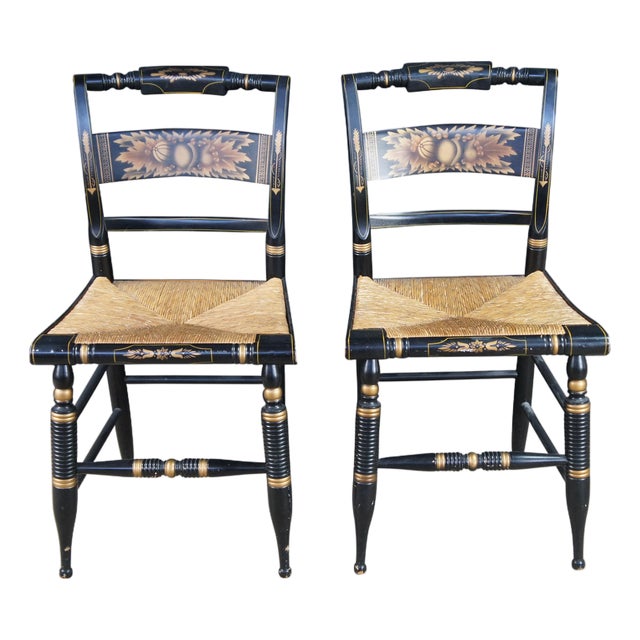
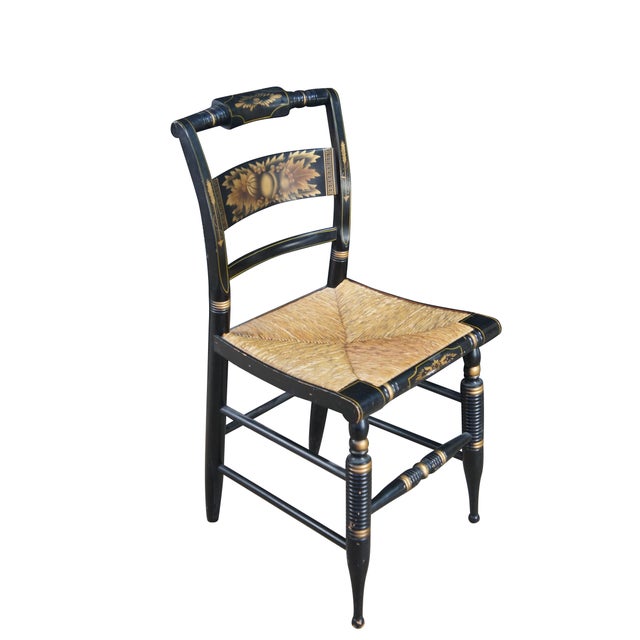
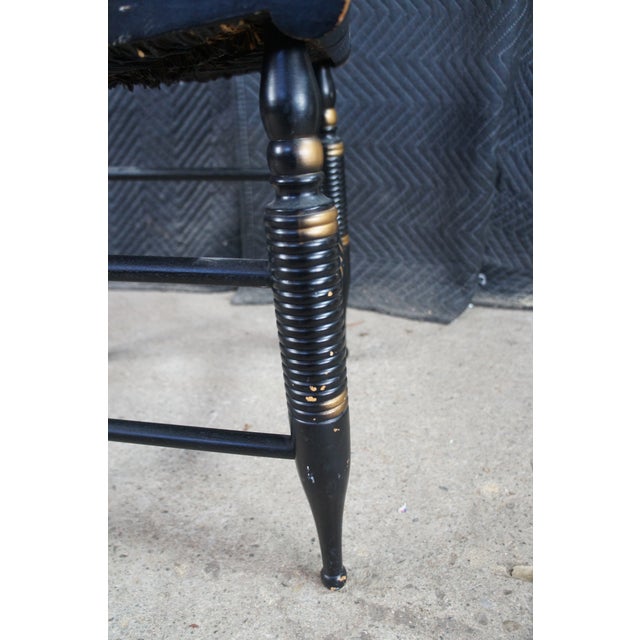
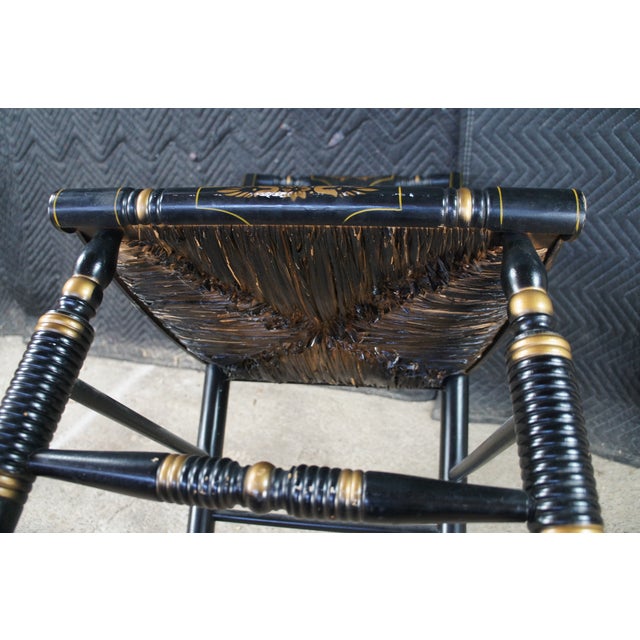
Two antique early 20th Century original L. Hitchcock Harvest Windsor dining chairs. Made with an ebonized finish, gold stenciled accents, …
Read more
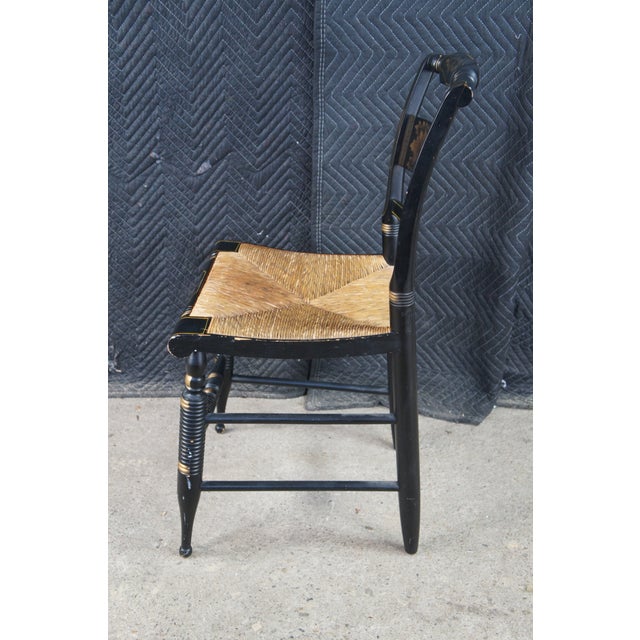
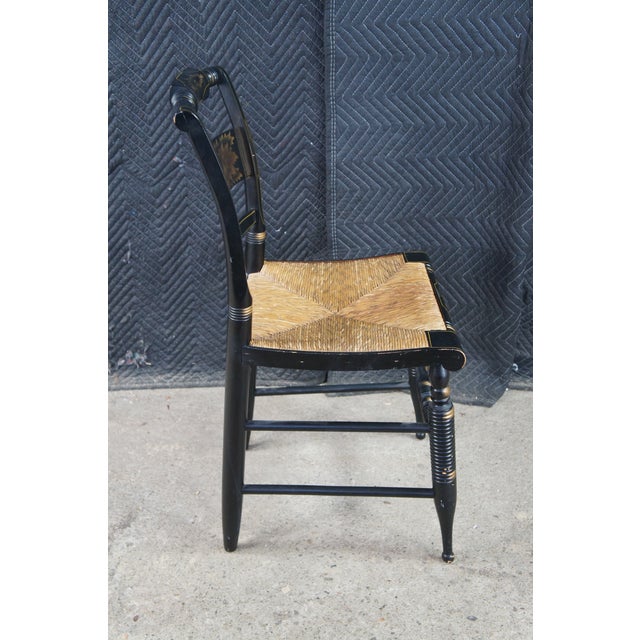
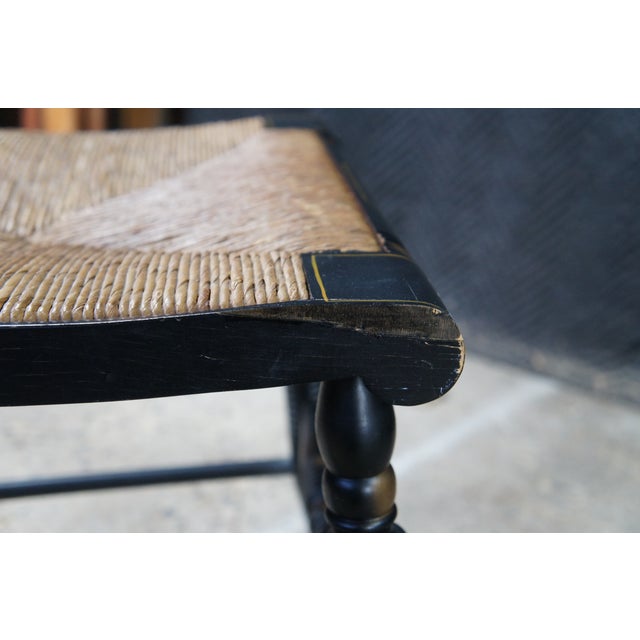
Two antique early 20th Century original L. Hitchcock Harvest Windsor dining chairs. Made with an ebonized finish, gold stenciled accents, and woven rush seat.
The story of L. Hitchcock began in 1814 when 19-year-old Lambert Hitchcock of Cheshire, Connecticut was apprenticed to Silas Cheney (1776-1821) of Litchfield as a novice woodworker. Cheney was the typical cabinetmaker of the period turning out well made examples of Federal sideboards and fancy painted chairs that caught young Hitchcock’s attention. While apprenticed to Cheney he became familiar with the work of Eli Terry, the famous clock maker and inventor. Terry had formed a partnership with Seth Thomas and his son, also named Seth Thomas, to produce the components of wooden clock works in an assembly line fashion. This little trick stuck in Hitchcock’s mind as he mapped his future.
In 1818 Hitchcock completed his apprenticeship and moved to a tiny sawmill community in the township of Barkhamsted known as Fork-of-the-Rivers at the junction of the Farmington and Still Rivers. He found employment in the local sawmill which was owned by some family friends and settled in. He “homesteaded” a small room at the back of the mill and after tapping into the mill’s power source from the river he began to manufacture a small number of unfinished individual chair components. He sold these components to Yankee traders who sold them to mercantile stores as replacement parts for broken chairs. Business was good and demand soon outstripped his ability to meet it by himself. He hired some help to make the parts and began to expand his market, shipping chair components as far away as Charleston, South Carolina. He eventually graduated to making complete unfinished chairs in the “knockdown” stage ready to ship as unassembled kits for the do-it-yourself customers of the mercantile trade.
But Eli Terry still lurked in his long term plans and he began to lay the groundwork for a company that made and finished complete chairs of his own design. In 1820 he acquired a wooden two story building nearby and began his dream of making chairs. The chair he made was based loosely on the Sheraton style of the period but it also included elements from Empire klismos chairs with a few pointers from the popular “Baltimore” chairs. And most importantly the Eli Terry model of an assembly line was put into place with manufactured components combined by workers who performed only that one operation or a very limited number of operations. He was about 80 years ahead of Henry Ford. The chairs included no carvings of any sort and a minimum of hand painting to speed up the process.
The raw assembled frames were painted black or dark green and received a first coat of clear finish. While the finish was still slightly tacky Hitchcock borrowed the newly developed British technique of “stenciling” to richly decorate the otherwise rather plain chairs. Using a variety of metal stencils, as many as five different ones on a single chair, different colors of metallic powders were applied by brush to produce the mostly floral designs seen on the ubiquitous “Hitchcock” chair of the 1820s. To further reduce the cost, Hitchcock used laborers from a nearby prison to weave cane and rush seats for his chairs.
Having decided early in the process to produce a reliable, fashionable seating platform for the average family at a reasonable cost, he priced his early chairs ranging from $.49 to $1.50. They were a hit and the factory was soon shipping chairs all over the East and Midwest as well as to the South.
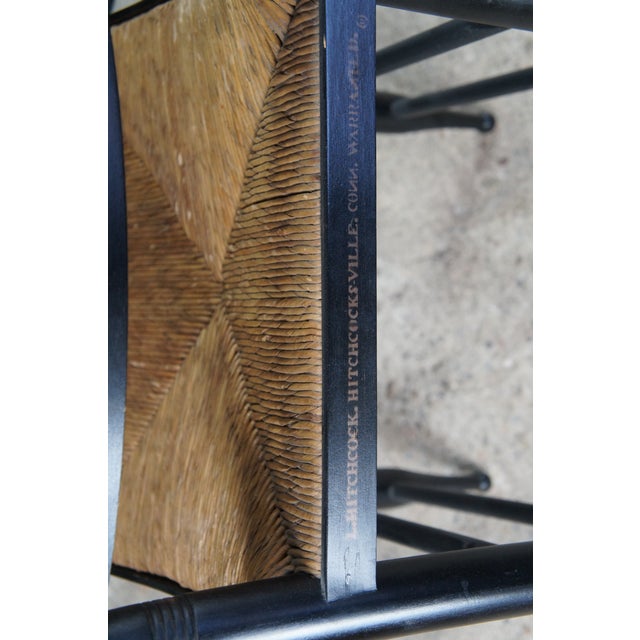
Since he employed over 100 men at the height of the operation, most of the male population of the town and the area, the town changed its name to Hitchcocksville in 1821 in honor of its largest employer. By 1825 Lambert Hitchcock was ensconced in a new three story brick building that turned out 300 chairs a week. He also was marking his chairs with the now famous “L. HITCHCOCK, HITCHCOCKS-VILLE, CONN. WARRANTED” stenciled across the back of the seat rail.
Dimensions:
17.5"w x 18" x 34"
See less
- Dimensions
- 17.5ʺW × 18ʺD × 34ʺH
- Styles
- Farmhouse
- Seat Height
- 16.0 in
- Number of Seats
- 2
- Artist
- Hitchcock
- Brand
- Hitchcock
- Designer
- Hitchcock
- Styled After
- Hitchcock
- Period
- Early 20th Century
- Country of Origin
- United States
- Item Type
- Vintage, Antique or Pre-owned
- Materials
- Rush
- Wood
- Condition
- Good Condition, Original Condition Unaltered, Some Imperfections
- Color
- Black
- Condition Notes
- Edge wear, distressing, finish loss, missing trim along side of one. Edge wear, distressing, finish loss, missing trim along side of one. less
Questions about the item?
Returns & Cancellations
Return Policy - All sales are final 48 hours after delivery, unless otherwise specified in the description of the product.
Cancellation Policy - Prior to shipping or local pickup, buyers may cancel an order for up to 48 hours, unless otherwise specified.
Related Collections
- Michael Graves Side Chairs
- Burke, Inc. Side Chairs
- Medium-Density Fibreboard Side Chairs
- Carlo Hauner Side Chairs
- Berkey and Gay Side Chairs
- Saffron Side Chairs
- Enzo Mari Side Chairs
- Peter Hvidt and Orla Mølgaard-Nielsen Side Chairs
- Steel Finish Side Chairs
- Jonathan Charles Side Chairs
- Kenneth Ludwig Chicago Side Chairs
- Victorian Side Chairs
- Bamboo Side Chairs
- Empire Side Chairs
- Rush Side Chairs
- Maple Side Chairs
- Louis XVI Side Chairs
- Eames Side Chairs
- Mohair Side Chairs
- Arhaus Side Chairs
- Mother-of-Pearl Side Chairs
- Faux Bamboo Side Chairs
- Folk Art Side Chairs
- Velvet Side Chairs
- French Side Chairs