

Cheshire Antiques Consultant LTD
Chester, Cheshire West and Chester
Since 2021100+ sales
3x Super Seller

Details
Description
18th-Century Court Portrait of Duke Anthony Ulrich with the Order of St Andrew (Circle of Grooth)
Overview
A striking mid-18th-century …
Read more
18th-Century Court Portrait of Duke Anthony Ulrich with the Order of St Andrew (Circle of Grooth)
Overview
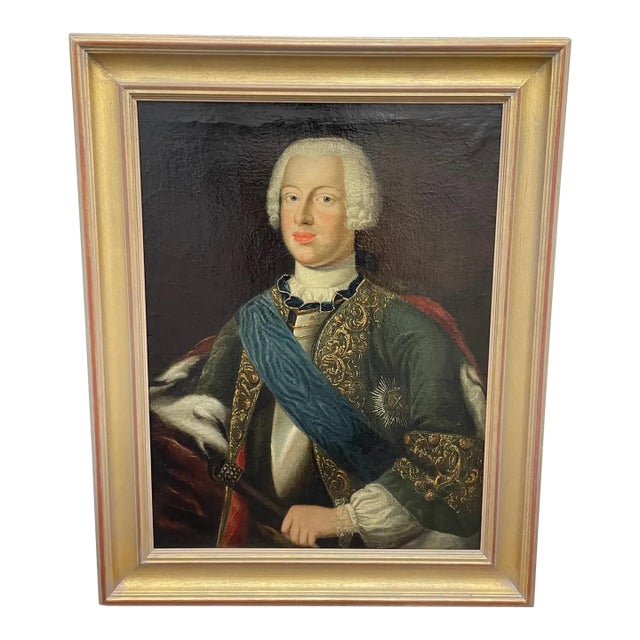
A striking mid-18th-century court portrait of Duke Anthony Ulrich of Brunswick-Lüneburg, father of the short-lived Russian emperor Ivan VI and Generalissimo of the Russian army.
Painted in oil on canvas and now relined, this half-length portrait shows the Duke in full ceremonial and military dress, wearing the pale blue sash and insignia of the Imperial Order of St Andrew, the highest order of chivalry in imperial Russia, and holding a field-marshal’s baton.
On stylistic grounds the work belongs to the circle of Georg Christoph Grooth (1703–1749), a German painter active at the Russian imperial court, and is best dated to c. 1740–1750 (German School).
Subject & Medium
Anthony Ulrich is shown half-length, turned three-quarter to the left, gazing steadily at the viewer. He wears a deep green coat richly embroidered with gold, over a crimson mantle lined with ermine, and the pale blue sash and dark blue collar of the Order of St Andrew. The radiant star of the order, with St Andrew’s saltire, gleams on his breast.
In his right hand he grasps a dark field-marshal’s baton with a jewelled finial, set diagonally across his body – a classic symbol of supreme command and a key compositional element. The painting is executed in oil on canvas, later relined, and housed in a sympathetic moulded giltwood frame.
Framed dimensions: 97 cm high × 78 cm wide × 4.5 cm deep.
Composition & Technique
The composition is deliberately simple and formal. A deep, neutral background sets off the sitter’s pale complexion, powdered wig and richly coloured costume. The eye is led from the face down along the sash and baton, then back to the star of the order and the ermine mantle.
Technically, the head is built up in thin, carefully controlled layers over a light ground, giving smooth, cool, porcelain-like flesh with crisp modelling around the eyes, nose and mouth. A faint rosiness in the cheeks and lips brings life to the features. Wig, lace, fur and gold embroidery are handled more broadly with broken, lively strokes that catch the light and suggest texture rather than labouring every detail.
The surface shows a fine, even craquelure typical of 18th-century oil on canvas, and retains good depth and presence.
Artist – Circle of Georg Christoph Grooth
While the painting is unsigned, it sits convincingly within the German–Russian court portrait tradition of the mid-18th century, and particularly within the stylistic circle of Georg Christoph Grooth (1703–1749).
Grooth’s portraits at the Russian court often feature:
Dark, uncluttered backgrounds
Cool, smoothly blended flesh
Strong emphasis on sashes, stars and batons as markers of rank
All of these are present here. The slightly idealised but dignified characterisation of the sitter, and the balance between rich costume and calm expression, also reflect the broader influence of Antoine Pesne (1683–1757), whose Franco-German style shaped north-German court portraiture.
In line with best practice, the work is most accurately described as:
Circle of Georg Christoph Grooth (1703–1749), German School, c. 1740–1750.
About the Sitter
Anthony Ulrich (1714–1774) was a prince of the House of Welf, son of Ferdinand Albert II, Duke of Brunswick-Bevern. In 1739 he married Anna Leopoldovna, granddaughter of Tsar Ivan V of Russia. When their infant son Ivan VI was proclaimed emperor in 1740, Anna became regent and Anthony Ulrich was elevated to Generalissimo of the Russian Army, the highest military rank in the empire.
His fortunes changed abruptly in 1741 when Elizabeth, daughter of Peter the Great, seized the throne. Anthony Ulrich, Anna and their children were arrested and sent into remote northern exile. They lived under strict confinement for decades; Anthony Ulrich eventually lost his sight and died a prisoner at Kholmogory in 1774.
Seen with this background in mind, the portrait records a very specific moment: the Duke at the zenith of his career, wearing the Order of St Andrew and bearing the baton of command, just before his dramatic fall from power.
Inscriptions
The painting is not signed on the front.
On the reverse of the relined canvas, a later German inscription identifies the sitter as “Anton Ulrich, Prinz von Braunschweig-Wolfenbüttel” and summarises his life (birth in 1714, marriage to Anna, appointment as generalissimo, imprisonment and death). The handwriting appears 20th-century and functions as a historical label rather than a contemporary note, but it broadly matches the known biographical facts and supports the identification.
Framing
Presented in a later moulded and gilded wooden frame that suits the painting’s period and status. The gilding has a warm tone with minor rubbing and small chips on some edges and corners, consistent with age and normal handling. The frame is structurally sound and ready to hang.
Provenance
Almost certainly German origin, supported by the sitter’s Brunswick background, German inscription on the reverse, and stylistic links to German painters at the Russian court.
Relined and inscribed, likely in the 19th or early 20th century, by a restorer or historically minded owner.
By the 21st century in the British art trade, handled by notable Scottish auction house and curated by Cheshire Antiques Consultant LTD. Thence to the present collection.
Earlier ownership is not documented, but the painting is entirely consistent with long residence in a north-German noble or substantial bourgeois interior, possibly as part of an “ancestor gallery” or formal reception room.
See less
- Dimensions
- 30.7ʺW × 1.77ʺD × 38.18ʺH
- Styles
- Baroque
- Portraiture
- Frame Type
- Framed
- Art Subjects
- Portrait
- Period
- 18th Century
- Country of Origin
- Germany
- Item Type
- Vintage, Antique or Pre-owned
- Materials
- Canvas
- Oil Paint
- Wood
- Condition
- Original Condition Unaltered, Needs Restoration
- Color
- Army Green
- Condition Notes
- Condition Overall in good, stable condition for an 18th-century canvas. The surface shows fine craquelure and some more pronounced age … moreCondition Overall in good, stable condition for an 18th-century canvas. The surface shows fine craquelure and some more pronounced age cracks, particularly in darker areas, as expected for its date. There are small, scattered paint losses and spots of foxing which have been addressed with minor historic retouching. A horizontal line near the upper part of the image marks the area where a former frame or stretcher edge pressed against the canvas over many years; along this band there is associated flaking and small losses. An earlier relining has stabilised the support, and there is no sign of active lifting in normal conditions. The frame shows typical age-related wear – light scuffs, small chips to the gilding and some dust in recesses – but remains sound and presentable. The painting is ready to hang and enjoy. A future owner could, if desired, commission a light professional clean and localised conservation to harmonise the varnish and visually soften the stretcher mark. less
Cheshire Antiques Consultant LTD
Chester, Cheshire West and Chester
Since 2021100+ sales
3x Super Seller
Questions about the item?
Returns & Cancellations
Return Policy - All sales are final 48 hours after delivery, unless otherwise specified in the description of the product.
Cancellation Policy - Prior to shipping or local pickup, buyers may cancel an order for up to 48 hours, unless otherwise specified.
Related Collections
- Photorealism Canvas Paintings
- Ed Ruscha Paintings
- Photorealism Paintings in New York
- Richard Serra Paintings
- Herman Miller Paintings
- Jo Baskerville Paintings
- Louise Nevelson Paintings
- Karen Offutt Paintings
- Nicola Simbari Paintings
- BDDW Paintings
- James McCray Paintings
- Jaanika Peerna Paintings
- Leroy Neiman Paintings
- Black Photorealism Paintings
- Jeff Slemmons Paintings
- Milton Avery Paintings
- Vienna Secession Paintings
- Johannes Andersen Paintings
- Pedro Friedeberg Paintings
- Peter Behrens Paintings
- Piet Hein Eek Paintings
- Raphael Paintings
- Photorealism Paintings in Los Angeles
- Carl-Axel Acking Paintings
- Karl-Erik Ekselius Paintings