




Details
Description
Chinese porcelain story tianqiuping, a a finely formed, globe shape vase with a blue and white glazed exterior and a …
Read more
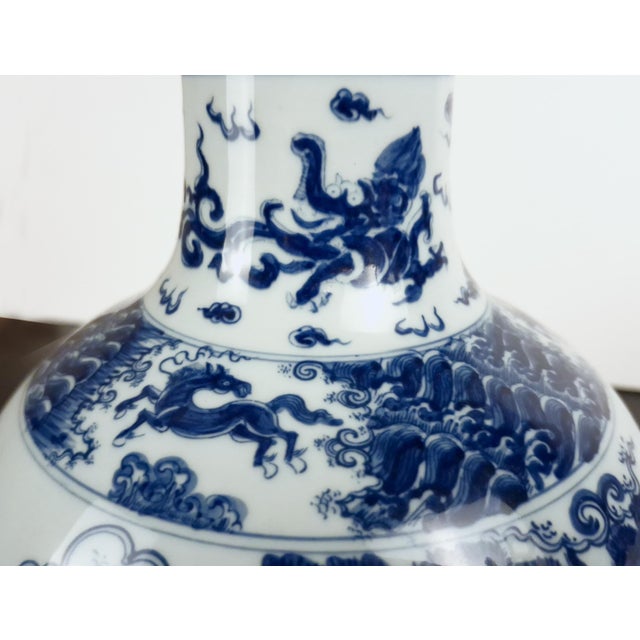
Chinese porcelain story tianqiuping, a a finely formed, globe shape vase with a blue and white glazed exterior and a white glazed interior and inset base. The top of the neck is decorated with a band of fruits bracketed by double, blue ringlets. A band of banana leaves decorates the middle of the neck followed by a wide band of double dragons amid Taoist flames and xiangyun, bracketed by double blue ringlets. The shoulder of the vase has a narrower band of three horses cavorting within Taoist flames and xiangyun cartouches, alternating with dense patches of ocean waves. The main body of the vase is decorated with a finely painted, continuous scene of two horsemen and a squire with two waiters carrying food baskets, going to a garden viewing platform, which has two figures at the windows and another waiter inside holding a bottle of wine, all amid decorative xiangyun amid pine trees and various plants below, all bracketed by double blue ringlets. The bottom of the vase is decorated with a band of dense, ocean waves between double blue ringlets. A blue, Da Ming Cheng Hua Nian Zhi mark is glazed to the inset base. The traditional, Chinese, hongmu, circular stand is included. Circa Republic of China era or earlier.
vase: 12.5" high x 8" diameter
stand: 1.75" high x 7.375" diameter
Da Ming Cheng Hua Nian Zhi: made during the Chenghua reign of the great Ming Dynasty
xiangyun: associated with the presence of deities and were considered a good omen indicating the arrival of good fortune. In Chinese mythologies, mythological creatures and deities use clouds as their mount. Clouds were also closely associated with the Chinese immortals (called xian) and their residence on Mount Penglai. Xiangyun were also symbolic motifs which implied immortality.
Banana leaves: symbolize renewal and resilience due to their annual die-back and regrowth. They also represent prosperity and abundance, with large leaves signifying successful businesses and hanging fruit bunches indicating unity. The banana leaf fan is even a magical tool in the legend of the Monkey King from Journey to the West.
Dragons: symbolize Imperial power: Historically, the emperor was considered the "son of heaven" and the dragon was his emblem. Dragon motifs were common in the Forbidden City, and the Chinese flag featured a dragon until 1911.
Symbolize good fortune and prosperity: Chinese dragons are a symbol of good luck. They are a central part of celebrations like the Chinese New Year, where dragon dances are performed to bring good fortune.
Symbolize control over water:
Dragons were seen as controllers of weather, especially rainfall and floods. They are associated with rivers, seas, and rain, which is why farmers would make offerings to them for a good harvest.
Perseverance and success:
The legend of the carp "jumping over the Dragon Gate" to become a dragon symbolizes perseverance and a life-changing achievement, such as getting into a good university or securing a great job.
Strength and nobility:
Chinese dragons are seen as noble and powerful creatures. This is why the phrase "dragon head enterprise" is used to describe a leading company, and why they appear on decorative items to represent strength and good fortune.
Chinese horses: symbolize power and status. Horses were crucial for ancient Chinese society, and control over them influenced diplomacy, military strategy, and the economy. They are frequently depicted in art and literature as a symbol of status and might.
Symbolize freedom and independence. The horse is seen as a symbol of freedom and a desire to break from constraints, embodying an adventurous and ambitious spirit.
Symbolize Strength and endurance. Reflecting their physical attributes, horses represent resilience and the ability to overcome obstacles.
Symbolize Ambition and energy. The horse is linked to positive traits like being high-spirited, active, and energetic, often with sharp minds.
See less
- Dimensions
- 8ʺW × 8ʺD × 13.88ʺH
- Styles
- Chinese
- Traditional
- Period
- 1930s
- Country of Origin
- China
- Item Type
- Vintage, Antique or Pre-owned
- Materials
- Porcelain
- Wood
- Condition
- Good Condition, Some Imperfections
- Color
- Blue
- Condition Notes
- Excellent vintage condition. Excellent vintage condition. less
Questions about the item?
Returns & Cancellations
Return Policy - All sales are final 48 hours after delivery, unless otherwise specified in the description of the product.
Cancellation Policy - Prior to shipping or local pickup, buyers may cancel an order for up to 48 hours, unless otherwise specified.
Related Collections
- Clarice Cliff Vases
- Dorothy Draper Vases
- Franco Bucci Vases
- Arcore Ceramica Vases
- Poltronova Vases
- Surface Ceramics Vases
- Graphite Vases
- St. Louis Crystal Vases
- Libbey Glass Co. Vases
- Raymor Import Vases
- Workaday Handmade Vases
- Bimini Glass Vases
- Liz Marsh Vases
- The American School Vases
- Karl Springer Vases
- Southeast Asia Vases
- From Vienna Vases
- Lenox Vases
- Blenko Vases
- Swung Vases
- Fenton Art Glass Company Vases
- Haeger Vases
- Viking Glass Company Vases
- Italian Vases
- Orrefors Vases