Details
Description
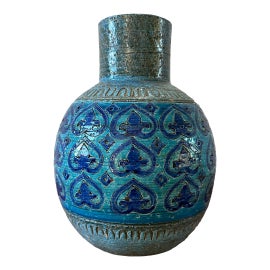
An outstanding, hand-turned and -decorated, chamotte pottery vase with a colorful Vine and Leaf relief décor from the studios of …
Read more
An outstanding, hand-turned and -decorated, chamotte pottery vase with a colorful Vine and Leaf relief décor from the studios of FRATELLI FANCIULLACCI of Florence, Italy. Only one of an original matched pair remains available. In excellent condition with the original paper label still affixed to the base.
FRATELLI FANCIULLACCI was born of a family whose roots in Italian ceramics date to the 1700s. The Fanciullaccis had collaborated with the Richard-Ginori porcelain company in Sesto Fiorentino (a municipality of Florence) since its 1737 founding. They were so invested in the concern that when its founder, Carlo Ginori, died in 1757, they attempted to wrest control from his son Lorenzo. Carlo’s widow, Mariana Garzoni Venturi, thwarted the “coup” and acted as interim manager until the minor Lorenzo came of age.
The most artistically important Fanciullacci at Ginori during the 18th and early 19th centuries was arguably Giovanni Battista Fanciullacci. He joined the company as a miniaturist and porcelain painter in 1759 and rose to head the painting department in 1772. He was named factory director in 1806 and retired two decades later. His rare works are highly coveted by collectors today.
In 1862 (sometimes 1858 is cited), Raffaello Fanciullacci (1803-1881), another former Ginori factory director, established his own pottery in nearby Capraia Fiorentino: Ceramiche Capraia. The new company initially produced simple, utilitarian wares. Raffaello was joined by his son Demetrio in the late 1870s, and subsequently by his four sons, Ilario, Giovanni, Amedeo, and Alfredo. By 1880, the pottery officially became FRATELLI FANCIULLACCI, i.e., the Bros. Fanciullacci.
In 1911, with the arrival of the Florence-Pisa railroad, operations moved from Capraia to nearby Montelupo. The new line provided easy and inexpensive transport to vital Italian cities, and the relocation was such a boon that, by 1914, the company had over 1,000 different molds. FANCIULLACCI’s offerings were among Italy’s most appealing, and the pottery became the area’s largest employer.
From the 1920s through the 1940s, the firm slowly branched into a rich repertoire of artistic products as the golden age of FRATELLI FANCIULLACCI blossomed. The company famously stayed in sync with the pulse of consumers in both Italy and America (its main export destination). Work was produced almost immediately in the latest styles: Raffaellesco, Istoriati, Art Deco, Art Nouveau, Futurism, Cubism, Modernism, and Avant-Garde.
Many of the elements that would eventually define the unique characteristics of FANCIULLACCI’s mid-century ceramics began to emerge at this time—the innovative fusion of heavily textured finishes, the application of traditional sgraffito techniques to produce both abstract and figurative designs, and the juxtaposition of bold, glossy glazes with matte backgrounds. Some designs featured raw, pumice-like or chamotte textures, in sharp contrast with the smooth, high-gloss finishes typical of contemporary Italian ceramics. Colorful majolica might be applied to specific areas, such as in a geometric shape or an animal motif. The result was a collection of highly graphic and sculptural pieces that were both modern and deeply rooted in traditional craftsmanship.
FRATELLI FANCIULLACCI was one of the few ceramics factories able to operate throughout WWII. At war’s end, Colorificio, parent company of Bitossi Ceramiche, assumed control, though the family ran the business with little oversight. By the late ’50s, production was back up to speed, and new international markets soon accounted for 90 percent of output.
Disaster struck on November 4, 1966, with a major flood of the Arno—the worst in over 400 years. It resulted in many deaths and the loss of countless art treasures and manuscripts. FRATELLI FANCIULLACCI was hard hit: priceless molds (some dating to its founding), all kilns, raw clay, and finished export stockpiles were destroyed. The company shut down for over a year, and many talented artists and craftsmen left for other work.
Production shifted to a temporary Florence plant while the Montelupo site was renovated. However, both output and quality suffered dramatically. FRATELLI FANCIULLACCI attempted to reestablish itself but never regained its former success. The company ceased all operations in 1988.
See less
- Dimensions
- 5ʺW × 5ʺD × 10ʺH
- Period
- 1950s
- Country of Origin
- Italy
- Item Type
- Vintage, Antique or Pre-owned
- Materials
- Ceramic
- Condition
- Good Condition, Original Condition Unaltered, Some Imperfections
- Color
- Brown
- Condition Notes
- Excellent vintage condition. Excellent vintage condition. less
Questions about the item?
Returns & Cancellations
Return Policy - All sales are final 48 hours after delivery, unless otherwise specified in the description of the product.
Related Collections
- Pink Fenton Art Glass Company Vases
- Loetz Vases
- Gae Aulenti Vases
- Pottery Barn Vases
- Red Fenton Art Glass Company Vases
- Mazzega Murano Vases
- Bristol Porcelain Vases
- Toso Murano Vases
- Lapis Lazuli Vases
- Shannon Crystal Vases
- Licio Zanetti Vases
- Carlsbad Porcelain Vases
- Pickard China Vases
- Ikea Vases
- Westmorland Vases
- Roycroft Vases
- Luciano Gaspari Vases
- Boda Nova Glassworks Vases
- Lyngby Porcelain Vases
- Union Porcelain Works Vases
- Blue Baccarat Vases
- Antonio Salviati Vases
- Ermanno Nason Vases
- Dr. Wall Worcester Porcelain Vases
- Neon Green Vases