

Details
Description
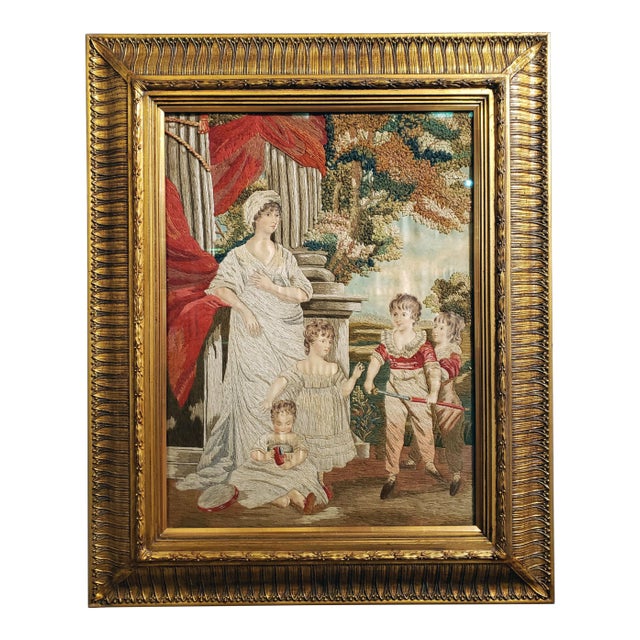
Regency Silk and Wool Needlework Portrait of Lady Anne Lambton and Family after John Hoppner
Circa 1800–1820
This English needlework …
Read more
Regency Silk and Wool Needlework Portrait of Lady Anne Lambton and Family after John Hoppner
Circa 1800–1820
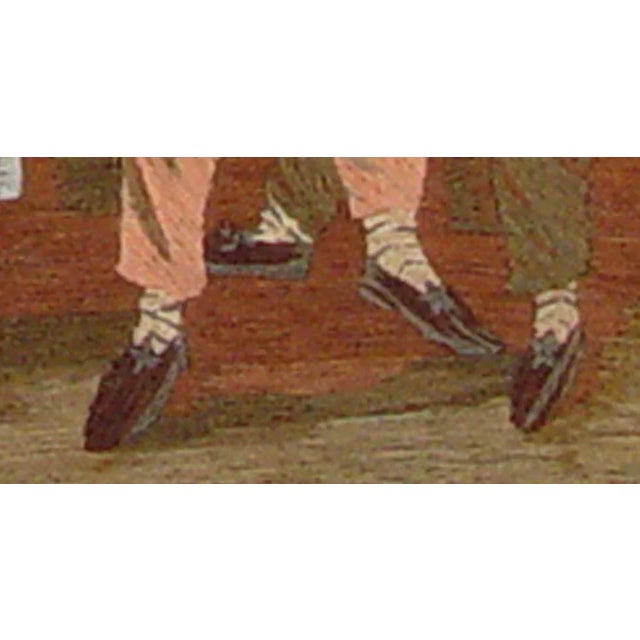
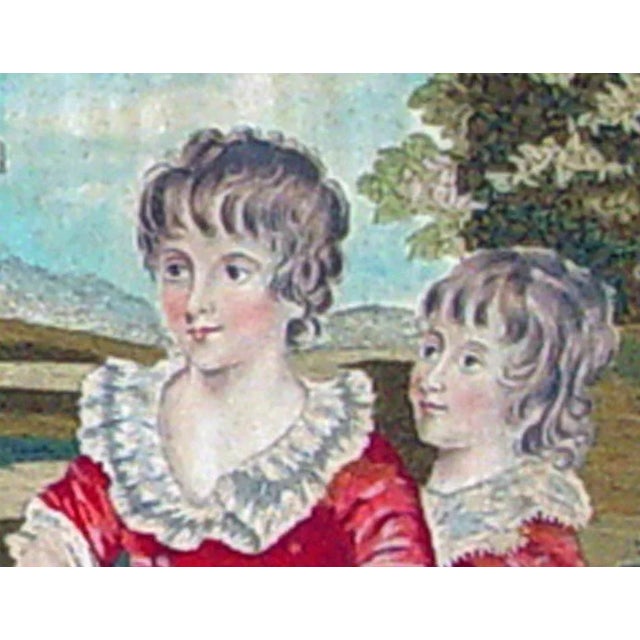
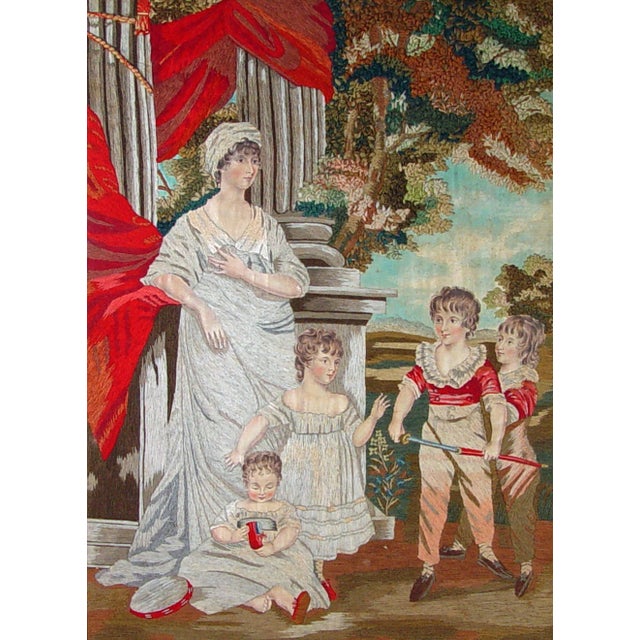
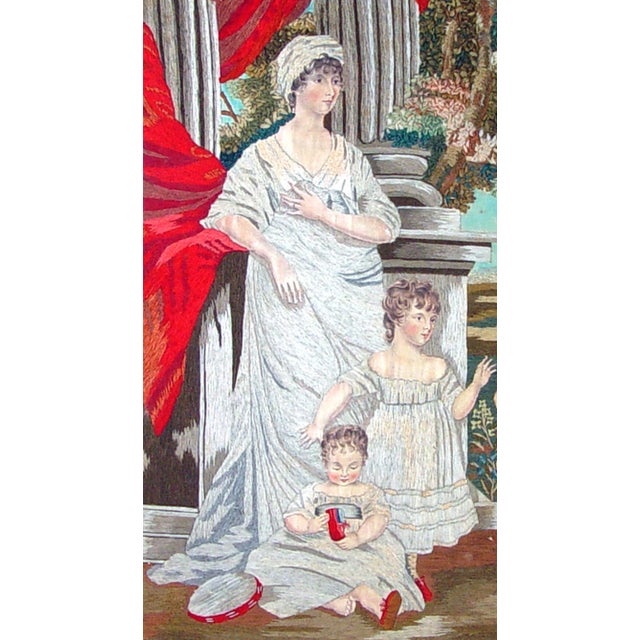
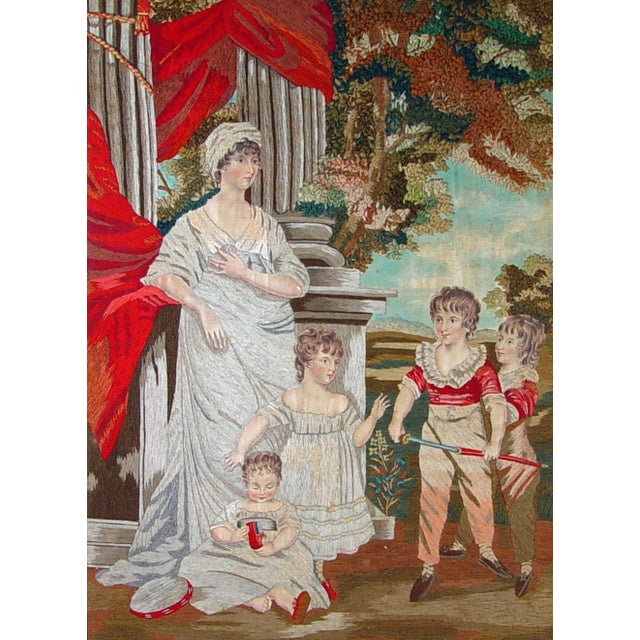
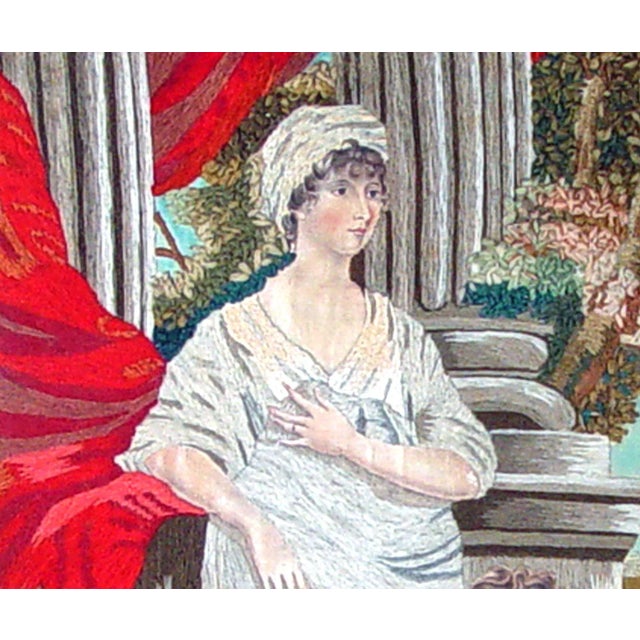
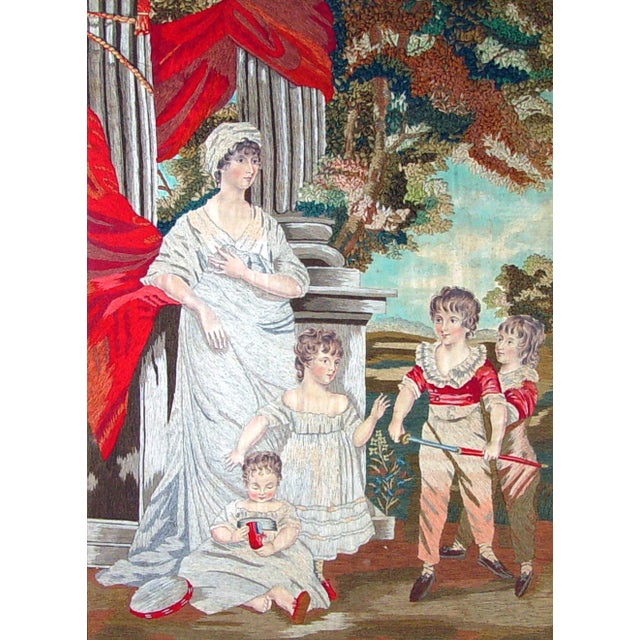
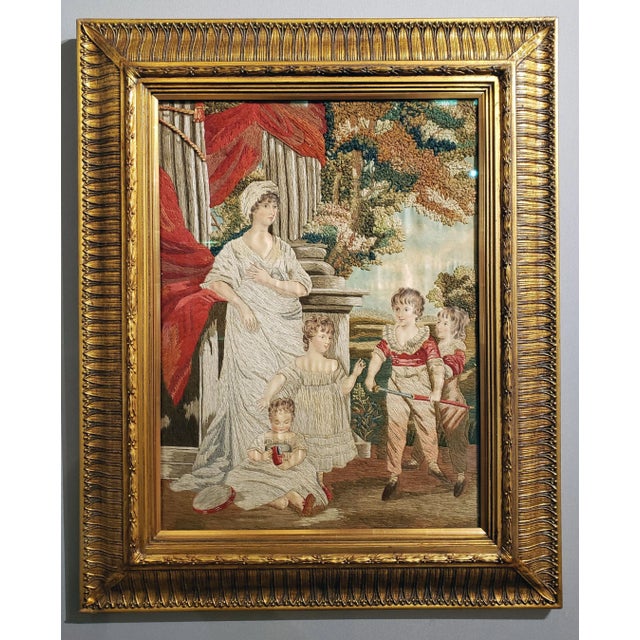
This English needlework picture reproduces John Hoppner’s group portrait The Right Hon.ble Lady Ann Lambton and Family, a composition known to the public through the mezzotint engraved and published by John Young in April 1799. It is worked in silk floss and worsted wool on a silk ground laid on linen, in the mixed technique of the Regency “needle painting.” The gowns, skeleton suits, crimson drapery and fluted columns are built up in long, directional stitches that follow the fall of the fabric; the canopy of the tree is worked in raised, knotted wool for depth and texture; and the faces, hands, sky and distant landscape are painted in watercolor directly onto the silk. The play between the soft sheen of the silk, the density of the wool and the delicately painted features gives the picture a tactile presence no print could offer.
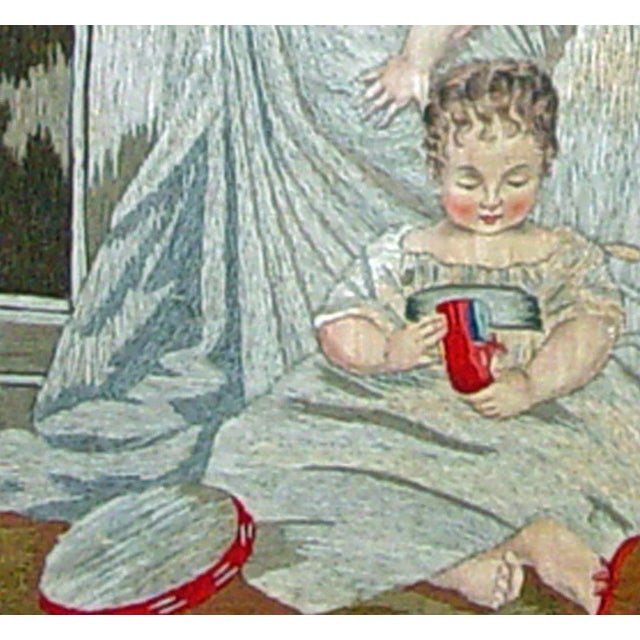
Lady Anne Barbara Frances Villiers (1772–1832), daughter of the 4th Earl of Jersey, stands at left against a column hung with crimson drapery, wearing a high-waisted white muslin gown and a turban, her right hand at her breast. At her feet the youngest child, Hedworth (1797–1876), still in the white frock worn by small boys before breeching, sits beside a tambourine examining a red shoe he has pulled off, while his sister Frances Susan (1794–1840) stands behind him. At right the two elder boys, John George (1792–1840) and William Henry (1793–1866), are dressed alike in skeleton suits with deep frilled collars, and the elder draws a sword from its red scabbard. John George Lambton became the 1st Earl of Durham, Governor General of British North America in 1838 and author of the Durham Report.
Hoppner painted the group in the late 1790s. Lady Anne had been widowed in November 1797, when William Henry Lambton, Member of Parliament for the City of Durham, died in Italy, and in 1801 she married the Hon. Charles William Wyndham. Young’s mezzotint, also recorded under the title Domestic Happiness, carried the composition well beyond the family circle, and prints of this kind supplied the patterns from which accomplished needlewomen worked. The present picture follows the engraving closely in composition and detail and was almost certainly worked from an impression of it.
The original canvas was in the Lambton family collection at Lambton Castle, County Durham, when it was offered in the sale of the castle’s contents conducted by Anderson and Garland in April and May 1932, the same dispersal in which Sir Thomas Lawrence’s “Red Boy” failed to sell. Its subsequent history has not been published, and it does not appear in any public collection. A black chalk drawing by Hoppner of the same group, dated circa 1799, is in the Museum Boijmans Van Beuningen, Rotterdam, and impressions of Young’s mezzotint are held by the Yale Center for British Art, the Victoria and Albert Museum, the Fitzwilliam Museum, the Toledo Museum of Art and the National Trust.
The palette of crimson, ivory and autumnal greens sits comfortably with English and Continental period furniture, and the scale suits a library wall, a stair landing, or the space above a console or chest of drawers. As with all silk pictures, it should be hung away from direct sunlight.
Dimensions
Height: 31 inches (78.7 cm)
Width: 24½ inches (62.2 cm)
Depth: 1½ inches (3.8 cm)
Provenance
Earle D. Vandekar of Knightsbridge
Condition
Good antique condition. The silk highlights in Lady Anne’s gown and the boys’ collars retain their sheen, and the reds of the drapery and suits remain strong. The watercolor faces and hands are finely detailed and without significant loss.
Historical Context
By the 1790s the culture of sensibility had changed the way the English elite chose to be painted: portraits of mothers with their children now celebrated affection and informality as much as lineage, and Hoppner, Portrait Painter to the Prince of Wales, was among the most admired exponents of the mode. Mezzotints after such pictures were widely collected, and they furnished the designs for the silk and wool pictures worked by well-educated young women, often as the culmination of their schooling. The costume here is a document in its own right. The elder boys wear early versions of the skeleton suit, a jacket and high-waisted trousers buttoned together at the waist, fashionable for young boys from the 1780s to the 1830s and regarded as a less constricting alternative to adult tailoring. It was the first outfit a boy wore after “breeching,” while the youngest, Hedworth, is still in the white frock of infancy that boys and girls alike wore in their earliest years.
(Ref: VM98122)
See less
- Dimensions
- 24.5ʺW × 3ʺD × 31ʺH
- Period
- Early 19th Century
- Item Type
- Vintage, Antique or Pre-owned
- Materials
- Silk
- Wool
- Condition
- Good Condition, Original Condition Unaltered, Some Imperfections
- Color
- Red
- Condition Notes
- Excellent Excellent less
Questions about the item?
Returns & Cancellations
Return Policy - All sales are final 48 hours after delivery, unless otherwise specified in the description of the product.
Cancellation Policy - Prior to shipping or local pickup, buyers may cancel an order for up to 48 hours, unless otherwise specified.
Related Collections
- Loloi Rugs Textile Art
- Louis XIII Textile Art
- Workaday Handmade Textile Art
- Resin Textile Art
- Antique Gold Finish Textile Art
- Kenneth Ludwig Chicago Textile Art
- Chanel Textile Art
- Mid-Century Modern Textile Art
- Chinese Textile Art
- Japanese Textile Art
- Tapestry
- Framed Scarves
- Scandinavian Textile Art
- Aubusson Tapestry
- Edwardian Textile Art
- Ralph Lauren Textile Art
- Märta Måås-Fjetterström Textile Art
- Surrealism Textile Art
- Pablo Picasso Textile Art
- Space Age Textile Art
- Cardboard Textile Art