




Details
Description
English Black Basalt Engine-Turned Teapot and Cover
Circa 1790-1810
A compact and well-potted black basalt teapot of squat globular form, …
Read more
English Black Basalt Engine-Turned Teapot and Cover
Circa 1790-1810
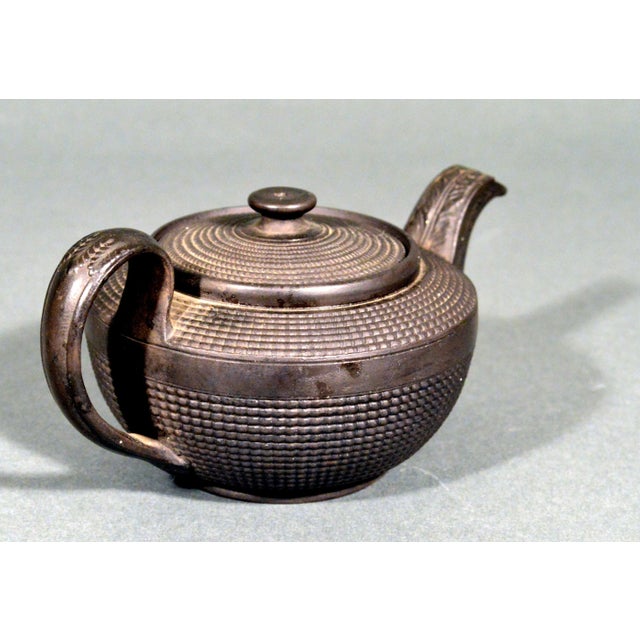
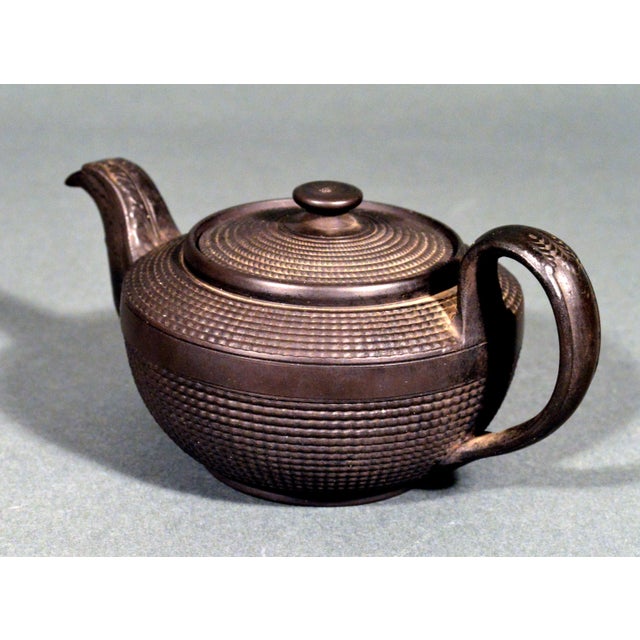
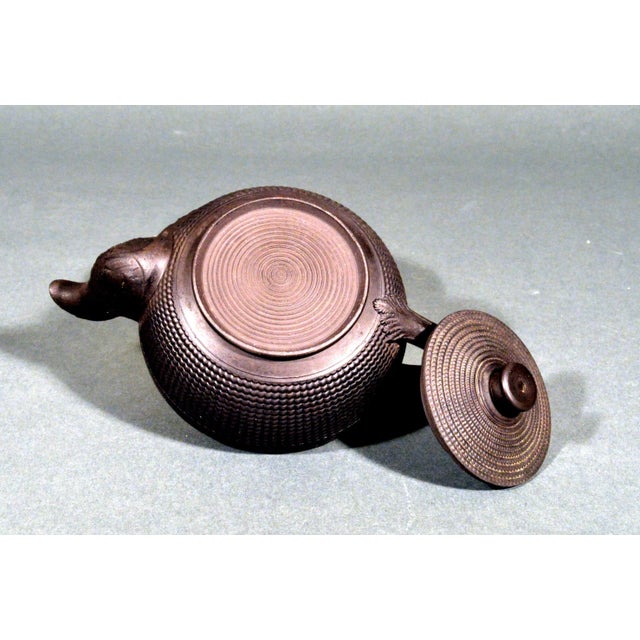
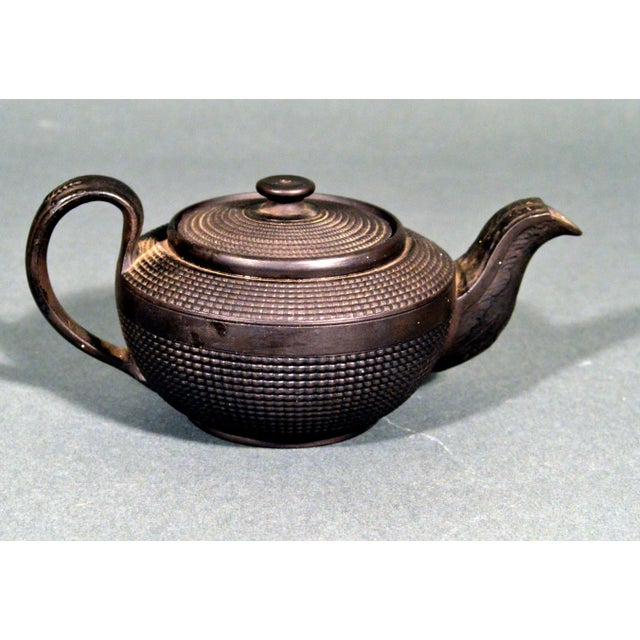
A compact and well-potted black basalt teapot of squat globular form, with cover, the entire surface decorated by engine-turning in an all-over diced or basketweave pattern of fine regularity. Two narrow plain bands divide the body horizontally — one at the shoulder, one at mid-body — creating a subtle tripartite register that prevents the relentless geometric patterning from becoming monotonous. The domed cover repeats the dicing on its upper surface, resolving into a series of concentric turned rings towards the flat disc finial. The interior of the base (visible in photographs) is decorated with a dense field of closely spaced concentric lathe-turned circles, a characteristic feature of engine-turned stonewares of this period.
The loop handle is plain and D-shaped in section, rising to a pronounced outward scroll at the top; its inner face retains traces of the dicing pattern. The curved spout, rising from low on the body, is applied with a band of delicately moulded foliage — a scrolling acanthus or bay-leaf design — along its lower edge, providing a counterpoint in relief to the engine-turned ground. The body retains a fine, evenly burnished surface characteristic of high-quality black basalt, with the warm dark brown of the undecorated base and interior visible through the photographs.
The piece is unmarked. The attribution to Leeds Pottery is consistent with the form and decoration, and closely comparable examples appear in the Leeds pattern books; however, the identical engine-turned dicing and acanthus-spout treatment were also employed by Wedgwood, Turner, Adams, Hackwood, and a number of other Staffordshire and Yorkshire manufacturers working in black basalt around 1790–1810. Without an impressed mark, a firm attribution to a single factory cannot be made.
Dimensions
• Height (with cover): 2¾ in. (7.0 cm)
• Width (handle to spout): 6¾ in. (17.1 cm)
• Depth: 4¼ in. (10.8 cm)
Medium and Date
Black basalt stoneware with engine-turned decoration. English, circa 1790–1810.
Historical Context
Black basalt — a dense, unglazed vitreous stoneware fired to a matt black surface — was refined and named by Josiah Wedgwood around 1767 and rapidly became one of the most admired wares produced in England during the late eighteenth and early nineteenth centuries. Its resemblance to ancient bronze and to Greco-Roman antiquities made it supremely well suited to the Neoclassical taste of the period, and it was adopted with enthusiasm by a wide range of manufacturers beyond Wedgwood himself, including Turner of Lane End, William Adams of Burslem, Neale & Co., Hackwood, and the Leeds Pottery.
Engine-turning — the mechanical decoration of unfired clay vessels on a specially adapted lathe — was introduced to the Staffordshire pottery industry by Wedgwood in 1763 and quickly became the definitive surface treatment for black basalt teawares. The process produced patterns of extraordinary precision and consistency: the diced or basketweave design seen on the present teapot was one of the most favoured, achieved using a double-edge cam on the rose-engine lathe. The resulting surface, at once geometric and tactile, also served a practical function, making the pot easier to hold and pleasant to handle.
The squat globular teapot form enjoyed widespread popularity in English ceramics from the 1780s onwards, derived from silver prototypes and ideally suited to the compact proportions of black basalt. Very closely related examples with diced engine-turned bodies and acanthus-moulded spouts appear in the Leeds Pottery pattern books and are documented in John Griffin’s study of the factory (Griffin, John. The Leeds Pottery: 1770–1881). Comparable pieces attributed to Leeds are in the collection of the Victoria and Albert Museum, London.
(VM60033)
See less
- Dimensions
- 6.75ʺW × 4.25ʺD × 2.75ʺH
- Period
- Late 18th Century
- Country of Origin
- United Kingdom
- Item Type
- Vintage, Antique or Pre-owned
- Materials
- Basalt
- Pottery
- Condition
- Good Condition, Original Condition Unaltered, Some Imperfections
- Color
- Black
- Condition Notes
- Good Good less
Questions about the item?
Returns & Cancellations
Return Policy - All sales are final 48 hours after delivery, unless otherwise specified in the description of the product.
Cancellation Policy - Prior to shipping or local pickup, buyers may cancel an order for up to 48 hours, unless otherwise specified.
Related Collections
- Empire Kitchen Accessories
- Williams-Sonoma Kitchen Accessories
- Kenneth Ludwig Chicago Kitchen Accessories
- Kitchen Accessories in Santa Fe
- Rococo Kitchen Accessories
- Copper Kitchen Accessories
- Mid-Century Modern Kitchen Accessories
- Italian Kitchen Accessories
- French Kitchen Accessories
- Limoges, France Kitchen Accessories