

Details
Description
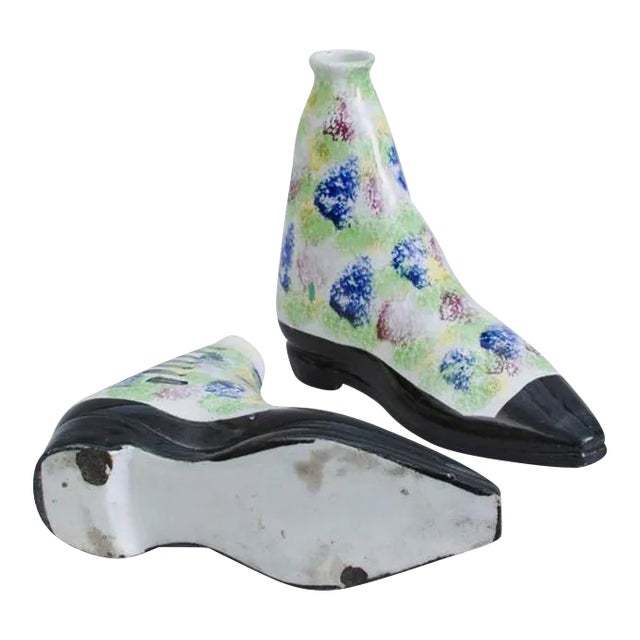
Folk Art Footwear: Scottish Sponged Boot Flasks
Object: Pair of Spirit Flasks (or Miniature Storage Vessels)
Origin: Scotland (British Pottery)
…
Read more
Folk Art Footwear: Scottish Sponged Boot Flasks
Object: Pair of Spirit Flasks (or Miniature Storage Vessels)
Origin: Scotland (British Pottery)
Date: Circa 1840-1850
Medium: Pearlware, with sponged, high-fired enamel decoration
Dimensions (Each): 7 1/2 inches high x 6 inches long (19.05 cm high x 15.24 cm wide).
Provenance: J. Sewell, London; Ambassador and Mrs. Joseph Verner Reed.
These unusual pearlware flasks, ingeniously modeled in the form of laced boots, are captivating examples of Victorian novelty pottery. Their surface is decorated using the distinctive sponging technique, where mottles of bright blue, pink, and green enamel are randomly applied, creating a vibrant, folky camouflage pattern over the white pearlware body. The pointed toe and black sole ground the form, creating a witty and recognizable piece of decorative earthenware.
The popularity of figural and novelty flasks surged in the first half of the 19th century, often associated with social customs and a demand for humorous, inexpensive decorative goods for the mantelpiece. These boot flasks, likely intended to hold a spirit like whisky or gin, reflect the playful aesthetic of the era, elevating a utilitarian drinking vessel into an eccentric piece of collectible folk art.
Historical Context: Sponging and Scottish Earthenware
The sponging or "spatterware" technique was a highly efficient and widespread method of decoration used by British and Scottish potteries to mass-produce colorful wares. By dabbing the colors onto the surface with sponges or moss, potters could create vibrant, randomized patterns that required less skill and time than hand-painting, making the final product affordable and appealing to a broad domestic and export market. While the specific factory is unlisted, the style and execution align with the bold, often whimsical traditions of Scottish earthenware production during the mid-Victorian era.
References:
Kelly, Henry E.: Spongeware, 1835-1935: Makers, Marks & Patterns (A comprehensive survey of spongeware ceramics produced in Scotland, England, Europe, and North America).
Kelly, Henry E.: Scottish Sponge-Printed Pottery: Traditional Patterns, Their Manufacturers and History (A specialist reference focusing on the regional origins and history of the technique).
McConnell, Kevin: Spongeware and Spatterware (Provides visual examples and context for collecting 18th to 20th-century sponged and figural novelty wares, including boot flasks).
(Ref: NY8556-panx)
See less
- Dimensions
- 6ʺW × 2ʺD × 7.5ʺH
- Period
- Mid 19th Century
- Item Type
- Vintage, Antique or Pre-owned
- Materials
- Pottery
- Condition
- Good Condition, Original Condition Unaltered, Some Imperfections
- Color
- Bright Pink
- Condition Notes
- Good condition Good condition less
Questions about the item?
Returns & Cancellations
Return Policy - All sales are final 48 hours after delivery, unless otherwise specified in the description of the product.
Cancellation Policy - Prior to shipping or local pickup, buyers may cancel an order for up to 48 hours, unless otherwise specified.
Related Collections
- Ralph Lauren Bottles and Jars and Jugs
- Medieval Bottles and Jars and Jugs
- Fratelli Fanciullacci Bottles and Jars and Jugs
- Port 68 Bottles and Jars and Jugs
- Beech Bottles and Jars and Jugs
- Borosilicate Glass Bottles and Jars and Jugs
- Acrylic Bottles and Jars and Jugs
- Otto Brauer Bottles and Jars and Jugs
- Crocks
- Wicker Bottles and Jars and Jugs
- Cookie Jars
- Apothecary Jars
- Candy Jars
- Japanese Bottles and Jars and Jugs
- Antique Water Jugs
- 1950s Perfume Bottles
- 1800s Perfume Bottles
- Murano Glass Bottles and Jars and Jugs
- Apothecary Bottles
- Deruta Bottles and Jars and Jugs
- Shaker Bottles and Jars and Jugs
- Creamware Bottles and Jars and Jugs
- Carl Auböck Bottles and Jars and Jugs
- Egyptian Revival Bottles and Jars and Jugs
- Lead Bottles and Jars and Jugs