

Details
Description
Sussex Pig Pottery Drinking Vessel, Jug and Cup, Belle-Vue Pottery, Rye, Frederick Mitchell
Circa 1870
A Sussex Pig drinking vessel …
Read more
Sussex Pig Pottery Drinking Vessel, Jug and Cup, Belle-Vue Pottery, Rye, Frederick Mitchell
Circa 1870
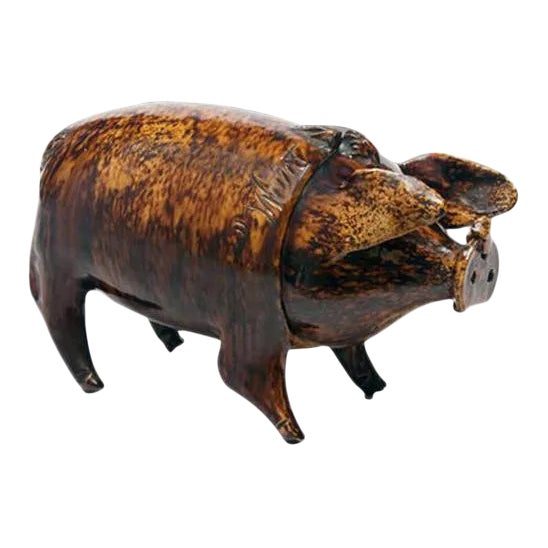
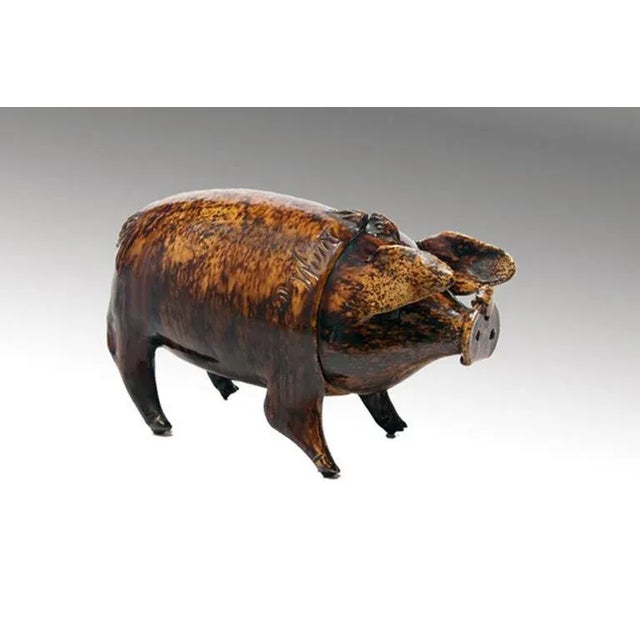
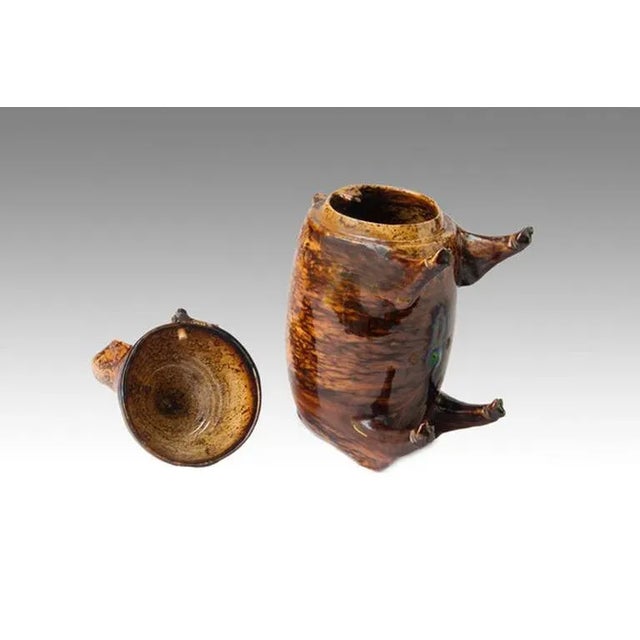
A Sussex Pig drinking vessel from the Belle-Vue Pottery in Rye, made around 1870, is one of the most engaging pieces of English country pottery there is. The pig stands on all fours when it is on display, but it was made to sit back on its haunches at the table, when the head lifts off to become a cup, the "hogshead", and the body pours like a jug. At nineteenth-century Sussex weddings every guest was invited to drink a hogshead of beer to the health of the bride, which explains the grin.
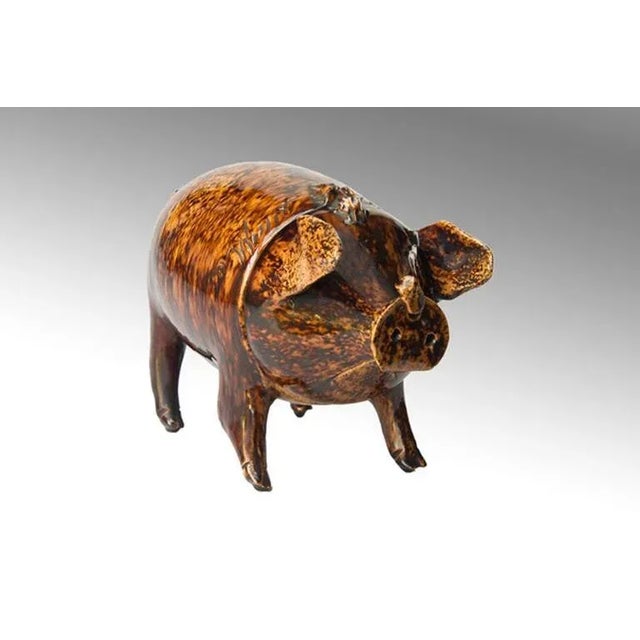
The modeling is full of character: pricked ears, a flat disc snout with two pierced nostrils, and a crest of applied bristles along the shoulder join. Incised across the shoulder in rustic lettering is the Sussex motto "Won't be druv" (won't be driven), from the local rhyme "You can pook / And you can shove / But a Sussex pig / He wun't be druv." The whole is covered in a rich mottled and splashed brown glaze, the finish that made the pottery's "Sussex Rustic Ware" famous, over a light local earthenware body.
This is a piece that earns a place where it will be seen and talked about: on a kitchen dresser or open shelf among treen and slipware, on a library table beside leather bindings, or as the one witty object on a console in an entrance hall. It sits comfortably with English country and farmhouse interiors, with folk art collections, and equally well as a warm, tactile counterpoint in a pared-back modern room.
Dimensions
Height: 5 1/2 inches (14 cm)
Length: 8 1/2 inches (21.6 cm)
Depth: 4 inches (10.2 cm)
Marks
The interior of the removable head is incised with a cross, the letters R.S.W. (Rustic Sussex Ware) set within its arms and the word "Rye" in the remaining space. The shoulder of the body is incised "Won't be druv".
Provenance
Earle D. Vandekar of Knightsbridge
Condition
Excellent antique condition.
Historical Context
The Rye pottery began at Cadborough Farm, just west of the town, where William Mitchell was managing the works by 1834 and had bought them by 1840. His son Frederick, working with the potter William Watson, developed the sprigged relief decoration of hops, leaves and acorns in white, green and brown clays under a clear lead glaze that became the firm's signature, and in 1869 he built the Belle-Vue Pottery in Ferry Road to concentrate on this decorative "Sussex Rustic Ware", leaving everyday wares to Cadborough. Frederick Mitchell died in 1875, and his widow Caroline carried on the business with Watson; the pottery remained in the family until 1930 and closed in 1939.
The Sussex Pig was made at both Cadborough and Belle-Vue and is the best-known product of either. Jewitt, writing in 1878, described the custom at Sussex weddings of inviting each guest to drink a "hogshead" of beer to the health of the bride, the cup being the pig's head, and the joke has kept the form in production.
(Ref: NY8532/IAMR)
See less
- Dimensions
- 8.5ʺW × 4ʺD × 5.5ʺH
- Period
- Late 19th Century
- Country of Origin
- United Kingdom
- Item Type
- Vintage, Antique or Pre-owned
- Materials
- Pottery
- Condition
- Good Condition, Original Condition Unaltered, Some Imperfections
- Color
- Brown
- Condition Notes
- good condition good condition less
Questions about the item?
Returns & Cancellations
Return Policy - All sales are final 48 hours after delivery, unless otherwise specified in the description of the product.
Cancellation Policy - Prior to shipping or local pickup, buyers may cancel an order for up to 48 hours, unless otherwise specified.
Related Collections
- Medieval Bottles and Jars and Jugs
- Borosilicate Glass Bottles and Jars and Jugs
- Bottles and Jars and Jugs in Lexington, KY
- Khaki Bottles and Jars and Jugs
- Port 68 Bottles and Jars and Jugs
- Ralph Lauren Bottles and Jars and Jugs
- Acrylic Bottles and Jars and Jugs
- Roger Capron Bottles and Jars and Jugs
- Gold-Plate Bottles and Jars and Jugs
- Crocks
- Wicker Bottles and Jars and Jugs
- Apothecary Jars
- Cookie Jars
- Japanese Bottles and Jars and Jugs
- 1800s Perfume Bottles
- Candy Jars
- Antique Water Jugs
- Murano Glass Bottles and Jars and Jugs
- 1950s Perfume Bottles
- Apothecary Bottles
- Deruta Bottles and Jars and Jugs
- Portieux Vallerysthal Bottles and Jars and Jugs
- Carl Auböck Bottles and Jars and Jugs
- Mottahedeh Bottles and Jars and Jugs
- Lead Bottles and Jars and Jugs