




Details
Description
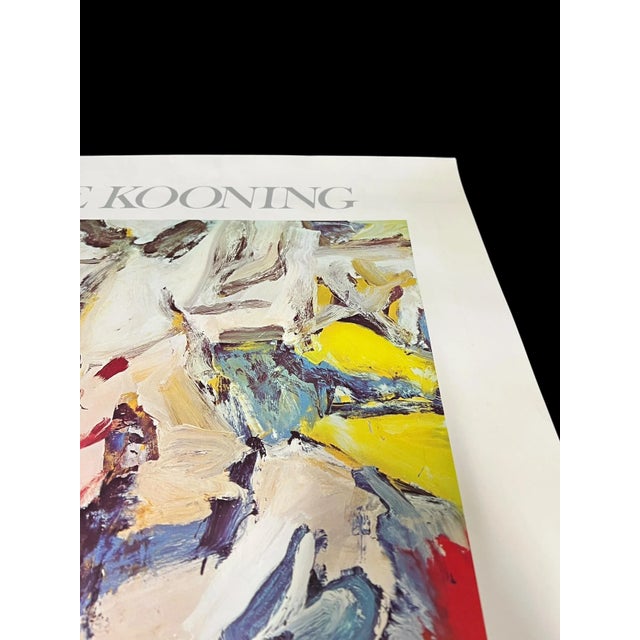
Willem De Kooning original poster from 1976, MODERN Art Pavilion Seattle Art Museum. Signed at lower right. Unframed, measures 28" …
Read more
Willem De Kooning original poster from 1976, MODERN Art Pavilion Seattle Art Museum. Signed at lower right. Unframed, measures 28" x 22". Excellent condition.
"If Jackson Pollock was the public face of the New York avant-garde, Willem de Kooning could be described as an artist’s artist, who was perceived by many of his peers as its leader. He was born in Rotterdam, where he grew up in an impoverished household and attended the Rotterdam Academy, training in fine and commercial arts. In 1926, the adventurous young artist stowed away on a ship bound for Argentina. While the ship was docked in Virginia, de Kooning slipped off, skirted immigration, and made his way to New Jersey—and so began the rest of his life.
In New Jersey, de Kooning found work as a house painter. Large brushes and fluid paints were the tools of this trade, ones that he would continue to utilize throughout his artistic career. His dual foundations in drawing and craftsmanship underlay all of his work, even his most abstract paintings.
De Kooning’s next stop was New York, where he forged his artistic career. The Jazz Age was in full swing when he moved to the city, and he quickly fell under the sway of the lyrical freedom of jazz and the abstract art made by other artists under its influence. New York also brought him into contact with the work of Henri Matisse and with contemporaries including John Graham and Arshile Gorky, with whom he developed a particularly close and inspiring friendship.
In 1929, the Great Depression brought the Jazz Age to a crashing end. As part of President Franklin D. Roosevelt’s Works Progress Administration (WPA) program, in the 1930s de Kooning was commissioned to design public murals; he worked under Fernand Léger, who proved to be an important influence. Though his studies for the murals were never realized, they were among his first abstractions, and the experience of working on this project spurred him to pursue art making full-time.
By the 1940s, de Kooning had gained prominence as an artist. Over the course of a career lasting nearly seven decades, he would work through a wide array of styles, eventually cementing himself as a crucial link from New York School painting to European modernism. Physical labor and countless revisions were constants in his work, which ranged from abstraction to figuration, often merging the two. “I never was interested in how to make a good painting…,” he once said. “I didn’t work on it with the idea of perfection, but to see how far one could go…”
The female figure was an especially fertile subject for the artist. His paintings of women were among his most controversial works during his lifetime and continue to be debated today."
10749-104
See less
- Dimensions
- 22ʺW × 0.25ʺD × 28ʺH
- Styles
- Abstract
- Frame Type
- Unframed
- Art Subjects
- Abstract
- Period
- 1970s
- Country of Origin
- United States
- Item Type
- Vintage, Antique or Pre-owned
- Materials
- Paper
- Condition
- Good Condition, Original Condition Unaltered, Some Imperfections
- Color
- Red
- Condition Notes
- Excellent condition Excellent condition less
Questions about the item?
Returns & Cancellations
Return Policy - All sales are final 48 hours after delivery, unless otherwise specified in the description of the product.
Cancellation Policy - Prior to shipping or local pickup, buyers may cancel an order for up to 48 hours, unless otherwise specified.
Related Collections
- Le Corbusier Posters
- Ceramic Posters
- Baroque Posters
- Claes Oldenburg Posters
- Silk Posters
- Posters in Savannah
- Posters in Naples, FL
- Screen Print Posters
- Marc Chagall Posters
- Mid-Century Modern Posters
- Mark Rothko Posters
- Art Deco Posters
- Pablo Picasso Posters
- French Posters
- Milton Avery Posters
- Posters in Los Angeles
- Peter Max Posters
- Lee Krasner Posters
- Museum Posters
- Japanese Posters
- Polish Posters
- Keith Haring Posters
- Framed Posters
- Posters in Orlando
- Woodcut Posters