






Details
Description
This is a very special piece of furniture that was specially made for a collector. It was made in Southeast …
Read more
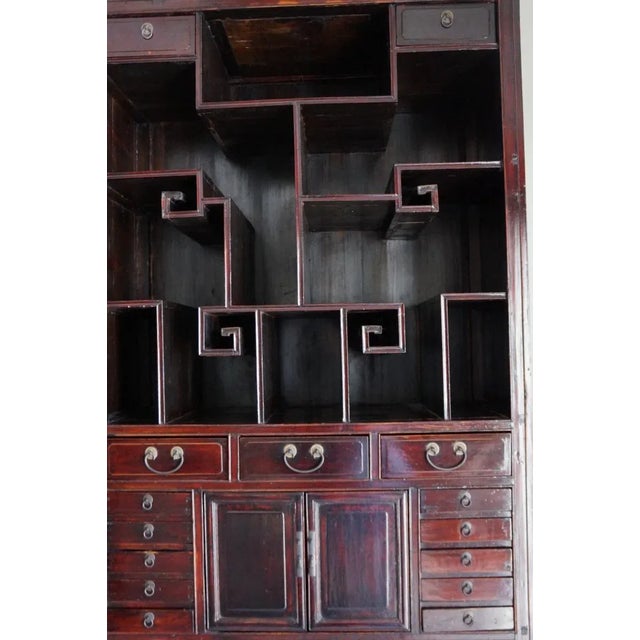
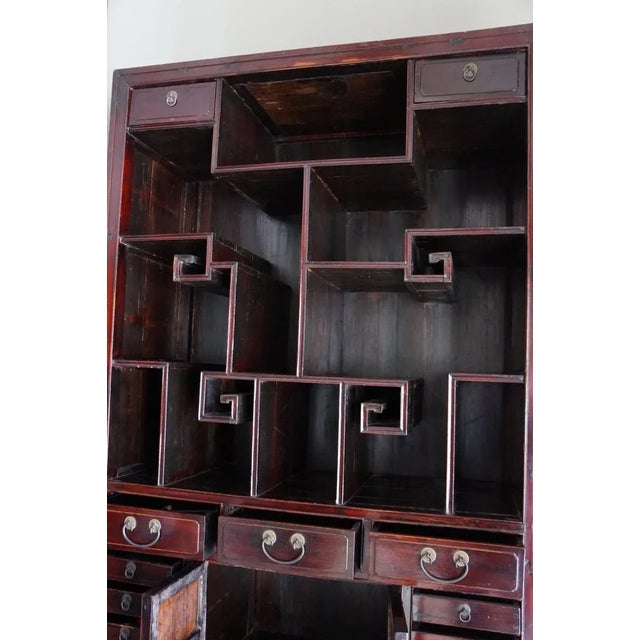
This is a very special piece of furniture that was specially made for a collector. It was made in Southeast China in the delta of the Yangxi River, one of the wealthiest regions of China. The collector requested a space to show the antiques and drawers upon drawers to store his pieces of jades, his seals, and small items. The larger pieces are stored in the storage space behind the doors. There is attention paid in the details - the beading along the edges, and the interesting metal fittings though they are replacements. The reason why it attracted my attention was expressed in an essay I wrote a while back.
When a piece of furniture captures my attention, the motivation to buy is not always pecuniary. Sometimes I confess I was driven by sentimentality. The purchase soothes my heart and soul. One such piece is the handsome curio cabinet pictured here. Made of cedar or a similar wood, the surfaces were coated with dark brown lacquer. Unusual breaks from the traditional symmetry, shelves in the top section are staggered in different levels for interesting display of curios and antiques. The multiple drawers are perfect for holding small objects like jades and seals. More antiques can be stored in the lower section for occasional rotation. There are plenty of attention to details that enhance its look - beaded edging, raised panels and good looking hardwares. The dark background and the uneven spacing provide an ambiance for the pieces of antiques and enhance their value. So why did I buy it? In another time and place, a curio cabinet like this was forever etched in my memory, displaying objects of art that were not to be forgotten.
The last time I saw it was a sneaked peek into my great-grandfather’s Curio Room in his stately home in Hong Kong. Great-grandfather Ho Kom-tong made his fortune in successful business dealings. But he was best remembered as a man with a wife, eleven concubines and twenty seven children - a local record that has yet to be surpassed. A reputation like this obviously overshadows his fame as a collector of antiques and curios. His house Kom Tong Hall, built in 1914 in a classic revival style, boasted of a walk-in safe, a place to keep his extra antiques as he rotated his collection. His European antiques were on display in the drawing room that was called the French Parlour, so named because of the white and gold architectural features that included ionic columns and gilded ceilings with crown mouldings and furnished with French provincial furniture. His Chinese antiques were exhibited in glass vitrines in his living room upstairs, filled with Guangdong black wood furniture that were ornamented with designs made from mother-of-pearl. The rare and valuable pieces of the collection were kept in the Curio Room where Great-grandfather would entertain his fellow collectors and visiting dignitaries by showing his latest acquisitions of archaic jades or painted porcelains. Children were forbidden to enter the room. On one occasion when I, a small child of no more than six, found the door ajar and stole a glance, before my nanny shooed me away, her main charge was to make sure I would not misbehave. The moment was short in sight but long in remembrance - an unforgettable memory of beautiful objects on display in his curio cabinet. As time progressed and my interest in Chinese art grew, these objects acquired names – the square tube became an archaic jade cong, the lady in white was a blanc de chine Guanyin, and the pretty vases were Qing Dynasty painted porcelains.
The art collection survived World War II and was noted as being one of the best private collections in Southeast Asia. A museum in Australia offered to buy 400 of the best pieces but Great-grandfather was ill advised to send the collection to New York for auctions. And that was that. No one knew what happened to the objects or the monies from the purported sales. Upon his passing, family members retained some pieces and the remainder sold. Even until twenty years ago, unscrupulous dealers on antique row in Hollywood Road and Cats Street would surreptitiously embellish the salability of an antique by giving it a false Ho Kom-tong provenance.
Kom Tong Hall was preserved as a historic building by the Hong Kong Government. After extensive renovations, it opened in December 2006 as the Dr. SunYat-sen Museum, to commemorate the founder of the Chinese Republic. I make it a ritual to visit whenever I am in Hong Kong. The Curio Room is no longer forbidden, it is now part of the exhibition space.
See less
- Dimensions
- 37ʺW × 18ʺD × 87ʺH
- Period
- Early 20th Century
- Country of Origin
- China
- Item Type
- Vintage, Antique or Pre-owned
- Materials
- Wood
- Condition
- Good Condition, Restored, Some Imperfections
- Color
- Sienna
- Condition Notes
- The patina is expected of antique pieces with the dark brown lacquer fading in some areas. There are small blemishes … moreThe patina is expected of antique pieces with the dark brown lacquer fading in some areas. There are small blemishes due to age and usage, such as snicks on the beaded edges. The cabinet was restored before 2000 and remains in good condition with the exception of the flaws mentioned. The metal hardwares are replacements. less
Questions about the item?
Returns & Cancellations
Return Policy - All sales are final 48 hours after delivery, unless otherwise specified in the description of the product.
Cancellation Policy - Prior to shipping or local pickup, buyers may cancel an order for up to 48 hours, unless otherwise specified.
Related Collections
- Grosfeld House China and Display Cabinets
- Michael Taylor China and Display Cabinets
- Medium-Density Fibreboard China and Display Cabinets
- China and Display Cabinets in Buffalo
- Drexel China and Display Cabinets
- Antique Hutch Cabinets
- Ethan Allen China and Display Cabinets
- Thomasville China and Display Cabinets
- Mid-Century Modern China and Display Cabinets
- Corner Display Cabinets
- Curio Display Cabinets
- Cherry Wood China and Display Cabinets
- Henredon China and Display Cabinets
- Glass Curio Display Cabinets
- Century Furniture China and Display Cabinets
- Display Cabinets with Glass Doors
- Broyhill China and Display Cabinets
- Art Deco China and Display Cabinets
- Victorian China and Display Cabinets
- French Provincial China and Display Cabinets
- Drexel Heritage China and Display Cabinets
- Green China and Display Cabinets
- Wall Display Cabinets
- Bamboo China and Display Cabinets
- 1980s China Cabinets